













First Land Creatures Had Wild Appearances

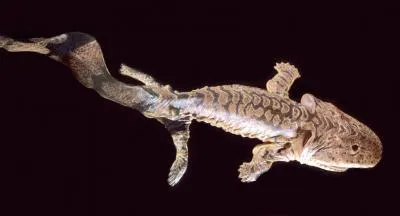
The first fish-like animals to squirm out of the sea and onto land were pretty wild looking, new research concludes.
Cartoon depictions of the first animals to emerge from the ocean and walk on land often show a simple fish with feet, venturing from water to land. But Jennifer Clack, a paleontologist at the University of Cambridge who has studied the fossils of these extinct creatures for more than two decades, says the earliest land vertebrates — also known as tetrapods — were more diverse than we could possibly imagine.
"Some looked like crocodiles, some looked like little lizards, some like moray eels, and some were snake-like," Clack said. "They occupied all sorts of niches and habitats. And they varied tremendously in size — from about 10 cm [4 inches] long to 5 meters [16 feet]."
Long before mammals, birds and dinosaurs roamed the Earth, the first four-legged creatures made their first steps onto land, and quickly inhabited a wide range of terrestrial environments. These early land vertebrates varied considerably in size and shape, Clack said.
To understand the anatomical changes that accompanied this diversity, Clack teamed up with two biologists who work on living fishes — Charles Kimmel of the University of Oregon and Brian Sidlauskas of the National Evolutionary Synthesis Center in North Carolina.
The researchers focused on 35 early tetrapods that lived between 385 million and 275 million years ago. As a proxy for body size and shape, the team examined the dimensions of a number of bones in a region of the skull known as the palate. By tracing changes in the length and width of interlocking bones in this part of the skull, the researchers hoped to get a more fine-grained picture of skeleton evolution as a whole.
"I tend to think the genetic instructions for making a skeleton come from how you make individual bones first, and then how you fit those bones together as a refinement of that," said Kimmel, a developmental biologist.
Get the world’s most fascinating discoveries delivered straight to your inbox.
When the researchers mapped the changes in bone length and width onto the tetrapod family tree, they discovered that not all bones changed size at the same rate or in the same direction. This phenomenon can result in an overall reshaping from one lineage to the next, Sidlauskas said.
"Sometimes a change in size can have indirect consequences for the shape of the animal," Sidlauskas said. "When different parts of an animal's body change size at different rates over evolutionary time, that can generate changes in body shape from one species to another."
Moreover, some changes are consistent with an evolutionary quirk known as paedomorphosis, in which species retain in adulthood the youthful dimensions that their ancestors had as juveniles.
"Paedomorphosis is definitely there — the descendents of some groups are retaining the proportions that their juveniles had in the past," said Clack.
These results not only help explain why early tetrapods were so diverse in size and shape, but also shed light on an important chapter in the evolution of life on land — the transition from fish to amphibians.
"One of the big questions at the moment is: where did modern amphibians come from?" Clack said. "One of the hypotheses is that they have evolved by paedomorphosis and miniaturization from early tetrapods. This study lends weight to that idea."
The team's results will be detailed in the July 16 online issue of the Journal of Anatomy.
- All About Evolution
- Gallery: Drawing Dinosaurs
- Gallery: Freaky Fish
