













Photos: Escape Tunnel at Holocaust Death Site

Escaping Ponar

This month, archaeologists relocated a lost tunnel that Jewish prisoners dug to escape a Nazi killing site in Lithuania. They discovered the secret passage way at Ponar, near Vilnius, using non-invasive ground-sensing techniques.
Up to 100,000 people, most of them Jews, were killed at Ponar between 1941 and 1944. Beginning in 1943, Nazi forces kept a unit of Jewish prisoners at the site to cover up the evidence of the executions that took place in pits like this one. [Read the full story here]
Burning Brigade

This is a view of "Pit 6," a former execution pit where the unit of Jewish prisoners known as the burning brigade was housed while they carried out their work; at night, they were forced to open the mass graves and burn the corpses during the day. This pit is where they began to dig the escape tunnel.
Seeing underground

Researchers Richard Freund and Harry Jol discuss the best location for ground penetrating radar at the lip of Pit 6.
Non-invasive archaeology

In addition to ground-penetrating radar, the researchers used electrical resistivity tomography (ERT), a technique that sends an electrical current into the ground to produce a map of what’s below the surface. [Read the full story here]
Electric maps

The flags in this photo were used to mark where the electrical lines were anchored when taking the measurements.
A view from above
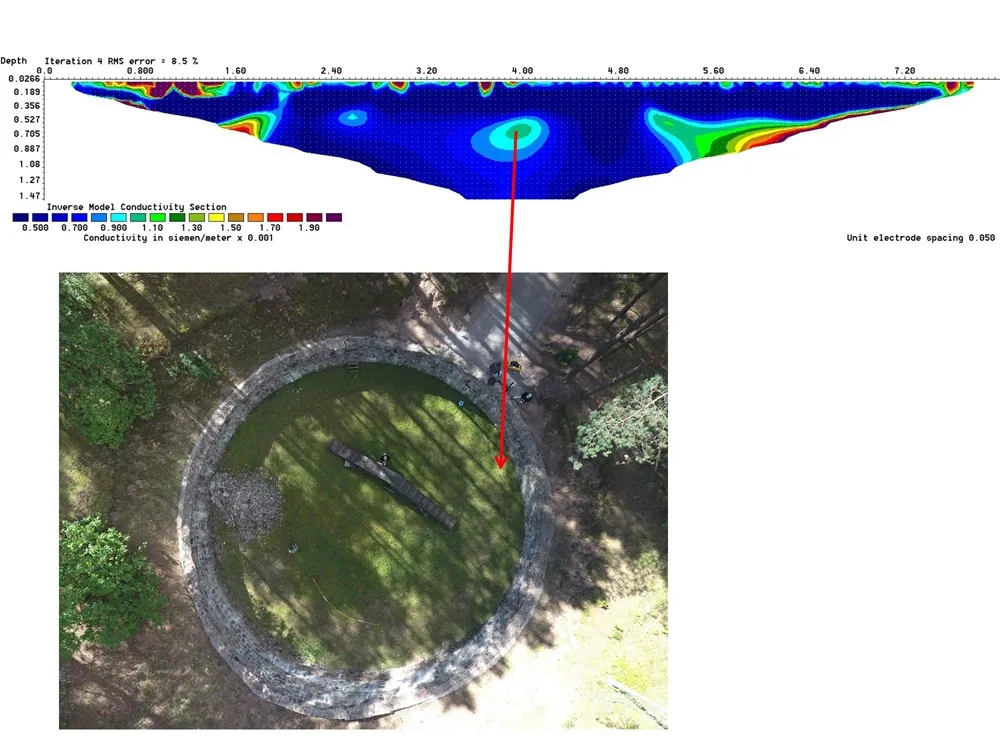
This image shows data collected using ERT alongside a drone photo of Pit 6. It shows the entrance to the escape tunnel, which had been previously located by another investigation.
Get the world’s most fascinating discoveries delivered straight to your inbox.
Tunnel revealed

With the ERT data, the researchers were able to trace the path of the rest of the tunnel.. [Read the full story here]
