 Live Science Plus





You are now subscribed
Your newsletter sign-up was successful
Want to add more newsletters?

Delivered Daily
Daily Newsletter
Sign up for the latest discoveries, groundbreaking research and fascinating breakthroughs that impact you and the wider world direct to your inbox.

Once a week
Life's Little Mysteries
Feed your curiosity with an exclusive mystery every week, solved with science and delivered direct to your inbox before it's seen anywhere else.

Once a week
How It Works
Sign up to our free science & technology newsletter for your weekly fix of fascinating articles, quick quizzes, amazing images, and more

Delivered daily
Space.com Newsletter
Breaking space news, the latest updates on rocket launches, skywatching events and more!

Once a month
Watch This Space
Sign up to our monthly entertainment newsletter to keep up with all our coverage of the latest sci-fi and space movies, tv shows, games and books.

Once a week
Night Sky This Week
Discover this week's must-see night sky events, moon phases, and stunning astrophotos. Sign up for our skywatching newsletter and explore the universe with us!
Join the club
Get full access to premium articles, exclusive features and a growing list of member rewards.
Exhibition entrance

From March 15, 2016, to Jan. 2, 2017, a new exhibit called "Dinosaurs Among Us" will roar onto the scene at the American Museum of Natural History (AMNH) in New York. The showcase will examine how birds evolved from a particular group of dinosaurs, as well as explore the connections between these living dinosaurs and their extinct relatives.
Dinosaur runway

The unique display highlights rare fossils, elaborate illustrations and realistic models of feathered dinosaurs. Modern birds belong to a group called the Dinosauria, which includes the extinct dinosaur cousins and all of their living descendants. This is why scientists consider birds to be in the dinosaur family.
Yutyrannus

Yutyrannus hauli a giant feathered dinosaur, was uncovered in northeastern China in 2012. When alive, it weighed a whopping 3,000 lbs. (1,400 kilograms).
Beauty and power
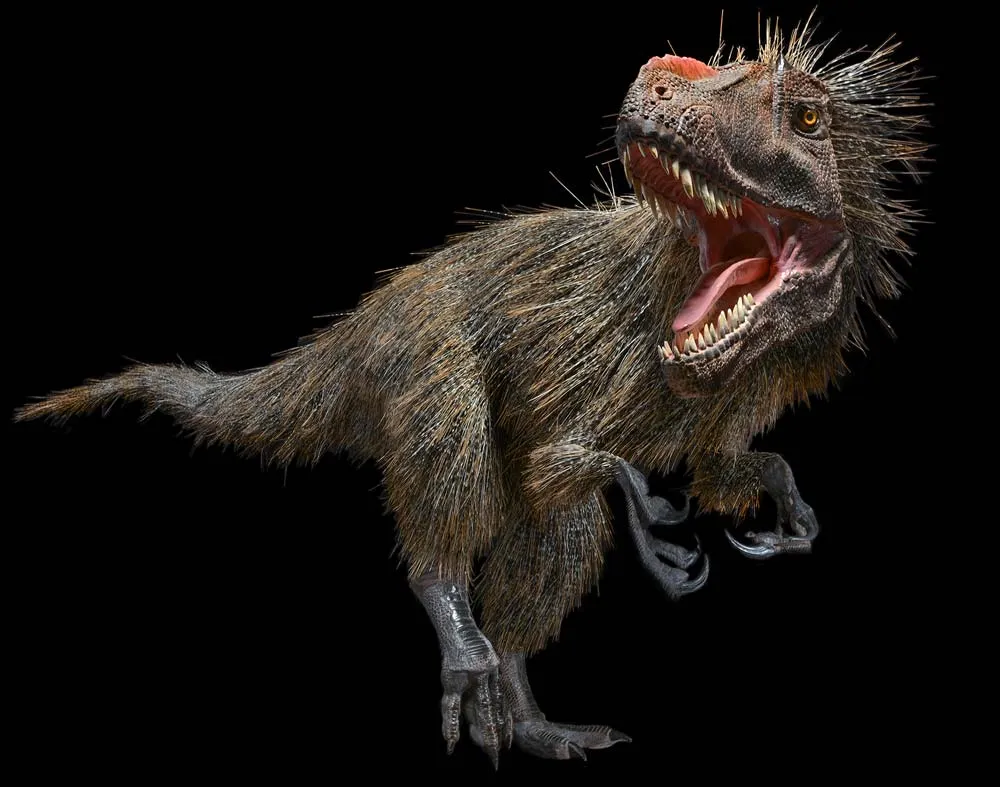
Yutyrannus huali, which means "beautiful feathered tyrant," was a terrifying predator with a woolly hide of filaments called "proto-feathers."
Crazy cousin

This stunning creature, seen here in an artist's depiction, resembles a fuzzy T. rex.
Citipati nest

The fossil of a Citipati osmolskae, an oviraptorid dinosaur, shows a parent protecting its eggs. This behavior — the animal's forearms spread wide and its body over the nest — is commonly seen in modern-day birds. The cast comes from a fossil uncovered by AMNH scientists in the Mongolian Gobi Desert.
Citipati

Early specimens of the Citipati osmolskae, like this model, were found in 1993 during an excavation by scientists from the AMNH and the Mongolian Academy of Sciences.
What's in a name?

The animals are named in honor of Halszka Osmólska, a Polish paleontologist who specialized in dinosaurs and explored the Gobi Desert.
Religious history

Citipati osmolskae, represented by dancing skeletons, are used as guards for funeral pyres in traditional Himalayan Buddhism.
Khaan fossils

These two skeletons of Khaan mckennai, while almost identical, have a major difference: the animal on the left has boney structures larger than on the other specimen. Experts believe these structures may have supported muscles used in tail-feather displays, which birds like the sage grouse and peacock still exhibit today.
Khaan

The small, birdlike dinosaurs, known as oviraptorids (which the Khaan mckennai) had beaks with no teeth. Some fossils show them exhibiting birdlike behaviors — sitting on eggs, in the brooding posture.
