 Live Science Plus





You are now subscribed
Your newsletter sign-up was successful
Want to add more newsletters?

Delivered Daily
Daily Newsletter
Sign up for the latest discoveries, groundbreaking research and fascinating breakthroughs that impact you and the wider world direct to your inbox.

Once a week
Life's Little Mysteries
Feed your curiosity with an exclusive mystery every week, solved with science and delivered direct to your inbox before it's seen anywhere else.

Once a week
How It Works
Sign up to our free science & technology newsletter for your weekly fix of fascinating articles, quick quizzes, amazing images, and more

Delivered daily
Space.com Newsletter
Breaking space news, the latest updates on rocket launches, skywatching events and more!

Once a month
Watch This Space
Sign up to our monthly entertainment newsletter to keep up with all our coverage of the latest sci-fi and space movies, tv shows, games and books.

Once a week
Night Sky This Week
Discover this week's must-see night sky events, moon phases, and stunning astrophotos. Sign up for our skywatching newsletter and explore the universe with us!
Join the club
Get full access to premium articles, exclusive features and a growing list of member rewards.
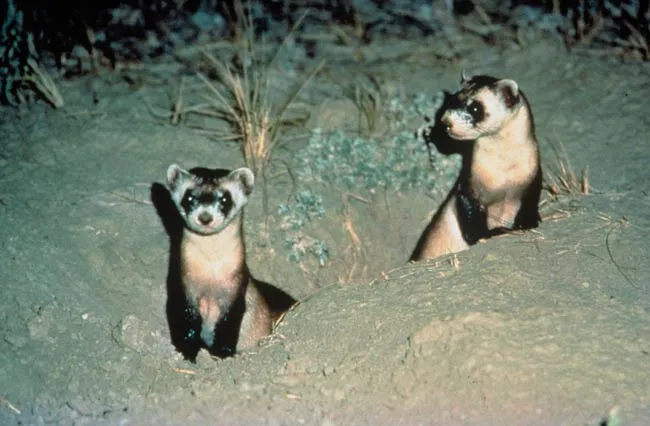
Thanks to conservation efforts and some exceptionally frisky behavior in the wild, the endangered black-footed ferret is making a comeback.
Scientists considered the furry creatures extinct as recently as the 1970s, but 120 of the ferrets were found in Wyoming in the mid-1980s. Then in 1985 two disease outbreaks wiped out most of the remaining ferrets, and the last 18 were captured for a breeding program.
The offspring of those 18 now live in eight reintroduction sites in the United States and Mexico. This past year has been the "best year yet" for the ferrets, according to biologists at the Arizona Game and Fish Department.
"In addition to the high total numbers from the year's two ferret surveys, the project is also seeing more ferrets reproduce in the wild," said Carrie King, head of the field portion of the Department's ferret reintroduction project, which periodically releases ferrets into the wild in the Aubrey Valley of northwest Arizona.
For five nights every spring and fall—the seasons when the ferrets spend the most time above ground—conservationists use high-powered spotlights to monitor the population.
In the Aubrey Valley, biologists trapped and released 35 ferrets during this year's two surveys, up nearly 50 percent from last year's catch of 24. They also trapped a record 29 wild-born ferrets, which they released after marking them with electronic identification tags.
Biologists try to help the captive-born ferrets make it in the wild by preconditioning them—keeping them in outdoor pens during the winter to get them used to their surroundings before their spring-time release. They also make sure ferrets can avoid predators and kill prey.
"Several factors are contributing to the success of this project," King said. "We release pregnant females each spring. That's the time of year when prairie dogs, the ferrets' main source of food, are born. We also precondition the ferrets bred in captivity before they are released."
Black-footed ferrets, which are related to weasels, can grow up to two feet long and weigh as much as two and a half pounds. One ferret can give birth to three to five kits a year.
- Ferret Brain Activity Surprises Scientists
- Language of Prairie Dogs Includes Words for Humans
- Oops! Scientists Nudge Fish Closer to Extinction
- U.S. Wildlife Refuges Facing Threats
