















Clearing Hurdles: Cheetah Robot Shows Off New Trick
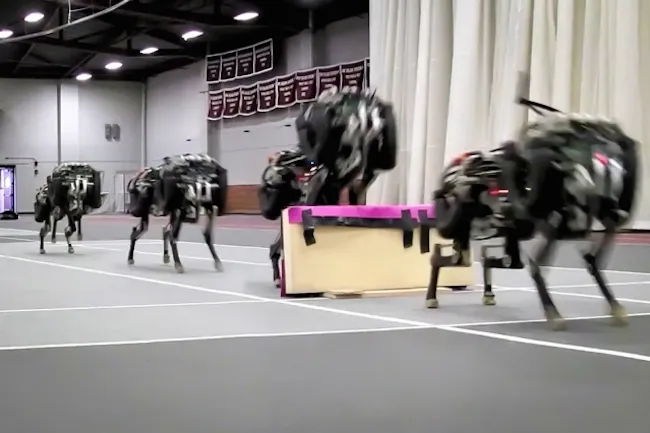
One four-legged machine is making great leaps in the field of robotics: Researchers have developed a cheetahlike bot that can run at impressive speeds and even jump over obstacles in its path.
The mechanical cheetah first made a name for itself last fall, when researchers at the Massachusetts Institute of Technology (MIT) showed off its top speed of 10 miles per hour (16 km/h). But now, the bot is back with a new trick: It can jump over hurdles, much like a human runner can.
The cheetah bot is the first robot that can spot obstacles from a distance and clear them with a running jump without any assistance from humans, the researchers said. The bot will soon show off its leaping abilities at the Defense Advanced Research Projects Agency's (DARPA) Robotics Challenge Finals, which will be held next week in Pomona, California. [The 6 Strangest Robots Ever Created]
To "see" objects that appear in front of it, the robot uses a visual system known as light detection and ranging, or lidar. The system (located onboard the cheetah bot) sends out a small laser light that bounces off objects and is reflected back. This lidar system lets the robot create a virtual map of its terrain, which is then sent to an onboard computer programmed with a series of "path-planning" algorithms.
The algorithms help the robot make sense of its environment and enable it to determine which path to take. For example, it can figure out the size of obstacles along its route, as well as how far away they are. The bot can also determine the best way to clear an obstacle — for instance, how high it needs to jump to clear a barrier or what angle to approach an object from when jumping.
"A running jump is a truly dynamic behavior," Sangbae Kim, an assistant professor of mechanical engineering at MIT, said in a statement. "You have to manage balance and energy, and be able to handle impact after landing. Our robot is specifically designed for those highly dynamic behaviors."
Right now, the cheetah bot can clear obstacles while maintaining a speed of 5 mph (8 km/h), and it can jump over objects as tall as 18 inches (46 centimeters), which is more than half of its own height.
Get the world’s most fascinating discoveries delivered straight to your inbox.
So far, the cheetah bot's leaping abilities have been tested on both a treadmill and an indoor track. On the track, the robot cleared about 70 percent of the hurdles placed in its path. But the agile robot did better on the track, where it had more space (and therefore more time) to detect obstacles and figure out how to get over them. During test runs on the track, the bot cleared 90 percent of the obstacles, the researchers said.
Going forward, the researchers would like to test out the cheetah's cross-country skills, according to Kim, who said that the next trials could take place on softer terrain, such as a grassy field.
Follow Elizabeth Palermo @techEpalermo. Follow Live Science @livescience, Facebook & Google+. Original article on Live Science.