













Some Racing Raindrops Break Their 'Speed Limit'
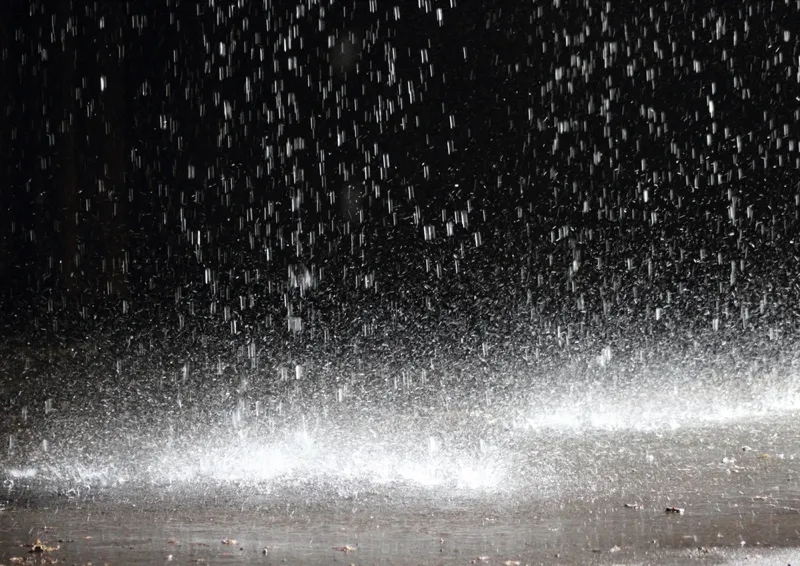
Some radical raindrops are flouting the rules: The wet-weather drips seem to be breaking a physical speed limit, sometimes falling 10 times faster than they should, scientists have found.
Like all objects in free fall, raindrops move according to the laws of physics. One of those laws puts a barrier on how fast a free-falling object can travel. This terminal velocity is reached when the downward tug of gravity equals the opposing force of air resistance.
In 2009, physicists reported that they had discovered small raindrops falling faster than this terminal velocity. In that study, detailed in the journal Geophysical Research Letters, Alexander Kostinski and Raymond Shaw of Michigan Technological University, along with Guillermo Montero-Martinez and Fernando Garcia-Garcia of the National University of Mexico, measured 64,000 raindrops, and found clusters of "superterminal" drops falling faster than they should based on their size and weight, especially as the rain became heavier. [Weirdo Weather: 7 Rare Weather Events]
In the new study, Kostinski and his colleagues verified that initial finding using completely different instruments. The researchers clocked the speeds of 1.5 million raindrops passing through a laser beam during six rainstorms at a site near Charleston, South Carolina. All of the raindrops measuring 0.8 millimeters (0.03 inches) and larger fell to the ground at predicted speeds, but 30 to 60 percent of the smaller drops (those measuring about 0.3 millimeters, or about 0.01 inches) traveled faster than their terminal velocity.
"Occasionally, smaller drops (less than a millimeter) fall more than 10 times faster than expected," Kostinski told Live Science in an email. "On average, small drops move about 30 percent faster than expected, but it depends on rain type and strength."
The superterminal drops may be the result of fragmenting, in which a "parent" droplet breaks up into smaller droplets. "Right after the breakup, fragments move approximately with the speed of mother drops," Kostinski wrote. "The mother drop is large, and its terminal speed is much higher than the one of smaller drops. This is one possible reason for smaller drops (fragments), breaking the speed limit."
So-called turbulent wakes that form behind the raindrops may also explain the odd behavior. In those wakes, air resistance that's opposing gravity's downward pull would decrease. "If they fall behind another drop, air drag decreases (like a group of bikers behind a leader)," Kostinski wrote.
Get the world’s most fascinating discoveries delivered straight to your inbox.
By using 21 laser precipitation monitors and a video device, the researchers also ruled out the idea that the speedy raindrops were the result of droplets splashing off the instruments or some kind of measurement error.
"The fact that a substantial fraction of drizzle-sized drops are moving faster than their terminal velocities suggest that we are not just seeing an outlier effect here," lead author Michael Larsen, an assistant professor of physics and astronomy at the College of Charleston, said in a statement. "That was a bit surprising to me and helped me realize that there's more science to be done."
The researchers aren't sure what is causing some raindrops to plummet to Earth so fast. "We did not predict this, to be honest," Kostinski said. However, the finding may impact rainfall estimates and erosion calculations based on models that use assumed speeds of all raindrops. (Faster-moving raindrops have more kinetic energy to erode the soils they hit.)
"The assumption that rain consists of single, isolated drops, falling at prescribed speeds, has lasted so long [in atmospheric science]," Kostinski said in the statement.
The new study is detailed in a recent issue of the journal Geophysical Research Letters.
Follow Jeanna Bryner on Twitter and Google+. Follow us @livescience, Facebook & Google+. Original article on Live Science.
Jeanna Bryner is managing editor of Scientific American. Previously she was editor in chief of Live Science and, prior to that, an editor at Scholastic's Science World magazine. Bryner has an English degree from Salisbury University, a master's degree in biogeochemistry and environmental sciences from the University of Maryland and a graduate science journalism degree from New York University. She has worked as a biologist in Florida, where she monitored wetlands and did field surveys for endangered species, including the gorgeous Florida Scrub Jay. She also received an ocean sciences journalism fellowship from the Woods Hole Oceanographic Institution. She is a firm believer that science is for everyone and that just about everything can be viewed through the lens of science.