













Nazca Lines of Kazakhstan: More Than 50 Geoglyphs Discovered

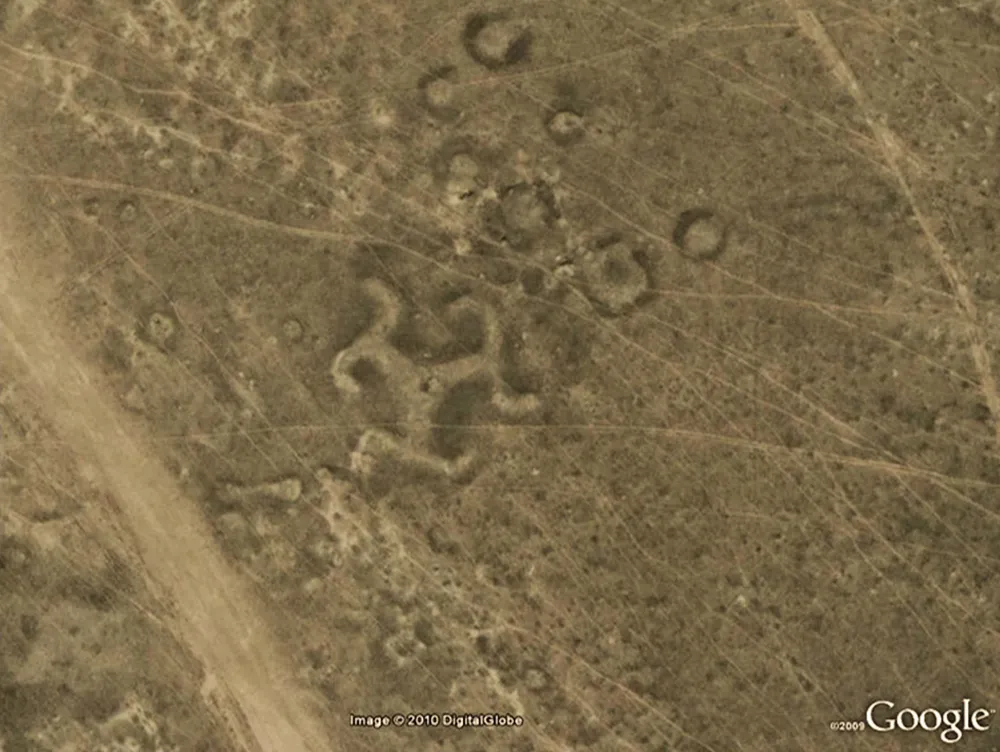
More than 50 geoglyphs with various shapes and sizes, including a massive swastika, have been discovered across northern Kazakhstan in Central Asia, say archaeologists.
These sprawling structures, mostly earthen mounds, create the type of landscape art most famously seen in the Nazca region of Peru.
Discovered using Google Earth, the geoglyphs are designed in a variety of geometric shapes, including squares, rings, crosses and swastikas (the swastika is a design that was used in ancient times). Ranging from 90 to 400 meters (295 to 1,312 feet) in diameter, some of them are longer than a modern-day aircraft carrier. Researchers say that the geoglyphs are difficult to see on the ground, but can easily be seen from the sky. [See Photos of the Amazing Geoglyphs in Kazakhstan]
Over the past year, an archaeological expedition from Kazakhstan's Kostanay University, working in collaboration with Vilnius University in Lithuania, has been examining the geoglyphs. The team, which is conducting archaeological excavations, ground-penetrating radar surveys, aerial photography and dating, recently presented its initial results at the European Association of Archaeologists' annual meeting in Istanbul.
The geoglyphs were made of earthen mounds.
Archaeological excavations uncovered the remains of structures and hearths at the geoglyphs, suggesting that rituals took place there, said archaeologists Irina Shevnina and Andrew Logvin, of Kostanay University, in an email to Live Science. Ancient tribes may also have used the geoglyphs to mark ownership of the land, the researchers noted.
"As of today, we can say only one thing — the geoglyphs were built by ancient people. By whom and for what purpose, remains a mystery," said Shevnina and Logvin.
Get the world’s most fascinating discoveries delivered straight to your inbox.
Why they're builders used geometric shapes is also a mystery, although the swastika is an ancient symbol found throughout Europe and Asia.
Geoglyphs around the world
While Peru's Nazca Lines are the world's most famous geoglyphs, archaeological research suggests that geoglyphs were constructed in numerous areas around the world by different cultures.
For instance, in the Middle East, archaeologists have found thousands of wheel-shaped structures that are easily visible from the sky, but hard to see on the ground. Also recently in Russia, archaeologists excavated a geoglyph shaped like an elk, which appears older than the Nazca Lines.
Ancient geoglyphs have also been reported in many other countries, including the United Kingdom, Brazil and even the Southwestern United States. The introduction of high-resolution Google Earth imagery over the last decade has helped both professional archaeologists and amateurs detect and study these enigmatic structures.
Editor's Note: This article was updated to reflect the fact that all of the geoglyphs were made of earthen mounds.
Follow us @livescience, Facebook & Google+. Original article on Live Science.

Owen Jarus is a regular contributor to Live Science who writes about archaeology and humans' past. He has also written for The Independent (UK), The Canadian Press (CP) and The Associated Press (AP), among others. Owen has a bachelor of arts degree from the University of Toronto and a journalism degree from Ryerson University.