













Mosaic Floor Revealed at Alexander the Great-Era Tomb

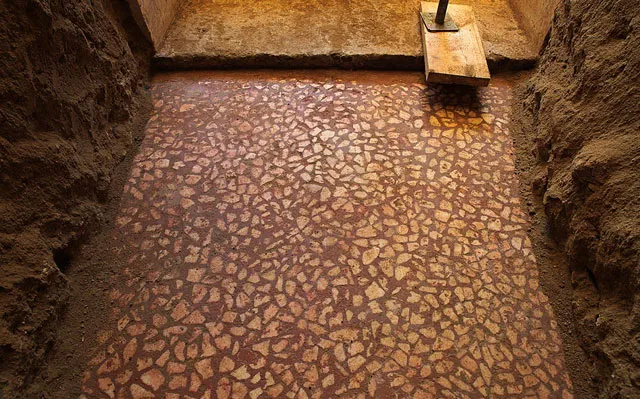
At a site under excavation in Greece, archaeologists have uncovered mosaic floors that pave the entrance to a huge tomb from the era of Alexander the Great.
The freshly revealed floor covers the antechamber behind the sphinx-guarded entrance to the tomb at Amphipolis in Macedonia, a historical region of Greece, photos released by the Greek Ministry of Culture show. Small, irregular fragments of white marble are embedded against a red background in the floor, which is preserved in excellent condition, the excavators said.
No graves have been discovered yet at the so-called Kasta Hill site at Amphipolis. But that hasn't stopped tourists, journalists and politicians from flocking to the ancient village to get a glimpse of the excavation. Greek Prime Minister Antonis Samaras toured the site last month and told reporters he was standing in front of an "extremely important discovery." Some local media outlets have derided the media circus. The Greek Reporter charged that Amphipolis has become "archaeological Disneyland." [See Photos of the Alexander-Era Tomb Excavation]
Besides the broken sphinxes, archaeologists have also revealed architectural elements that still bear traces of their original black and red paint. There are also traces of a blue fresco on the wall behind the sphinxes.
Before the excavators could continue digging farther into the tomb, they had to put in place a drainage ditch and other infrastructure to collect rainwater and protect the exposed entrance to the complex, according to another update on Tuesday (Sept. 2) from the Greek Ministry of Culture.
Follow Megan Gannon on Twitter and Google+. Follow us @livescience, Facebook & Google+. Original article on Live Science.
Get the world’s most fascinating discoveries delivered straight to your inbox.
