 Live Science Plus





You are now subscribed
Your newsletter sign-up was successful
Want to add more newsletters?

Delivered Daily
Daily Newsletter
Sign up for the latest discoveries, groundbreaking research and fascinating breakthroughs that impact you and the wider world direct to your inbox.

Once a week
Life's Little Mysteries
Feed your curiosity with an exclusive mystery every week, solved with science and delivered direct to your inbox before it's seen anywhere else.

Once a week
How It Works
Sign up to our free science & technology newsletter for your weekly fix of fascinating articles, quick quizzes, amazing images, and more

Delivered daily
Space.com Newsletter
Breaking space news, the latest updates on rocket launches, skywatching events and more!

Once a month
Watch This Space
Sign up to our monthly entertainment newsletter to keep up with all our coverage of the latest sci-fi and space movies, tv shows, games and books.

Once a week
Night Sky This Week
Discover this week's must-see night sky events, moon phases, and stunning astrophotos. Sign up for our skywatching newsletter and explore the universe with us!
Join the club
Get full access to premium articles, exclusive features and a growing list of member rewards.
Sexual orientation seems to be wired into the brains of nematode worms, and tweaking this sexual wiring can result in worms attracted to members of the same sex.
"The conclusion is that sexual attraction is wired into brain circuits common to both sexes of worms,” said researcher Erik Jorgensen, scientific director of the Brain Institute at the University of Utah and an investigator with the Howard Hughes Medical Institute.
“We cannot say what this means for human sexual orientation, but it raises the possibility that sexual preference is wired in the brain,” Jorgensen said. “Humans are subject to evolutionary forces just like worms. It seems possible that if sexual orientation is genetically wired in worms, it would be in people too.”
Sensual scents
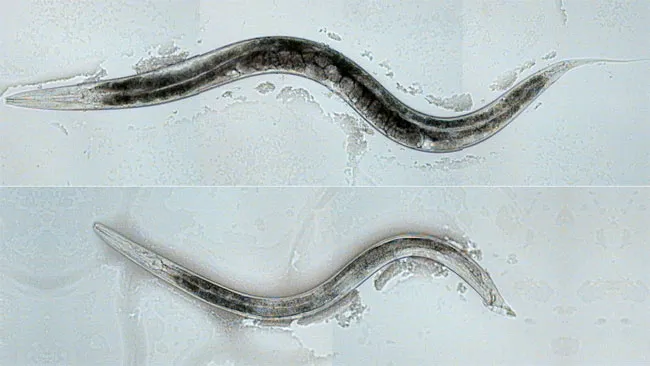
While most nematode worms (Caenorhabditis elegans) are hermaphrodites, having both male and female sex organs, one in 500 nematodes is a true male.
"The hermaphrodites are essentially females," said lead study author Jamie White, a member of Jorgensen's lab. "It just turns out they make a little bit of sperm during development that they store to fertilize their own eggs."
The ability to reproduce without a mate is crucial for the slender worms, which reside in the soil where it's hit or miss as to whether they come across a sporadic bacteria bloom—a meal. This way, when a lone worm spots such a feast, it doesn't have to wait around for a mate to take advantage of the nutrition and reproduce.
Male nematodes, however, must seek out a mate in order to reproduce. Since like all nematodes the males lack eyes, they sniff out sex-attractant odors called pheromones to find potential mates.
This olfactory obligation could explain why males have a nervous system that includes eight sensory neurons (out of 383 total nerve cells) that aid in pheromone detection. Female nematodes, however, only have four of these sensory neurons, general sensory neurons which they use for finding food and other sweet-smelling substances.
Sex change
Jorgensen and his colleagues were interested in finding out how the nervous system, which is directed by genetics, affected the sexual behaviors of the worms.
The researchers activated the so-called "fem-3" gene in the brains of hermaphrodite worms. The gene is responsible for the development of male-specific features of cells in the body and nervous system, but the scientists only switched on those in the worms' brain cells.
"The body cells are expressing the genes it normally would in the hermaphrodite," White told LiveScience. "The neurons themselves—we flipped this genetic switch to turn them into male."
Before the brain-sex change, the hermaphrodites showed no interest in the pheromones of other hermaphrodites—members of their own sex. The genetically altered hermaphrodites (or transgender ones), however, crawled toward the same-sex scents.
Most of the transgender worms still lacked the male-specific sensory neurons, even though the fem-3 gene was activated. White suggests they relied on the four general sensory neurons for pheromone sniffing.
The study is detailed online today in the journal Current Biology.
- Video: Sex & the Senses
- Gay Animals: Alternate Lifestyles in the Wild
- Sex Quiz: Myths, Taboos and Bizarre Facts
