 Live Science Plus





You are now subscribed
Your newsletter sign-up was successful
Want to add more newsletters?

Delivered Daily
Daily Newsletter
Sign up for the latest discoveries, groundbreaking research and fascinating breakthroughs that impact you and the wider world direct to your inbox.

Once a week
Life's Little Mysteries
Feed your curiosity with an exclusive mystery every week, solved with science and delivered direct to your inbox before it's seen anywhere else.

Once a week
How It Works
Sign up to our free science & technology newsletter for your weekly fix of fascinating articles, quick quizzes, amazing images, and more
Delivered daily
Space.com Newsletter
Breaking space news, the latest updates on rocket launches, skywatching events and more!
Once a month
Watch This Space
Sign up to our monthly entertainment newsletter to keep up with all our coverage of the latest sci-fi and space movies, tv shows, games and books.
Once a week
Night Sky This Week
Discover this week's must-see night sky events, moon phases, and stunning astrophotos. Sign up for our skywatching newsletter and explore the universe with us!
Join the club
Get full access to premium articles, exclusive features and a growing list of member rewards.
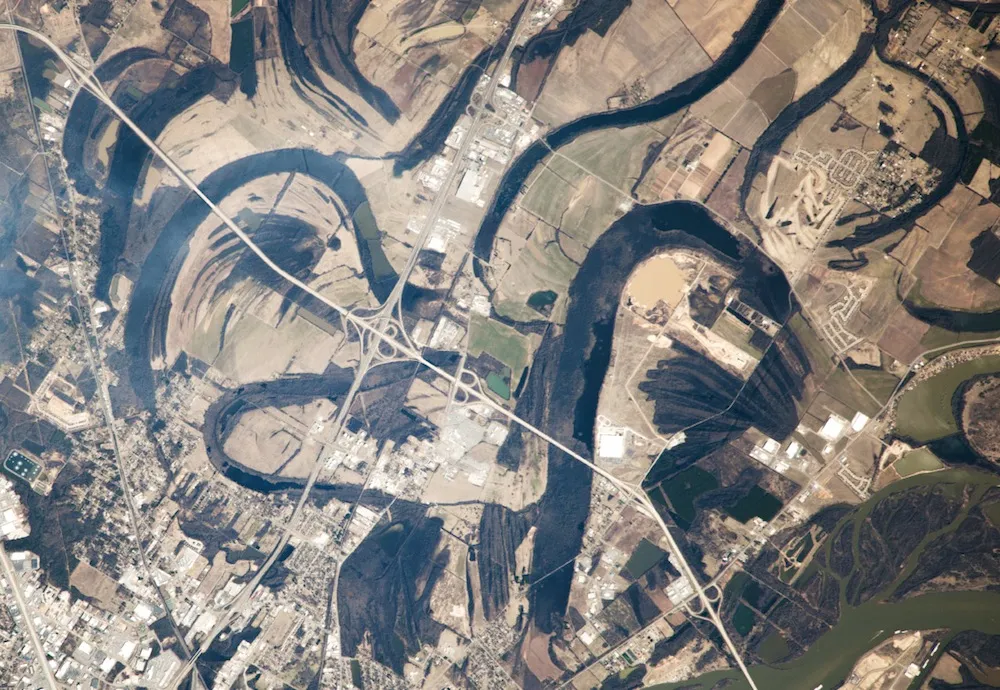
Twisty, turny lakes near Little Rock, Ark., show where the mighty Arkansas River once traveled. These meander lakes, as they're called, are the subject of a new astronaut photograph.
An astronaut on the International Space Station snapped the new picture from 250 miles (400 kilometers) above the Earth's surface on Feb. 21, according to NASA's Earth Observatory, which just released the photo. The image shows the curving neighborhood streets of Little Rock on the lower left, bounded by Interstate 40. The greenish Arkansas River of today is in the lower right corner of the photograph.
Finer dark lines that look like scour surfaces in the curves of these lakes are the remnants of ancient riverbanks, the Earth Observatory reports.
The headwaters of the Arkansas River begin in the Sawatch Range of the Rockies in Colorado, where they compose the most commercially rafted river in the United States, according to Colorado Parks and Wildlife. The river continues more than 1,450 miles (2,334 km) through eastern Colorado, Kansas, Oklahoma and Arkansas, draining more than 160,000 square miles (414,398 square km) along its path, according to the Kansas-based Arkansas River Coalition.
Follow Stephanie Pappas on Twitter and Google+. Follow us @livescience, Facebook & Google+. Original article on Live Science.

