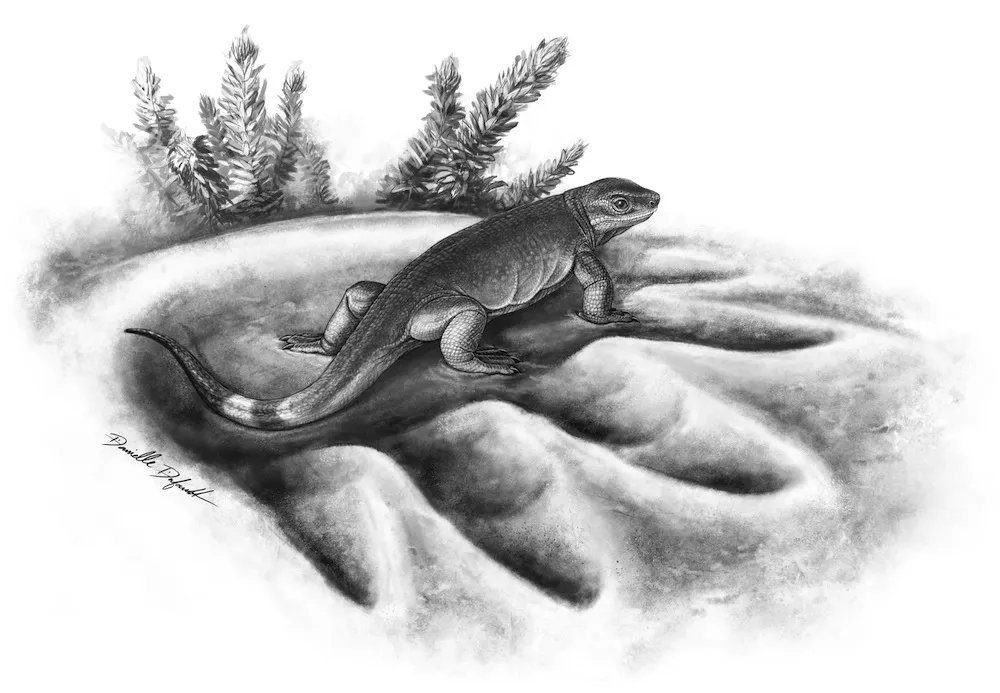
Tiny carnivorous Eocasea martini is the oldest, and smallest, known caseid. In this illustration, the new species sits in the footprint of a much-larger herbivore relative from 30 million years later, Cotylorhynchus.
A newly discovered 300-million-year-old meat-eating mammal ancestor is the oldest known member of a line that gave rise to rhinoceros-size herbivores.
The lizardlike animal, dubbed Eocasea martini, was a caseid. Caseids were a primitive group of synapsids, an umbrella term that includes mammals and their close relatives. Ancient nonmammalian synapsids, including caseids, looked reptilian — the famous fin-backed Dimetrodon was a synapsid — but were an entirely different branch of life from reptiles and birds.
"It's within this side of vertebrate evolution that we have the first plant-eating animals," said study leader Robert Reisz, a paleontologist at the University of Toronto.
The discovery of the new species is important, because E. martini appears to have been a carnivore, Reisz told Live Science. Weighing less than 4.4 lbs. (2 kilograms), the little caseid probably chowed down on insects. [Dimetrodon Photos: Bizarre Boomerang-Headed Amphibian]
"All other members of this group, the caseids, are plant eaters," Reisz said. This one, the oldest, isn't. We see a transformation within the group from an insectivorous animal to a plant-eating animal."
Waiting to be found
The fossilized skeleton of Eocasea martini, found near Hamilton, Kan.
(Image credit: PLOS ONE)
Reisz and his colleagues identified the new species from a partial skull and skeleton, including most of the backbone and one hind limb. The fossil came from Hamilton Quarry in southeast Kansas, the site of an ancient lagoon famous for plant and fish specimens.
Sign up for the Live Science daily newsletter now
Get the world’s most fascinating discoveries delivered straight to your inbox.
"There are very few terrestrial vertebrates coming out of that locality, but each one has turned out to be very important scientifically," Reisz said.
The specimen that would become E. martini was first found more than two decades ago by paleontologist Larry Martin of the University of Kansas. It sat in storage at the university's Dyke Museum of Natural History for years, until Reisz borrowed it to prepare it for study.
"Nobody paid much attention to it," he said. "It's a tiny little animal."
Once they analyzed the bones, however, Reisz and his colleagues realized they had something unknown. The anatomy revealed the animal was a caseid, but unlike later members of the group, it lacked a barrel-shaped rib cage. A broad rib cage indicates it was a plant eater, because animals that survive on plants need large guts to break down cellulose-rich roughage in leaves and stems.
Original plant eaters
The new species helps illustrate how some animals transitioned from eating insects to eating meat, Reisz said.
"What's really interesting is that this is not the only group that it happened to," Reisz said of the transition to eating plants. "Other groups seem to have been doing this roughly at the time."
And like other groups throughout history, the caseids benefited from the new food sources available to them, he said. Later species grew to the size of modern rhinoceroses, dwarfing little E. martini.
The researchers reported their findings today (April 16) in the open-access journal PLOS ONE.
Stephanie Pappas is a contributing writer for Live Science, covering topics ranging from geoscience to archaeology to the human brain and behavior. She was previously a senior writer for Live Science but is now a freelancer based in Denver, Colorado, and regularly contributes to Scientific American and The Monitor, the monthly magazine of the American Psychological Association. Stephanie received a bachelor's degree in psychology from the University of South Carolina and a graduate certificate in science communication from the University of California, Santa Cruz.