














Yellowstone Geyser Erupts For First Time in Years

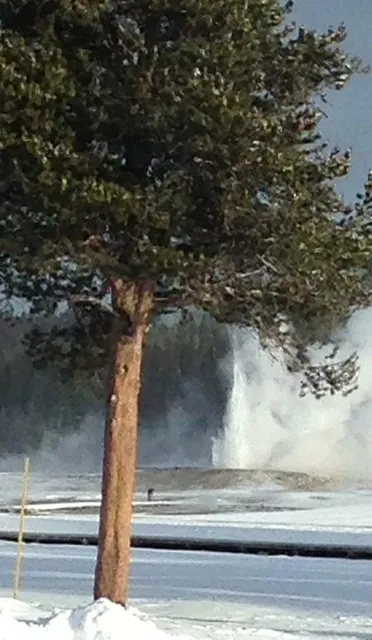
Yellowstone National Park's Giantess Geyser is erupting for the first time in two-and-a-half years, park rangers said today.
The usually quiet geyser is shooting off bursts of water that reach 50 feet (15 meters) into the air, said Annie Carlson, the supervisory park ranger at the Old Faithful Visitor Education Center. Giantess Geyser is nearby the more famous Old Faithful, but it is far less regular.
"We don't know when it will stop, and we don't know when it will go again in the future," Carlson told Live Science's Our Amazing Planet. [The Wild Geology of Yellowstone (Infographic)]
Sleeping giantess
There are more than 500 geysers in Yellowstone. Geysers occur when geothermally heated water gets trapped and pressurized in underground hot springs. The recurrence rate of geyser eruptions varies wildly. Old Faithful erupts, on average, every 92 minutes, according to the National Park Service, though the exact timing varies between every 35 minutes and every 120 minutes. It shoots water 90 to 184 feet (27-55 m) into the air.
Yellowstone also boasts the world's tallest active geyser, the Steamboat Geyser. It has a major eruption only rarely, but when it does, the water rises as high as 300 feet (90 m).
Giantess is another infrequent erupter. It averages two to three episodes per year, with as many as 41 per year in the 1980s, Carlson said, but in recent years has slowed down, perhaps as a result of small earthquakes that continuously rearrange the underground plumbing of the park's geysers. The last time Giantess erupted was Sept. 13, 2011.
Get the world’s most fascinating discoveries delivered straight to your inbox.
Surprise eruption
The pool around the geyser can surge before eruptions, giving a little notice, Carlson said. But yesterday (Jan. 29) afternoon, the weather in Yellowstone was snowy and windy, and no one was in the Upper Geyser Basin near Old Faithful watching the pool.
At about 2:55 p.m., rangers at the station near Old Faithful saw a plume of hot water rising from Giantess. They made an announcement so that several visitors were able to go watch the eruption despite the stormy conditions, Carlson said.
Giantess is still blowing off hot water as of this morning, she said. Previous eruptions have gone on intermittently for between one and 43 hours.
"It's definitely exciting for us here," Carlson said. "Giantess is a big geyser that does not erupt frequently."
Follow Stephanie Pappas on Twitter and Google+. Follow OurAmazingPlanet @OAPlanet, Facebook and Google+. Original article at Live Science's OurAmazingPlanet.

Stephanie Pappas is a contributing writer for Live Science, covering topics ranging from geoscience to archaeology to the human brain and behavior. She was previously a senior writer for Live Science but is now a freelancer based in Denver, Colorado, and regularly contributes to Scientific American and The Monitor, the monthly magazine of the American Psychological Association. Stephanie received a bachelor's degree in psychology from the University of South Carolina and a graduate certificate in science communication from the University of California, Santa Cruz.