 Live Science Plus





You are now subscribed
Your newsletter sign-up was successful
Want to add more newsletters?

Delivered Daily
Daily Newsletter
Sign up for the latest discoveries, groundbreaking research and fascinating breakthroughs that impact you and the wider world direct to your inbox.

Once a week
Life's Little Mysteries
Feed your curiosity with an exclusive mystery every week, solved with science and delivered direct to your inbox before it's seen anywhere else.

Once a week
How It Works
Sign up to our free science & technology newsletter for your weekly fix of fascinating articles, quick quizzes, amazing images, and more

Delivered daily
Space.com Newsletter
Breaking space news, the latest updates on rocket launches, skywatching events and more!

Once a month
Watch This Space
Sign up to our monthly entertainment newsletter to keep up with all our coverage of the latest sci-fi and space movies, tv shows, games and books.

Once a week
Night Sky This Week
Discover this week's must-see night sky events, moon phases, and stunning astrophotos. Sign up for our skywatching newsletter and explore the universe with us!
Join the club
Get full access to premium articles, exclusive features and a growing list of member rewards.
A 12-year-old girl in Arkansas has been hospitalized with a case of parasitic meningitis caused by a rare brain-eating amoeba.
The Arkansas Department of Health and the U.S. Centers for Disease Control and Prevention (CDC) confirmed that Kali Hardig contracted the disease after swimming in the Willow Springs Water Park in Little Rock, Ark.
Hardig's mother, Traci, took her daughter to a local hospital one day after visiting the water park. "I couldn't get her fever down," Hardig told the Christian Post. "She started vomiting. She'd say her head hurt really bad. She cried, and she would just look at me and her eyes would just kind of roll."
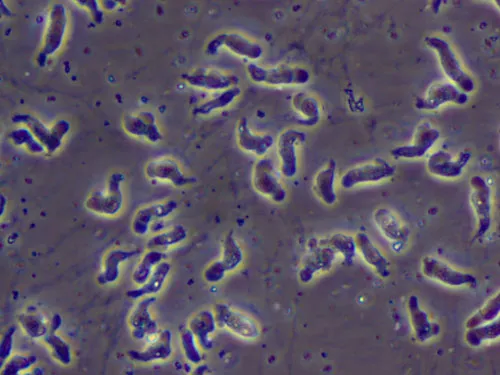
The brain-eating amoeba, Naegleria fowleri, causes a type of meningitis known as primary amebic meningoencephalitis, or PAM, according to the CDC. The single-celled microbe — found in warm, freshwater lakes and rivers — enters the body through the nose and travels along the olfactory nerves to the brain, where it destroys brain tissue. [The 9 Oddest Medical Case Reports]
In the United States, most infections occur in the South during the summer months. PAM infections are rare: Between 2001 and 2010, just 32 infections were reported in the United States, according to the CDC. The microbe is not found in oceans or other saltwater bodies.
Early symptoms of an infection with Naegleria fowleri usually show up within seven days of exposure and include neck stiffness, headache, fever, nausea and vomiting. Later, confusion, loss of balance, seizures and hallucinations can occur.
The disease is usually fatal, even when treatment begins early. Doctors put Hardig in a medically induced coma in order to stabilize her.
Though the majority of cases are caused by swimming in warm bodies of water, at least two cases have been linked to tap water: In 2011, two people living in different areas of Louisiana contracted PAM after using tap water in neti pots to irrigate their nasal passages and sinuses.
Officials in Arkansas have closed the Willow Springs Water Park during their investigation into the case. A 2010 Naegleria fowleri infection was also linked to the water park.
To minimize the risk of an infection with Naegleria fowleri, the CDC recommends that swimmers avoid bodies of freshwater when the water is warm, hold the nose shut or use nose clips, and avoid stirring up bottom sediments.
Additionally, people who use neti pots should only use water that is distilled, sterilized, filtered or boiled (and then left to cool), and should clean and dry their pots after each use.
A person cannot become infected from drinking tap water (Naegleria fowleri infections can only be contracted through the nose), and the infection cannot be passed from one person to another.
Follow Marc Lallanilla on Twitter and Google+. Follow us @livescience, Facebook & Google+. Original article on Live Science.

