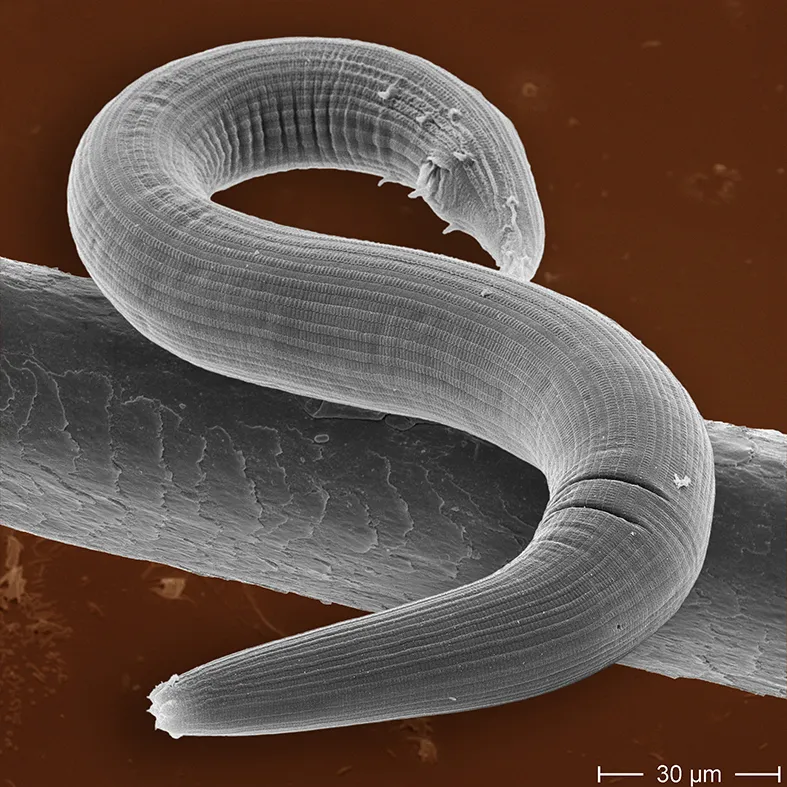
The decorated theoretical physicist Max Planck is getting another posthumous accolade: his own nematode.
The hitchhiking worm, Pristionchus maxplancki, is the first species to bear the name of the German scientist, a pioneer of quantum theory who died in 1947.
The new species measures just a millimeter long and was found piggy-backing on a stag beetle collected from an oak forest in Fukushima province, Japan. It was discovered by a group of researchers studying the self-fertilizing hermaphrodites Pristionchus pacificus at a lab in the Max Planck Institute for Developmental Biology.
Latest Videos From
Pristionchus worms latch onto beetles and put their lives on pause, going into a dormant state until their host dies. Then, the nematodes feed on the carcass of the insect and the fungi and bacteria that flourish around its remains. The genus Pristionchus has been found on all continents, and researchers are studying how the worms' biology has contributed to their global spread.
"Max Planck constantly emphasised the importance of exact observations and precise inspection as the actual core of scientific work," read a statement from the Max Planck Society, a major science and technology research organization in Germany. "In that regard, it is also completely appropriate for a worm living in concealment, yet illuminating fundamental processes of nature to keen-eyed observers, to now be named after him."
The new species is described in the journal Zoological Science.
Follow Megan Gannon on Twitter and Google+. Follow us @livescience, Facebook & Google+. Original article on LiveScience.com.

 Live Science Plus