 Live Science Plus





You are now subscribed
Your newsletter sign-up was successful
Want to add more newsletters?

Delivered Daily
Daily Newsletter
Sign up for the latest discoveries, groundbreaking research and fascinating breakthroughs that impact you and the wider world direct to your inbox.
Once a week
Life's Little Mysteries
Feed your curiosity with an exclusive mystery every week, solved with science and delivered direct to your inbox before it's seen anywhere else.
Once a week
How It Works
Sign up to our free science & technology newsletter for your weekly fix of fascinating articles, quick quizzes, amazing images, and more

Delivered daily
Space.com Newsletter
Breaking space news, the latest updates on rocket launches, skywatching events and more!

Once a month
Watch This Space
Sign up to our monthly entertainment newsletter to keep up with all our coverage of the latest sci-fi and space movies, tv shows, games and books.

Once a week
Night Sky This Week
Discover this week's must-see night sky events, moon phases, and stunning astrophotos. Sign up for our skywatching newsletter and explore the universe with us!
Join the club
Get full access to premium articles, exclusive features and a growing list of member rewards.
Intro
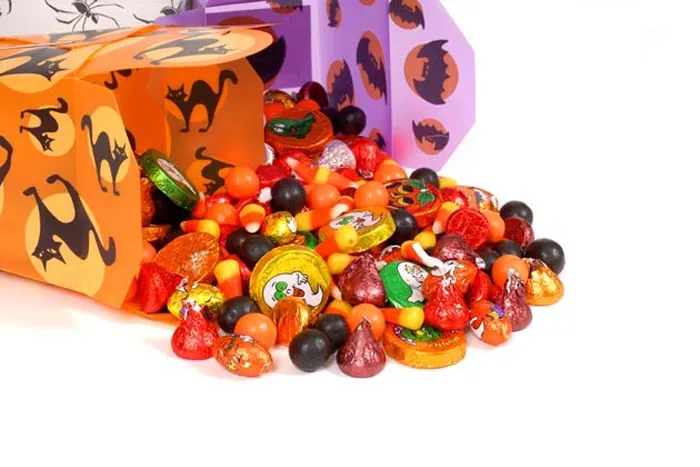
The mention of Halloween brings up images of trick-or-treaters with plastic jack-o'-lantern pails full of candy.
Here are six facts about the spooky holiday's sweets.
Side 2

Tootsie Rolls were the first wrapped penny candy in America. Inventor Leo Hirschfield gave the candies their name in 1896. He named them in honor of his daughter, according to "Chocolate Fads, Folklore & Fantasies" (Psychology Press, 1994).
Side 3

Reese's Peanut Butter Cups are the most popular candy among trick-or-treaters, according to a 2006 survey of 1,000 people conducted by ExtremeChocolate.com. The candies earned 20.8 percent of the vote, followed by candy corn with 15.8 percent and Snickers in a close third place with 15.3 percent.
Side 4

Halloween is the second most commercially successful holiday (after Christmas), according to the 2010 Halloween Consumer Intentions and Actions Survey. Americans are expected to spend $5.8 billion on Halloween supplies this year, with the average person spending $20.29 on candy alone , according to the NRF.
Side 5

Among several candies commonly handed out on Halloween, the least healthy is Mr. Goodbar, according to an analysis conducted by MyHealthNewsDaily, a sister site of Life's Little Mysteries. A 49-gram Mr. Goodbar gives you 250 calories, 17 grams of fat (including 7 grams of saturated fat) and 23 grams of sugar. The healthiest candy is Jolly Ranchers, as three of these hard candies have 70 calories, no fat and 11 grams of sugar.
Side 6

The game of bobbing for apples is believed to have originated from an ancient pagan Roman harvest festival that took place in late October. The festival honored Pamona, the Roman goddess of fruit and trees, whose symbol is the apple, according to "Don't Know Much About Mythology: Everything You Need to Know About the Greatest Stories in Human History But Never Learned" (HarperCollins, 2005).
Side 7

The pumpkin is not a vegetable, but a fruit. In fact, it's a berry, according to "The Perfect Pumpkin" (Storey Publishing, 1997). It's part of the Cucurbitaceae family of plants, which also includes gourds, cucumbers, melons and squash. What makes a pumpkin different from other berries, however, is its hard shell.
Follow Life's Little Mysteries on Twitter @llmysteries, then join us on Facebook.
