 Live Science Plus





You are now subscribed
Your newsletter sign-up was successful
Want to add more newsletters?

Delivered Daily
Daily Newsletter
Sign up for the latest discoveries, groundbreaking research and fascinating breakthroughs that impact you and the wider world direct to your inbox.

Once a week
Life's Little Mysteries
Feed your curiosity with an exclusive mystery every week, solved with science and delivered direct to your inbox before it's seen anywhere else.

Once a week
How It Works
Sign up to our free science & technology newsletter for your weekly fix of fascinating articles, quick quizzes, amazing images, and more

Delivered daily
Space.com Newsletter
Breaking space news, the latest updates on rocket launches, skywatching events and more!

Once a month
Watch This Space
Sign up to our monthly entertainment newsletter to keep up with all our coverage of the latest sci-fi and space movies, tv shows, games and books.

Once a week
Night Sky This Week
Discover this week's must-see night sky events, moon phases, and stunning astrophotos. Sign up for our skywatching newsletter and explore the universe with us!
Join the club
Get full access to premium articles, exclusive features and a growing list of member rewards.
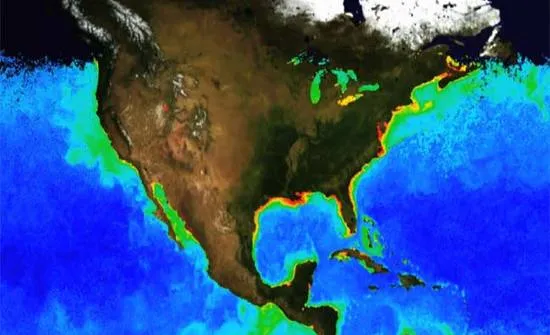
Coastal regions around the United States respond differently to ocean acidification, a large-scale study finds.
In the new study, scientists from 11 U.S. institutions measured levels of carbon dioxide and other forms of carbon in waters off the East Coast and the Gulf of Mexico. If the same amount of carbon dioxide entered both the Gulf of Maine and the Gulf of Mexico, it would have a greater effect on the Gulf of Maine's ecosystem, the scientists found.
"Before now, we haven't had a very clear picture of acidification status on the East Coast of the U.S.," lead study author Zhaohui 'Aleck' Wang, a chemical oceanographer at Woods Hole Oceanographic Institution (WHOI), said in a statement. "It's important that we start to understand it, because [an] increase in ocean acidity could deeply affect marine life along the coast and has important implications for people who rely on aquaculture and fisheries," Wang said.
Coastal ocean acidification occurs when excess carbon dioxide is absorbed by, washes into or is produced in coastal oceans, triggering chemical reactions that make the water more acidic. Species like oysters, snails and coral are disproportionally affected, because they cannot form their protective shells in highly acidic conditions.
The researchers set sail off of Galveston, Texas, and made their way past Louisiana, around Florida, and up the East Coast, collecting water samples between the coasts to as far as 300 miles (480 kilometers) offshore. They measured different forms of carbon and compared that with the water's total alkalinity (a measure of how basic it is, the opposite measure of acidity). The ratio of alkalinity to carbon tells scientists how well the water can resist, or "buffer," changes in acidity.
They found that the Gulf of Mexico waters, for the most part, were more resistant to acidification compared with more northern regions. The waters became less acid-resistant as the researchers moved north from Georgia, and the Gulf of Maine had the lowest ability of the entire Eastern Seaboard to resist acidification.
The results show that waters along the northeast U.S. coast are more susceptible to acidification than southern-facing regions of the country. It's not yet clear what's causing the greater susceptibility near Maine, but its cold ocean currents may be bringing fresh, low-alkalinity water south from the Labrador Sea, Wang said. If so, climate change could melt sea ice and glaciers and bring in more fresh water, though whether this would make the water more susceptible to acidification is unknown.

