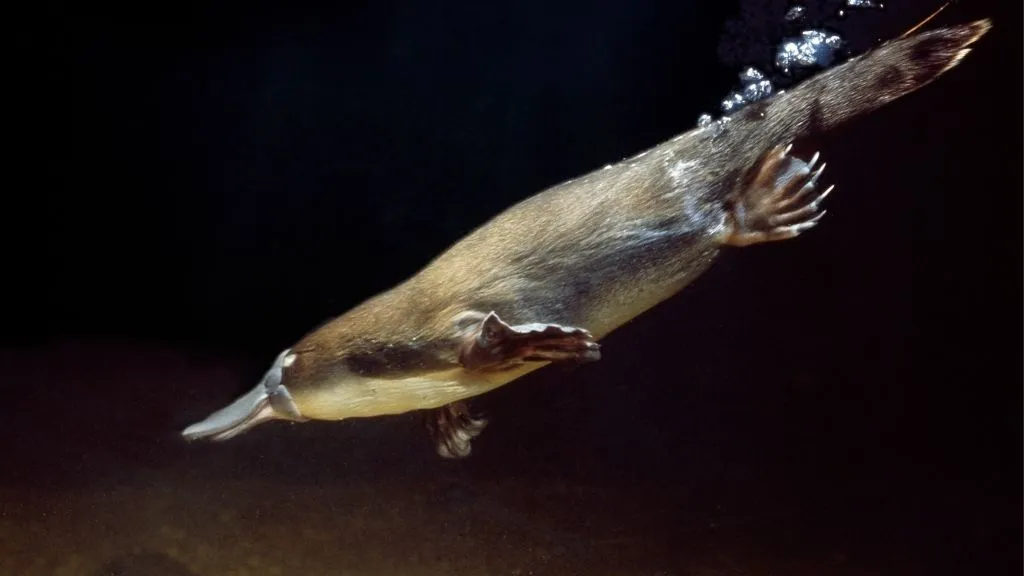
The platypus (Ornithorhynchus anatinus) is one of the most unusual creatures in the animal kingdom. The platypus has a paddle-shaped tail, like a beaver; a sleek, furry body, like an otter; and a flat bill and webbed feet, like a duck. In fact, the first time a stuffed platypus was brought from Australia to Britain, people couldn't believe it was a real animal; they thought a trickster had sewn two animals together, according to London's Natural History Museum.
Platypuses (which is the correct plural form, not "platypi") are among the few venomous mammals. Males have a spur, connected to a venom-secreting gland, on each hind foot. More venom is secreted during mating season, leading researchers to think that the spurs and venom help males compete for mates, according to the Australian Platypus Conservatory. The venom is not life-threatening to humans, but it can cause severe swelling and excruciating pain.
Related: Egg-laying mammals and peacock spiders: Meet some of Australia's weirdest creatures
Size and appearance
Adult male platypuses can range between about 15.7 inches to 24.8 inches (39.8 to 62.9 centimeters) long, from the tip of the bill to tip of the tail, according to the Australian Museum. Adult females range from 14.5 to 21.6 inches (36.8 to 54.8 cm) long. Adult males weigh about 1.7 to 6.6 lbs. (0.8 to 3 kilograms) and females weigh about 1.3 to 3.7 lbs. (0.6 to 1,7 kg).
Scientists have found fossils that suggest that ancient platypuses were significantly larger than the modern variety, at about 3.3 feet (1 meter) long, Live Science previously reported.
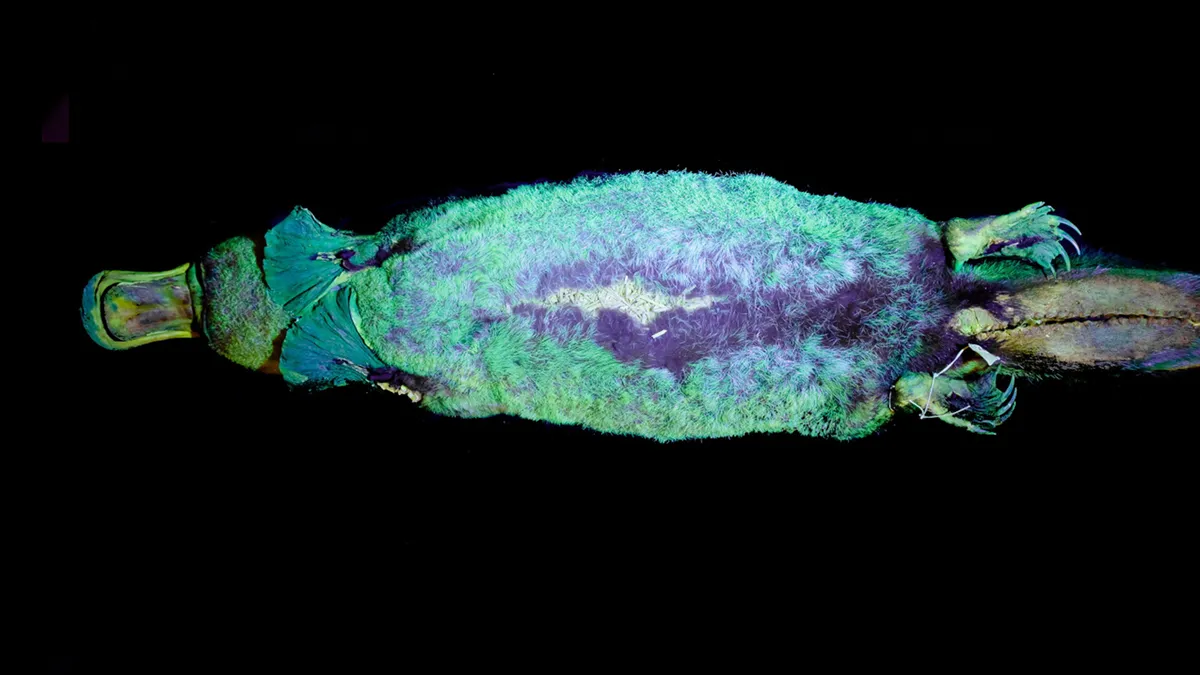
Platypuses have dense, thick fur that helps them stay warm underwater. Most of the fur is dark brown, except for a patch of lighter fur near each eye and lighter-colored fur on the underside. Under ultraviolet light, however, platypuses' drab brown fur glows green and blue, Live Science previously reported. It's possible that this biofluorescence helps reduce the animals' visibility to predators, but the eerie glow may serve little or no ecological function. Scientists are still investigating this question.
A platypus's front feet have extra skin that acts like a paddle when the animal is swimming. When platypuses are on land, their webbing retracts, making the claws more pronounced, according to National Geographic. The animals walk on their knuckles to protect the webbing, according to a 2001 report in the Journal of Experimental Biology.
The bill of a platypus resembles that of a duck and has a smooth texture that feels like suede. It is also flexible and rubbery. The skin of the bill holds tens of thousands of sensory receptors that help the platypus navigate underwater and detect movement of potential food, such as shrimp, according to the Australian Platypus Conservatory.
Venom
Male platypuses carry venom glands, located near their pelvises, that connect to hollow spurs on their hind legs, according to a blog written by Bianca op den Brouw, a toxinologist at the University of Melbourne in Australia. Young females also have these spurs, but they lose them in the first year of life.
The venom glands of adult males fluctuate in size throughout the year, reaching their maximum size during breeding season, when males use their venom to compete for mates. To inject its venom, a male wraps its legs around its victim and drives the spurs through the animal's flesh, according to op den Brouw.
The venom itself contains a cocktail of more than a dozen proteins that belong to three major classes of toxins, op den Brouw wrote. This venom is not lethal to platypuses or humans, but it causes swelling and excruciating pain, and it can disrupt wound healing and the function of cell membranes, she noted. In humans, the pain from a platypus sting can be treated with nerve blockers, which block specific nerve cells from sending signals to the brain.
Habitat
Platypuses live in Australia in a range that extends from western Victoria to about as far north as Cooktown in Queensland, meaning they occupy a large stretch of the east and southeast coast of the country, according to the Australian Platypus Conservatory. The creatures can also be found on Tasmania and King Island, as well as on Kangaroo Island, where platypuses were introduced by humans in the early 1900s.
Platypuses occupy freshwater systems — including river basins, lakes, ponds and streams — throughout their habitat range. The animals spend about 10 to 12 hours a night in the water, hunting for food; they are most active during nighttime and dusk, because they are nocturnal. They can stay underwater for only 30 to 140 seconds, the Australian Museum notes.
During the day, they hide out in burrows on the shore, where earthen tunnels open up into oval-shaped underground chambers, according to the San Diego Zoo. Platypuses also take shelter under rock ledges, roots and debris, according to the Australian Platypus Conservatory.
Though they exist on only one side of one continent, platypuses weather many climatic extremes. They have been found in plateaus, lowlands, tropical rainforests, and the cold mountains of Tasmania and the Australian Alps. Platypuses' waterproof, thick fur keeps them warm in chilly weather, and their big tails store extra fat for energy, according to the Australian Platypus Conservatory.

Diet
Platypuses are carnivorous, which means they eat meat but not plants. They hunt for their food in the water where they live. As they swim, they detect food along the muddy bottom of the river, stream, pond or lake using only their sensitive bills, since the animals actually close their eyes, ears and nostrils while foraging underwater, according to the Australian Museum.
When platypuses find something interesting, like insect larvae, they scoop it up in their bills, store it in their cheek pouches and swim to the surface. The animals also eat shrimp, swimming beetles, water bugs and tadpoles, as well as the occasional worm, freshwater pea mussel or snail. Platypuses have even been observed eating cicadas and moths that they catch at the water's surface, according to the Australian Museum.
After coming up from a dive, platypuses float atop the water and chew their food using "grinding plates" in their mouths. The animals sometimes pick up mud and sand in their cheek pouches, and as they eat, they expel this inedible sediment, along with excess water, through grooves in their lower jaws, according to the Australian Platypus Conservatory.
Baby platypuses
Most mammals give birth to live young. Platypuses, however, lay eggs. Mammals that lay eggs are known as monotremes, and besides the platypus, the only other monotremes are echidnas, or spiny anteaters, according to the University of Melbourne. Echidnas are found only in Australia and New Guinea.
When female platypuses are ready to have their young, they burrow inside the ground on the riverbank and seal themselves into tunnel rooms. Each female then lays one to three eggs and places them between her rump and her tail to keep them warm. After about 10 days, the eggs hatch and the bean-size babies nurse for three to four months inside their burrow, according to the Australian Museum.
Around the time of weaning, baby platypuses can swim on their own, according to the Australian Platypus Conservatory.
Taxonomy
Here is the taxonomy of the platypus, according to the Integrated Taxonomic Information System (ITIS):
- Kingdom: Animalia
- Phylum: Chordata
- Class: Mammalia
- Order: Monotremata
- Family: Ornithorhynchidae
- Genus and species: Ornithorhynchus anatinus

Conservation status
Platypuses are not endangered, but the International Union for Conservation of Nature (IUCN) lists them as "near threatened," meaning the species may be vulnerable to extinction in the near future but does not currently qualify as threatened.
The platypus was first listed as near threatened in 2016 after scientists observed a decline in the species' overall numbers, "although the decline is poorly defined and inconsistent across the platypus's range," the Australian Platypus Conservatory notes on its website.
Additional resources and readings
- Watch this video about how scientists discovered that platypuses glow under UV light, from SciShow.
- Explore the scientific debate over whether platypuses were real animals, in the book "Platypus: The Extraordinary Story of How a Curious Creature Baffled the World" (Smithsonian Books, 2001), by Ann Moyal.
- Learn about platypuses' weird genetic quirks, via NPR.
Bibliography
Australian Platypus Conservancy. (n.d). Platypus biology. Australian Platypus Conservancy. Retrieved February 11, 2022, from https://platypus.asn.au/biology/
Australian Platypus Conservancy. (n.d.). Distribution & numbers. Australian Platypus Conservancy. Retrieved February 11, 2022, from https://platypus.asn.au/distribution-numbers/
Divljan, A. D. A. (2021, June 16). Platypus. The Australian Museum. Retrieved February 11, 2022, from https://australian.museum/learn/animals/mammals/platypus/
Fish, F. E., Frappell, P. B., Baudinette, R. V., & MacFarlane, P. M. (2001). Energetics of terrestrial locomotion of the platypus Ornithorhynchus anatinus. Journal of Experimental Biology, 204(4), 797–803. https://doi.org/10.1242/jeb.204.4.797
Integrated Taxonomic Information System (ITIS). (n.d.). Ornithorhynchus anatinus (Shaw, 1799). Integrated Taxonomic Information System. Retrieved February 11, 2022, from https://www.itis.gov/servlet/SingleRpt/SingleRpt?search_topic=TSN&search_value=552524#null
International Union for Conservation of Nature. (n.d.). Platypus. IUCN Red List of Threatened Species. Retrieved February 11, 2022, from https://www.iucnredlist.org/species/40488/21964009
National Geographic. (n.d.). Platypus. National Geographic. Retrieved February 18, 2022, from https://www.nationalgeographic.com/animals/mammals/facts/platypus
op den Brouw, B. (2020, July 17). Wide world of venom - the platypus. The University of Melbourne, School of Biomedical Sciences. Retrieved February 11, 2022, from https://biomedicalsciences.unimelb.edu.au/departments/department-of-biochemistry-and-pharmacology/engage/avru/blog/wide-world-of-venom-the-platypus
Osterloff, E. (2018). The platypus puzzle. Natural History Museum. Retrieved February 11, 2022, from https://www.nhm.ac.uk/discover/the-platypus-puzzle.html
San Diego Zoo. (n.d.). Platypus. San Diego Zoo Wildlife Explorers. Retrieved February 11, 2022, from https://sdzwildlifeexplorers.org/animals/platypus
This article was last updated on Feb. 18, 2022, by Live Science staff writer Nicoletta Lanese.
Originally published on Live Science.