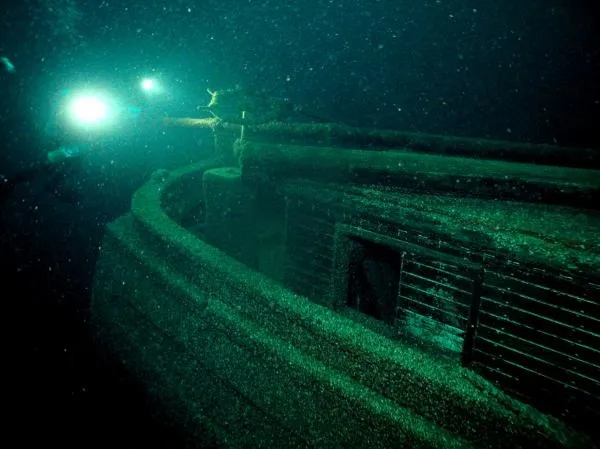
The Cornelia B. Windiate is a wooden schooner that went missing in December 1875 and was discovered in 1987 in Thunder Bay in excellent condition. With no survivors or witnesses, the wheat-carrying ship's sinking remains a mystery, although unpredictable weather was likely a factor, according to NOAA. The ship rests almost 200 feet (61 meters) underwater.
(Image credit: Steve Sellers/NOAA, Thunder Bay NMS)
Known as Shipwreck Alley, Thunder Bay in northwest Lake Huron presents a forbidding scene for boaters and captains but a wonder for divers and marine archaeologists. Its chilly bottom is dotted with dozens of wrecks, from 19th-century schooners to passenger-carrying steamboats to steel-moving freighters that have fallen prey to the bay's unpredictable weather and dangerous shoals.
More than 50 of these historic hulks are protected by the Thunder Bay National Marine Sanctuary, which was created in 2000 and covers 448 square miles (1,160 square kilometers) off the northeast coast of Michigan's Lower Peninsula. Though most are in relatively good shape, thanks to the wreck-friendly freshwater environment of Lake Huron, a new report released by the National Oceanographic and Atmospheric Administration (NOAA) finds the sunken ships might be threatened by a tiny menace: invasive mussels.
A few decades ago, zebra and quagga mussels were introduced to the Great Lakes, likely by ocean-going vessels from Europe dumping ballast water. Researchers believe the mollusks' quick domination of lake-bottoms in the region has contributed to the recent decline of some native species, such as the commercially valuable whitefish. (It's thought that the mussels, through competition, have depleted populations of the shrimplike Diporeia, which is an important part of the whitefish's diet.)
Taken just five years apart, these two photos show how quickly quagga mussels have spread over the schooner Kyle Spangler, which sank in Thunder Bay in 1860. The image at left was taken in 2003 and the one at right is from 2008.
(Image credit: Left: Stan Stock; right: NOAA Thunder Bay NMS)
The mussels also stubbornly attach to hard surfaces such as boat hulls, engines, docks, buoys, pipelines and shipwrecks. Layers of mussels several inches thick could make it difficult for marine archaeologists to get accurate measurements and study a shipwreck, but brushing off the little creatures could tear off delicate sections of sunken wood, according to NOAA. Additionally, pieces of wrecks could break off on their own, under the weight of heavy mussel build-ups.
"The weight of mussels has been known to sink submerged buoys, and similar forces are surely at play on shipwreck sites," the report says.
It's not just the wooden pieces that are at risk. Previous research has found that mussel colonies on steel surfaces can introduce a complex community of bacteria that lowers pH levels (the lower the pH the more acidic a solution is) and speeds up the corrosion of iron fasteners and fittings on shipwrecks. [See Photos of Shipwreck Alley's Sunken Treasures]
"Since many of the wooden ships in the Thunder Bay sanctuary are primarily iron and steel fastened, the structural integrity of these resources could potentially be compromised," the report says.
Sign up for the Live Science daily newsletter now
Get the world’s most fascinating discoveries delivered straight to your inbox.
To be sure, the report's authors note that so far, the mussels do not yet appear to have seriously reduced the historical, archaeological or educational value of the wrecks, but the layers of invasive mussels obscure information about the sites and make scientific study more difficult. The mussels also may be causing long-lasting damage, but since shipwrecks by nature are in a state of deterioration, it's tough determine how much of that wear can be attributed to mussels.
NOAA is currently weighing an expansion of the sanctuary, which would make it stretch over 4,300 square miles (11,136 square km) and cover 92 known historic shipwrecks, with possibly 100 additional sites that have yet to be properly documented. The purpose of the sanctuary is to foster public awareness about the region's maritime heritage and help protect the sites from artifact looting and other negative human impacts through law enforcement and scientific research. Part of this research includes a mussel monitoring initiative in Thunder Bay, which was launched last year by researchers from NOAA's Great Lakes Environmental Lab.
Megan has been writing for Live Science and Space.com since 2012. Her interests range from archaeology to space exploration, and she has a bachelor's degree in English and art history from New York University. Megan spent two years as a reporter on the national desk at NewsCore. She has watched dinosaur auctions, witnessed rocket launches, licked ancient pottery sherds in Cyprus and flown in zero gravity. Follow her on Twitter and Google+.