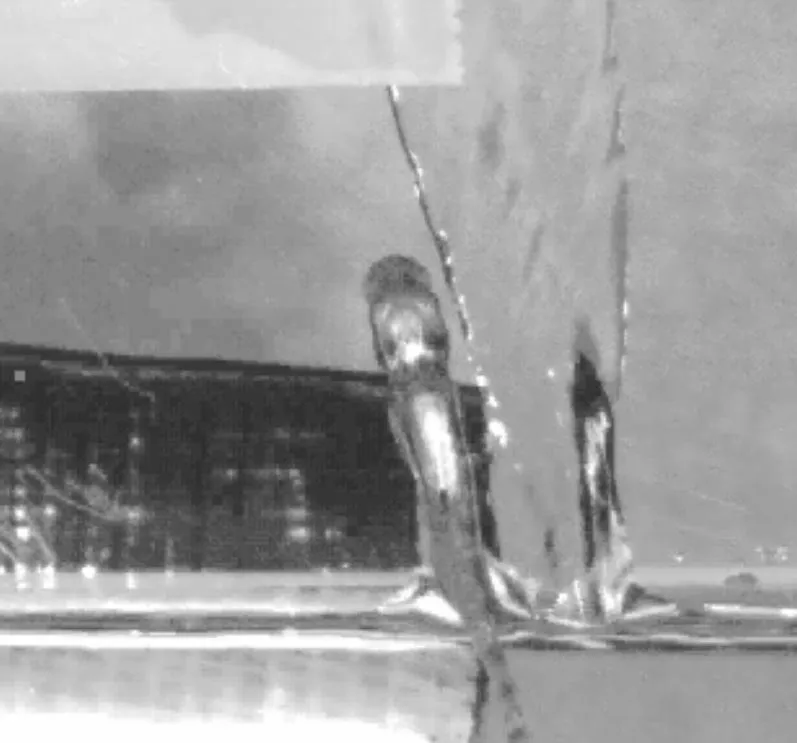
In this still from a high-speed video, the Hawaiian goby fish Sicyopterus stimpsoni is climbing an artificial waterfall with water flowing down a vertical Plexiglas sheet.
(Image credit: Richard Blob and Heiko Schoenfuss.)
A waterfall-climbing fish in Hawaii uses the same muscles to both rise and feed, researchers have discovered.
Scientists looked at the Nopoli rock-climbing goby (Sicyopterus stimpsoni), also known in Hawaiian as o'opu nopili. This plant-eating fish is found throughout Hawaii, and was once greatly relished as food, apparently being a favorite snack among priests.
Many gobies can inch their way up waterfalls with the aid of a sucker on their bellies formed from fused pelvic fins. The Nopoli rock-climbing goby, on the other hand, can climb waterfalls as tall as 330 feet (100 meters) with the aid of a second mouth sucker, which develops after their mouthparts move from a forward-facing position to under the body during a two-day-long metamorphosis into adulthood.
"For a human to go the equivalent distance based on body size, it'd be like doing a marathon, some 26 miles (42 kilometers) long, except climbing up a vertical cliff-face against rushing water," researcher Richard Blob, an evolutionary biomechanist at Clemson University in South Carolina, told LiveScience. Indeed, an old Hawaiian saying is that as the Nopili clings, so will luck.
The goby, which can grow up to 7 inches (18 centimeters) long as an adult, feeds by cyclically sticking the tip of its upper jaw against rock to scrape food off surfaces. This behavior is quite distinct from other Hawaiian gobies, which feed by sucking in food from the water. Given the apparent similarity of the climbing and feeding behaviors of the S. stimpsoni species, researchers thought one might have developed from the other. [See Video of Waterfall-Climbing Fish]
To see if these behaviors really were as similar as they looked, the scientists captured Nopoli rock-climbing gobies from a stream on the island of Hawaii by net while snorkeling and kept them in aquaria. They next filmed the gobies' jaw-muscle movements as the fish climbed and ate, either scraping food off glass microscope slides or climbing up angled plastic boards. They found that overall movements were indeed similar during both activities.
It remains uncertain whether feeding movements were adapted for climbing, or vice versa.
Sign up for the Live Science daily newsletter now
Get the world’s most fascinating discoveries delivered straight to your inbox.
The Nopoli rock-climbing goby (Sicyopterus stimpsoni) uses the same muscles for feeding and climbing waterfalls. [See Video of Waterfall-Climbing Fish]
(Image credit: Takashi Maie)
"To understand the sequence of steps in the evolution of this extreme behavior, we want to look at closely related species that do one of the behaviors, but not the other," Blob said. "This fish has relatives in many oceanic islands, such as the Caribbean."
The scientists detailed their findings online Jan. 4 in the journal PLOS ONE. They will also present their findings Jan. 6 at the Society for Integrative and Comparative Biology annual meeting in San Francisco.
Charles Q. Choi is a contributing writer for Live Science and Space.com. He covers all things human origins and astronomy as well as physics, animals and general science topics. Charles has a Master of Arts degree from the University of Missouri-Columbia, School of Journalism and a Bachelor of Arts degree from the University of South Florida. Charles has visited every continent on Earth, drinking rancid yak butter tea in Lhasa, snorkeling with sea lions in the Galapagos and even climbing an iceberg in Antarctica.