













Fertile Ground: Soil Map Gives the Dirt on US

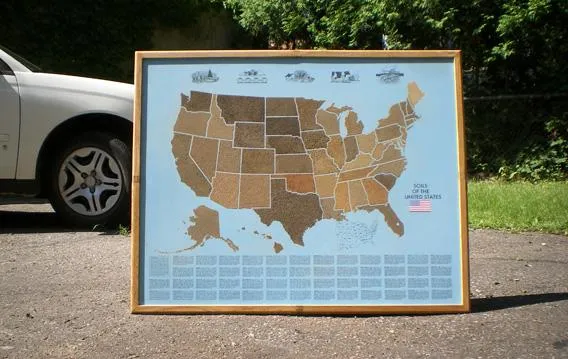
Quick: What's your official state soil? If you're like most Americans, you probably have no idea what you've been standing on all these years — or that you even had an official state soil.
Well, wonder no more. Retired art director Les Gregor discovered a novel way to use his creative energies when he dropped a piece of tape on the ground. When he picked it up, according to Slate.com, it had a perfect, uniform coating of soil on its sticky side.
Gregor, 85, then decided to design a map of the United States with each state covered in a thin film of that state's official soil; state agriculture departments assisted by sending a sample of their finest soil to Gregor. On his map, Nebraska, for example, is covered with the state's dark brown Holdrege loam, while Maine is represented by its pale Chesuncook glacial soil.
Gregor sells his maps ($195 including framing) from his home in Montreal. Asked why he chose to develop maps of the United States and not his native Canada, he told Slate.com, "We only have 11 provinces and not as much soil variation. It would be boring."
Follow LiveScience on Twitter @livescience. We're also on Facebook & Google+.
Get the world’s most fascinating discoveries delivered straight to your inbox.
