













Cave Structure Tells Tale of 13,000 Winters

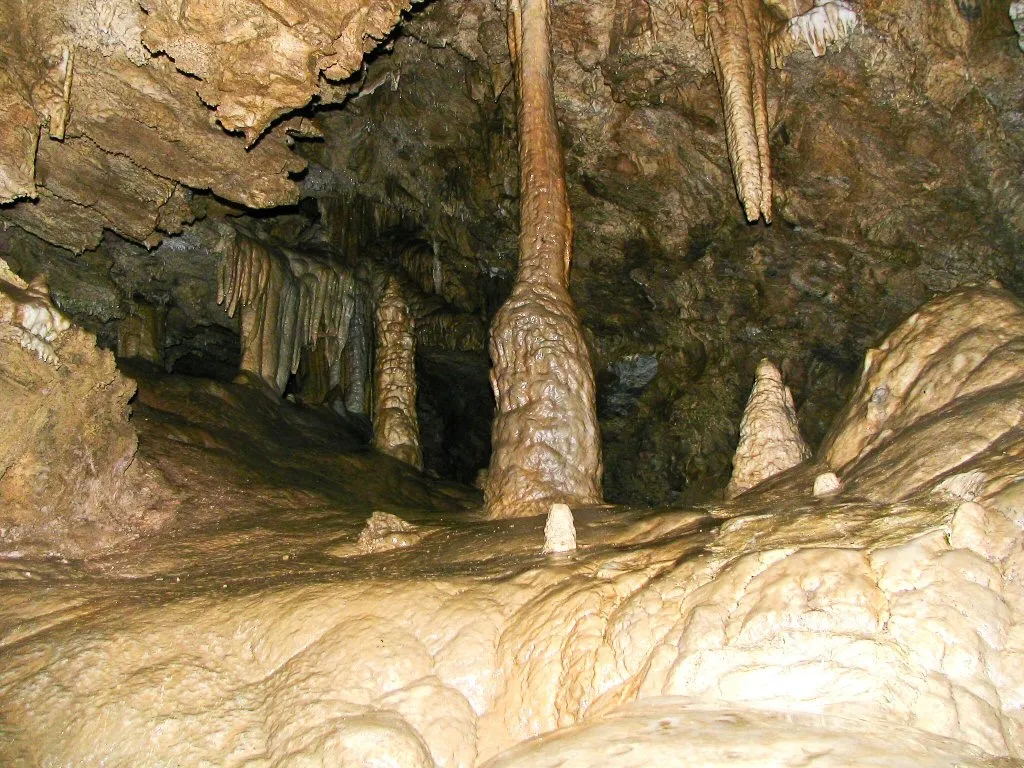
Scientists have found a stalagmite in an Oregon cave that tells the story of thousands of winters in the Pacific Northwest.
"Most other ways of estimating past climate, like tree-ring data, only tell us about summers, when plants are growing," Oxford University researcher Vasile Ersek said in a statement. But understanding ancient winters is also important for regions like western North America, where chilly conditions are critical for determining water resources.
For their study, Ersek and his colleagues examined a cave formation called a stalagmite that started forming 13,000 years ago in a cavern in what is now Oregon Caves National Monument. During the region's damp winters, water from the ground seeped through the cave's ceiling and trickled onto the floor, with the drips slowly forming the stalagmite over time.
The ratio of certain oxygen and carbon isotopes (atoms of the same element with a different number of neutrons) in these deposits provides information on ancient climate. The researchers' measurements of these chemical components showed that the Pacific Northwest of recent prehistory saw rapid shifts between dry and warm, and wet and cold periods, similar to the currently observed Pacific Decadal Oscillation (PDO) — a pattern of climate variability that switches between negative and positive every couple of decades. In a positive, or warm, phase, the surface waters of the west Pacific become cool and part of the eastern ocean warms, while the opposite occurs during a negative, or cool, phase.
"Whilst we can't directly relate these changes to the Pacific Decadal Oscillation, the mechanisms involved do look similar," Ersek said in a statement from Oxford. "Getting a long-term perspective on these sorts of natural climate variations may help us to understand the potential for future loss of winter snow cover along the West Coast, as well as what's happening out in the Pacific to influence other cyclical climate events such as El Niño."
The cave's record keeping stopped before the industrial age began, the researchers said, so the stalagmite unfortunately does not offer clues about how human activities have influenced the winter climate.
The study was detailed this week in the journal Nature Communications.
Get the world’s most fascinating discoveries delivered straight to your inbox.
Follow LiveScience on Twitter @livescience. We're also on Facebook & Google+.
