 Live Science Plus






Rare Star Explosion Reveals Hidden Black Hole in Our Galaxy
You are now subscribed
Your newsletter sign-up was successful
Want to add more newsletters?

Delivered Daily
Daily Newsletter
Sign up for the latest discoveries, groundbreaking research and fascinating breakthroughs that impact you and the wider world direct to your inbox.

Once a week
Life's Little Mysteries
Feed your curiosity with an exclusive mystery every week, solved with science and delivered direct to your inbox before it's seen anywhere else.

Once a week
How It Works
Sign up to our free science & technology newsletter for your weekly fix of fascinating articles, quick quizzes, amazing images, and more
Delivered daily
Space.com Newsletter
Breaking space news, the latest updates on rocket launches, skywatching events and more!

Once a month
Watch This Space
Sign up to our monthly entertainment newsletter to keep up with all our coverage of the latest sci-fi and space movies, tv shows, games and books.

Once a week
Night Sky This Week
Discover this week's must-see night sky events, moon phases, and stunning astrophotos. Sign up for our skywatching newsletter and explore the universe with us!
Join the club
Get full access to premium articles, exclusive features and a growing list of member rewards.
Astronomers have spotted a rare X-ray star explosion near the center of our Milky Way galaxy, revealing a previously unknown black hole munching on gas from a neighboring sun-like star.
NASA's Swift satellite made the cosmic find last month when it detected a new and rapidly brightening X-ray source a few degrees from the galactic center of the Milky Way. Astronomers identified the outburst as a short-lived bright X-ray nova, which is produced when a stream of gas rushes toward either a neutron star or a black hole. Unlike a supernova, which is the explosive death of a star, novas are smaller explosions that do not completely destroy a star.
The black hole is thought to be 20,000 to 30,000 light-years away in the galaxy's inner region. Astronomers, who named the bright X-ray nova Swift J1745-26 after its coordinates in space, said witnessing such an event is rare.
"Bright X-ray novae are so rare that they're essentially once-a-mission events and this is the first one Swift has seen," Neil Gehrels, of NASA's Goddard Space Flight Center in Greenbelt, Md., said in a statement. "This is really something we've been waiting for." [Stealth Black Hole Revealed by Nova (Video)]
At its peak in high-energy X-rays on Sept. 18, the nova reached an intensity equivalent to that of the Crab Nebula. While these rays dimmed, the nova brightened in lower-energy emissions detected by Swift's X-ray Telescope through at least the beginning of October, according to NASA.
Additional observations suggested that a black hole was at the center of this radiation flare-up.
"The pattern we're seeing is observed in X-ray novae where the central object is a black hole," Boris Sbarufatti, an astrophysicist from Milan's Brera Observatory who currently is working with the Swift team, said in an Oct. 5 NASA statement. "Once the X-rays fade away, we hope to measure its mass and confirm its black hole status."

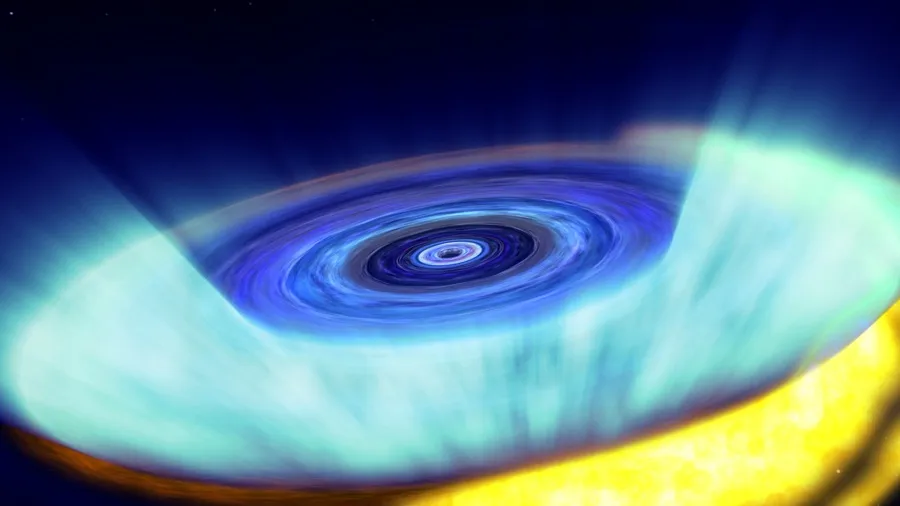
The Swift team believes the black hole is part of a low-mass X-ray binary system, in which gas flows from a star into a disk around the black hole, spiraling inward and heating up greatly as it heads toward the center.
But a cosmic glitch can disrupt the steady flow of gas and cause it to accumulate in the outer portion of the disk like water behind a dam, according to NASA scientists. After enough gas has built up (often over several decades), the disk can switch to a hotter, more ionized state that sends the gas rushing toward the center of the black hole, creating the X-ray nova.
This story was provided by SPACE.com, sister site to Livescience.com. Follow SPACE.com on Twitter @Spacedotcom. We're also on Facebook and Google+.

