














35-Year-Old Voyager 2 Probe Is NASA's Longest Mission Ever

The iconic Voyager 2 spacecraft celebrated its 35th birthday Monday (Aug. 20) in a milestone for NASA's longest-running mission ever.
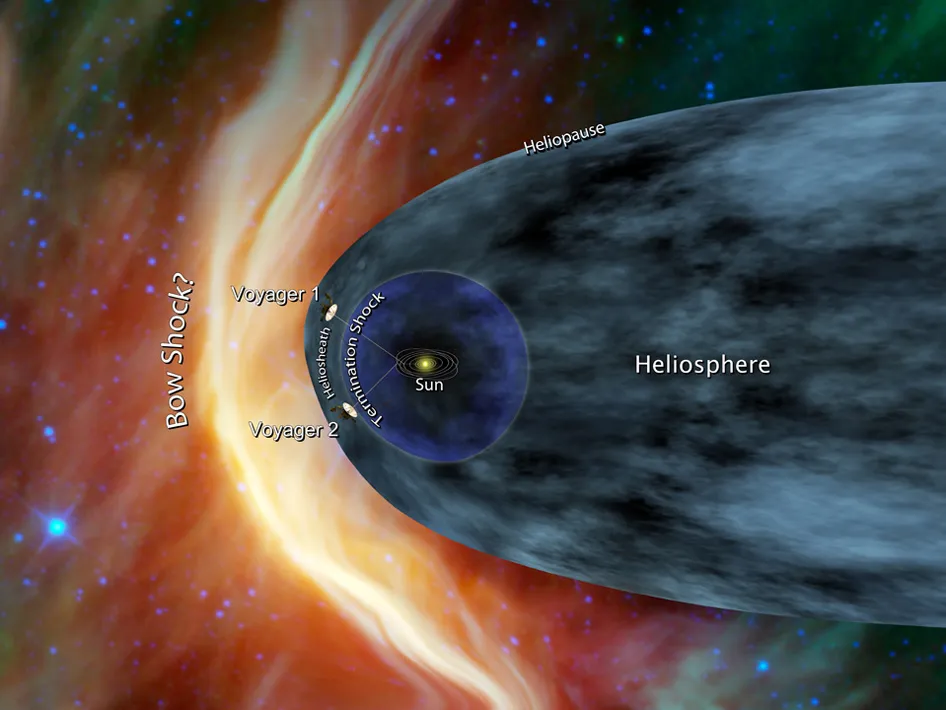
Voyager 2 was launched in 1977 just 16 days before its twin, Voyager 1. The probes were tasked chiefly with studying Saturn, Jupiter and the gas giants' moons, but have continued on through the solar system and are now about to cross into interstellar space. Voyager 1 is due to cross first, becoming the first manmade object to travel beyond our solar system, and Voyager 2 is not far behind.
"Even 35 years on, our rugged Voyager spacecraft are poised to make new discoveries as we eagerly await the signs that we've entered interstellar space," Ed Stone, Voyager project scientist at the California Institute of Technology in Pasadena, said in an Aug. 20 statement from NASA. "Voyager results turned Jupiter and Saturn into full, tumultuous worlds, their moons from faint dots into distinctive places, and gave us our first glimpses of Uranus and Neptune up-close. We can't wait for Voyager to turn our models of the space beyond our sun into the first observations from interstellar space." [Voyager 2 Still Trekkin' at 35]
Voyager 2 is currently about 9 billion miles (15 billion kilometers) away from the sun, NASA officials said. For the past five years it has been sending back information about the outer layer of the heliosphere, the bubble of charged particles the sun blows around itself. No one really knows how long it will take to get to interstellar space, but NASA officials said the Voyager twins will have enough power to keep communicating with Earth until 2020, possibly 2025. [Photos From NASA's Voyager Probes]
"We continue to listen to Voyager 1 and 2 nearly every day," Suzanne Dodd, Voyager project manager at NASA’s Jet Propulsion Laboratory in Pasadena, Calif., said in NASA's statement. "The two spacecraft are in great shape for having flown through Jupiter’s dangerous radiation environment and having to endure the chill of being so far away from our Sun."
In case the spacecraft encounter any life beyond our solar system, they are each carrying a golden record with a collection of sights and sounds from Earth, including 117 images and greetings in 54 languages, with a variety of natural and human-made sounds like storms, volcanoes, rocket launches, airplanes and animals. The collection was chosen by a committee chaired by the late Cornell University astronomer Carl Sagan.
This story was provided by SPACE.com, a sister site to LiveScience. Follow SPACE.com on Twitter @Spacedotcom. We're also on Facebook and Google+.
Get the world’s most fascinating discoveries delivered straight to your inbox.
