













Image Gallery: Fossilized Turtles Caught in the Act

Mating Turtles
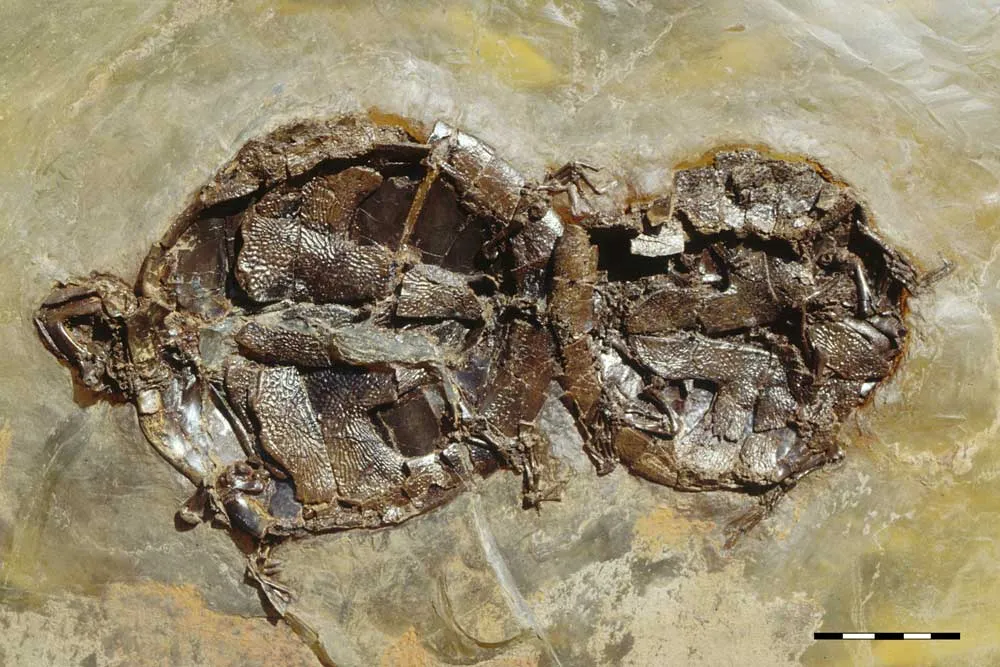
Researchers have discovered nine mating pairs of the extinct turtle Allaeochelys crassesculpta (one pair shown here) at the Messel Pit fossil site in Germany. The male (to the right) is about 20 percent smaller than the female. [Read full story]
Messel Pit

The Messel Pit site in Germany (an oil shale outcropping shown here) was once a deep volcanic crater lake in a wet, tropical environment. The pit was a quarry originally mined for the oil in the shale there; but over the years, it has become the richest site in the world for understanding the living environment of the Eocene, the epoch between 57 million and 36 million years ago when mammals began conquering the planet. [Read full story]
Caught in the Act

A mating pair of the extinct turtle found at Messel Pit. Researchers suspect the turtles died as they were having sex and sinking to deeper layers of the lake where toxic gases were likley present. [Read full story]
Turtle Tales

The short tail of a female specimen of the extinct turtle Allaeochelys crassesculpta found at the Messel Pit fossil site in Germany. The tails of paired turtles were seen aligned with each other. This is the very position in which the tails are held when living turtles mate. [Read full story]
Male Tail

The slightly curled tail of a male specimen of the extinct turtle Allaeochelys crassesculpta found at the Messel Pit fossil site. [Read full story]
Pig-Nosed Turtle

The extinct turtles would have looked very similar to their closest living relative, the pig-nosed turtle (Carettochelys insculpta), shown here, from New Guinea and Australia, just much smaller.
Today's Turtles

The extinct turtle would have mated like today's turtles, including its closest living relative, the pig-nosed turtle.
Get the world’s most fascinating discoveries delivered straight to your inbox.
