 Live Science Plus





You are now subscribed
Your newsletter sign-up was successful
Want to add more newsletters?

Delivered Daily
Daily Newsletter
Sign up for the latest discoveries, groundbreaking research and fascinating breakthroughs that impact you and the wider world direct to your inbox.

Once a week
Life's Little Mysteries
Feed your curiosity with an exclusive mystery every week, solved with science and delivered direct to your inbox before it's seen anywhere else.

Once a week
How It Works
Sign up to our free science & technology newsletter for your weekly fix of fascinating articles, quick quizzes, amazing images, and more

Delivered daily
Space.com Newsletter
Breaking space news, the latest updates on rocket launches, skywatching events and more!

Once a month
Watch This Space
Sign up to our monthly entertainment newsletter to keep up with all our coverage of the latest sci-fi and space movies, tv shows, games and books.

Once a week
Night Sky This Week
Discover this week's must-see night sky events, moon phases, and stunning astrophotos. Sign up for our skywatching newsletter and explore the universe with us!
Join the club
Get full access to premium articles, exclusive features and a growing list of member rewards.
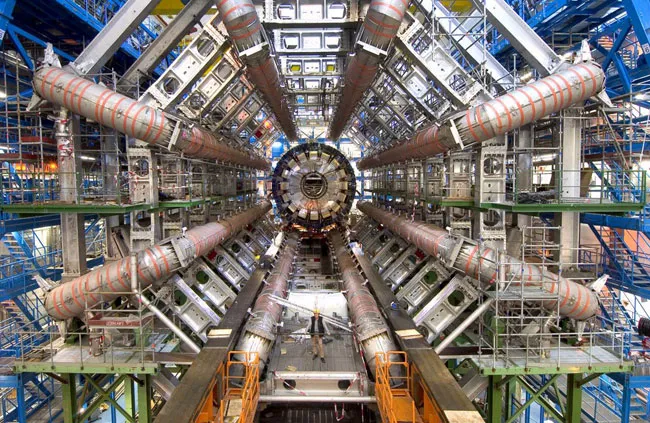
Construction on a cooling system for the world's biggest science experiment that produces temperatures colder than outer space was completed today.
The mammoth chill factory can generate temperatures as low as 1.9 degrees above absolute zero (-456 degrees Fahrenheit) for the Large Hadron Collider (LHC), a circular particle smasher 17 miles (27 kilometers) wide that is being built at the CERN physics laboratory near Geneva, Switzerland.
"This is a huge accomplishment," says LHC project leader Lyn Evans. "Now that it is done, we can concentrate on getting the machine cold and ready for physics."
The LHC is slated to begin operation in May 2008.

