Mystery Fireball in Texas Actually a Jet Contrail, NASA Scientist Says
Get the world’s most fascinating discoveries delivered straight to your inbox.
You are now subscribed
Your newsletter sign-up was successful
Want to add more newsletters?
Delivered Daily
Daily Newsletter
Sign up for the latest discoveries, groundbreaking research and fascinating breakthroughs that impact you and the wider world direct to your inbox.
Once a week
Life's Little Mysteries
Feed your curiosity with an exclusive mystery every week, solved with science and delivered direct to your inbox before it's seen anywhere else.
Once a week
How It Works
Sign up to our free science & technology newsletter for your weekly fix of fascinating articles, quick quizzes, amazing images, and more
Delivered daily
Space.com Newsletter
Breaking space news, the latest updates on rocket launches, skywatching events and more!
Once a month
Watch This Space
Sign up to our monthly entertainment newsletter to keep up with all our coverage of the latest sci-fi and space movies, tv shows, games and books.
Once a week
Night Sky This Week
Discover this week's must-see night sky events, moon phases, and stunning astrophotos. Sign up for our skywatching newsletter and explore the universe with us!
Join the club
Get full access to premium articles, exclusive features and a growing list of member rewards.
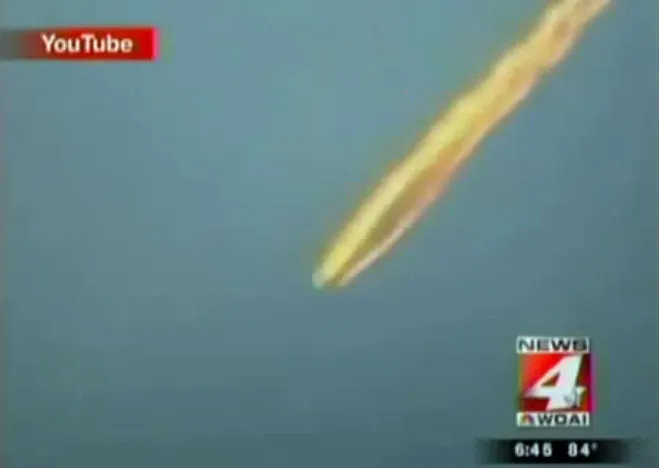
A bright object that streaked across the Texas sky during the day April 4, originally believed to be a meteor burning up as it entered Earth's atmosphere, was actually a flying jet and its contrail, a NASA scientist has confirmed.
Local news stations reported that the bright object was a fireball (an especially bright meteor) and Bill Cooke, head of NASA's Meteoroid Environment Office, initially said it was indeed a fireball, and more evidence of the mysterious and unexplained observation that there are more fireballs in the spring than other times of the year. However, other experts argued that the Texas fireball was actually a jet contrail reflecting the glow of the setting sun, making it appear fiery.
Cooke has agreed. "Reviewing the video, it does appear to be a contrail," he told Life's Little Mysteries. "There were sightings of a daytime meteor April 2 but this video is not of a meteor/fireball. Different event."
The April 2 daytime fireball — a rare event, as a meteor must be at least one yard across for its atmospheric entry to be visible during the day — was seen by thousands of people in New Zealand.
Follow Natalie Wolchover on Twitter @nattyover. Follow Life's Little Mysteries on Twitter @llmysteries and join us on Facebook.
Get the world’s most fascinating discoveries delivered straight to your inbox.
Natalie Wolchover was a staff writer for Live Science from 2010 to 2012 and is currently a senior physics writer and editor for Quanta Magazine. She holds a bachelor's degree in physics from Tufts University and has studied physics at the University of California, Berkeley. Along with the staff of Quanta, Wolchover won the 2022 Pulitzer Prize for explanatory writing for her work on the building of the James Webb Space Telescope. Her work has also appeared in the The Best American Science and Nature Writing and The Best Writing on Mathematics, Nature, The New Yorker and Popular Science. She was the 2016 winner of the Evert Clark/Seth Payne Award, an annual prize for young science journalists, as well as the winner of the 2017 Science Communication Award for the American Institute of Physics.