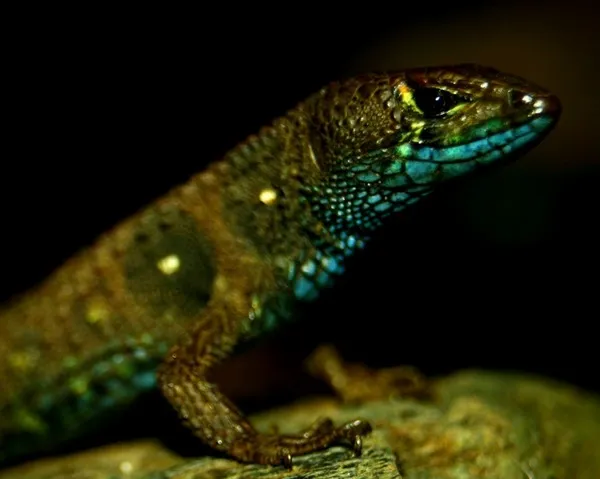
Researchers have discovered a new species of lizard in a strange place. The brightly colored, water-loving lizards live in the Andes Mountains in southern Peru — an odd place to find them, scientists say, because of the chilly conditions.
The semi-aquatic reptiles, dubbed Potamites montanicola, grow to about 2.5 inches (6.4 centimeters) in length from nose to hindquarters. Because lizards are not warm-blooded, scientists are wondering how they survive the alpine settings.
The newfound lizards proved elusive quarry. In August 2010, researchers found a single specimen near a wooded mountain stream. From the moment he saw it, lead researcher Germán Chávez said, he knew the little lizard must be a new species, because it looked so different from other lizards in the Potamites genus.
The find kicked off a feverish hunt for more specimens. Chávez and his collaborators searched at similar elevations, in mountain forests between 5,000 and 7,000 feet (1,570 and 2,100 meters). [World's Tiniest Chameleon Discovered]
Field conditions - it was dark - made it difficult to capture the lizards' colors on camera.
(Image credit: Germán Chávez.)
Three months later, in November, near another forested mountain stream about 40 miles (64 kilometers) from the original sighting, they hit the jackpot.
"During the day we didn't find any, but at night we found several individuals, males and females, running and swimming in the stream," Chávez told OurAmazingPlanet in an email. "That was a great moment for us."
It was not clear if the tiny creatures are nocturnal, and typically spend their nights running and swimming, or if the researchers simply roused them from sleep, and the lizards were trying to escape, Chávez said.
Sign up for the Live Science daily newsletter now
Get the world’s most fascinating discoveries delivered straight to your inbox.
In fact, whether the creatures are active at night or during the day is only one of the mysteries surrounding the new discovery, according to the study announcing the find, which was recently published in the open access journal ZooKeys.
Chávez said temperatures in the mountains can drop to between 50 and 60 degrees Fahrenheit (10 to 15 degrees Celsius) at night — harsh temperatures for cold-blooded creatures — and it's not clear how the lizards could muster the energy to run or go for a swim in such chilly conditions.
Is that lizard smiling for the camera? A male P. montanicola.
(Image credit: Germán Chávez.)
The home altitudes of P. montanicola are 3,300 feet (1,000 meters) higher — and therefore chillier — than areas frequented by its closest cousins.
"The reptiles here are amazing," Chávez said. "And I can imagine more 'lost places' in the Andes where probably other new species live right now."
He said he plans to continue the search. The fieldwork is often grueling and leaves little time for sleep, "but this is our passion," Chávez said. "I love my job, and things like this are the best reward for us."
Andrea Mustain was a staff writer for Live Science from 2010 to 2012. She holds a B.S. degree from Northwestern University and an M.S. degree in broadcast journalism from Columbia University.