It's quick and easy to access Live Science Plus, simply enter your email below. We'll send you a confirmation and sign you up for our daily newsletter, keeping you up to date with the latest science news.
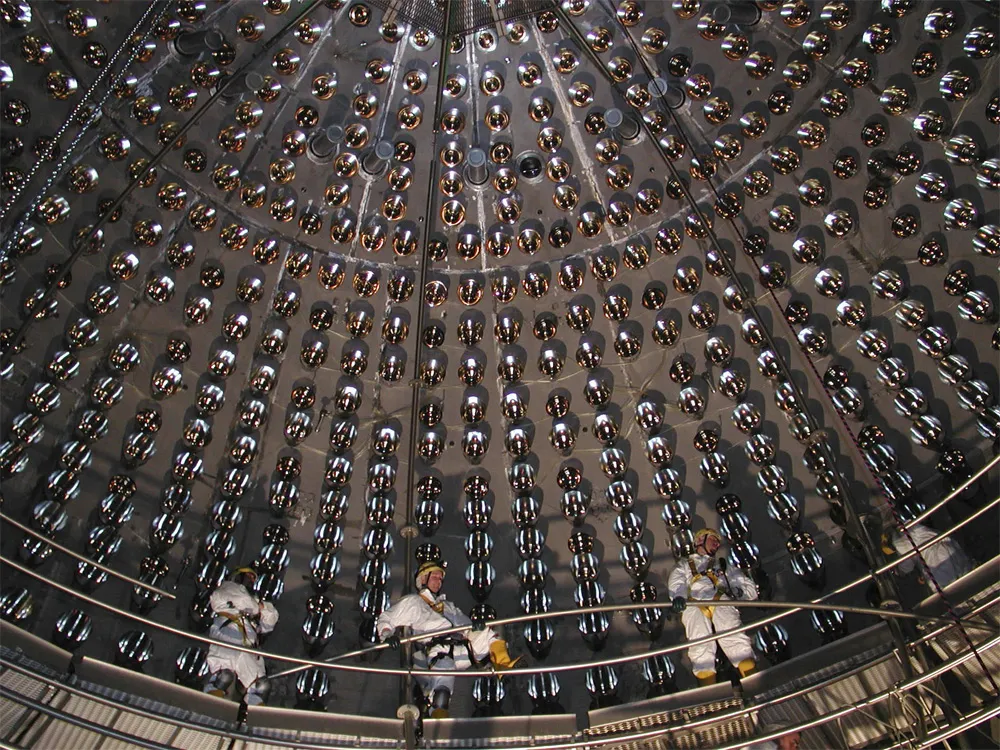
The Gran Sasso National Laboratory of the Italian Institute of Nuclear Physics, located nearly a mile below the surface of the Gran Sasso mountain about 60 miles outside of Rome, detects tiny particles called neutrinos.
The news that particles called neutrinos may travel faster than light has been met with shock, skepticism and excitement from physicists around the world since it was officially announced this morning (Sept. 23).
Scientists at the European Organization for Nuclear Research (CERN) in Geneva, Switzerland, have been running an experiment called OPERA that sends neutrinos 454 miles (730 kilometers) underground to the INFN Gran Sasso Laboratory in Italy. Neutrinos, tiny, almost massless particles that very rarely interact with normal matter, pass straight through the Earth as if it were a vacuum.
The researchers expected neutrinos to make this trip at about light speed, but found instead that they made it more quickly, arriving 60 billionths of a second before a beam of light would.
The discovery seems to contradict one of the most cherished laws of physics, Albert Einstein's special theory of relativity, which states that nothing can travel faster than the speed of light.
"Perplexity would be the first word that comes to mind," said Robert Plunkett of Fermilab in Batavia, Ill. "It's perplexing, fascinating. There's also a certain amount of healthy skepticism. Any result like this will be greeted with the need for confirmation."
Sign up for the Live Science daily newsletter now
Get the world’s most fascinating discoveries delivered straight to your inbox.
Even the OPERA scientists themselves admit that it's too soon to know for sure if the findings will hold up. They presented their results today in a public seminar to invite outside experts to inspect their data and suggest errors they might have overlooked. [Countdown: The Coolest Little Particles in Nature]
"There's nothing obvious they haven't done," said Stephen Parke, head of the theoretical physics department at Fermilab. "They've obviously done many of the checks that people would have hoped to see. They've been pretty thorough, I would say."
"I want to congratulate you for this extremely beautiful experiment," Nobel laureate Samuel Ting of MIT told the researchers after the seminar. "The experiment is very carefully done, with systematic error carefully checked. It's an extremely well-done experiment."
The speed of light has been long known to be the fastest possible speed in our universe. So what do you do when scientists catch subatomic particles traveling faster than light?
(Image credit: Karl Tate, SPACE.com Contributor)
Huge implications
If the neutrinos really are traveling faster than the speed of light, which was thought to be a cosmic speed limit, the consequences would be far-ranging. The theory of relativity itself, and many other theories that rest on it, would need to be revised.
"If this turns out to be correct, there's a lot of rethinking that has to go on, and that's fantastic," Parke told LiveScience. "To the theoretical physics community that's what we like to do best — reinvent the universe every day. If it's correct, I'm going to have a field day writing papers."
The implications could even range to astronomy and our understanding of the universe.
"It is hard to see what aspects of astronomy would not be implicated," astronomer Derek Fox of Pennsylvania State University wrote in an email to LiveScience. "Cosmological models depend on General Relativity being correct on large scales, and this would surely be thrown into doubt."
One of the first orders of business, physicists agree, is to try to confirm or disprove the discovery. One of the best ways to do this is to try to reproduce the OPERA finding at other, similar experiments. The MINOS experiment at Fermilab and the T2K project in Japan also send neutrinos over long distances (though the Japanese stretch is shorter than Fermilab's) and may be able to see the same effect.
MINOS, in fact, did find hints that neutrinos may be traveling faster than light in 2007. Yet the experiment's uncertainty, at that point, was too high to rule out the possibility that the signal was merely a statistical coincidence. But recent and planned upgrades to MINOS should allow that experiment to improve its precision greatly, and researchers there are eager to test the OPERA finding.
"Something like this kind of overcomes the normal scientific rivalries — it's that important," said Plunkett, who is a co-spokesman for MINOS. "We will be following up on this as hard as we can here, and we're in an ideal position to do so."
Follow LiveScience for the latest in science news and discoveries on Twitter @livescienceand on Facebook.
Clara has a bachelor's degree in astronomy and physics from Wesleyan University, and a graduate certificate in science writing from the University of California, Santa Cruz. She has written for both Space.com and Live Science.

 Live Science Plus