 Live Science Plus





You are now subscribed
Your newsletter sign-up was successful
Want to add more newsletters?

Delivered Daily
Daily Newsletter
Sign up for the latest discoveries, groundbreaking research and fascinating breakthroughs that impact you and the wider world direct to your inbox.

Once a week
Life's Little Mysteries
Feed your curiosity with an exclusive mystery every week, solved with science and delivered direct to your inbox before it's seen anywhere else.

Once a week
How It Works
Sign up to our free science & technology newsletter for your weekly fix of fascinating articles, quick quizzes, amazing images, and more
Delivered daily
Space.com Newsletter
Breaking space news, the latest updates on rocket launches, skywatching events and more!

Once a month
Watch This Space
Sign up to our monthly entertainment newsletter to keep up with all our coverage of the latest sci-fi and space movies, tv shows, games and books.

Once a week
Night Sky This Week
Discover this week's must-see night sky events, moon phases, and stunning astrophotos. Sign up for our skywatching newsletter and explore the universe with us!
Join the club
Get full access to premium articles, exclusive features and a growing list of member rewards.
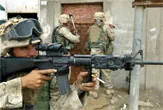
The most powerful nations failed to achieve their objectives in 39 percent of their military operations since World War II, according to a new study that bodes ill for American hopes of winning the war in Iraq.
Victory in any conflict hinges on getting the population of the adversary on your side, the study showed. Driving Saddam Hussein’s army out of Kuwait in the 1991 Gulf War and overthrowing his government in 2003 worked by brute force, said study leader Patricia L. Sullivan in the School of Public and International Affairs at the University of Georgia. But quelling sectarian violence in Iraq today would require "target compliance." “We can try to use brute force to kill insurgents and terrorists, but what we really need is for the population to be supportive of the government and to stop supporting the insurgents,” Sullivan said today. “Otherwise, every time we kill an insurgent or a terrorist, they’re going to be replaced by others.” The war in Iraq has a probability of success of about 26 percent with an estimated duration of 10 years, according to Sullivan's model. Sullivan analyzed all 122 post World War II wars and military interventions in which the United States, the Soviet Union, Russia, China, Britain or France fought a weaker adversary. She examined factors such as the type of objective, whether the target was a formal state or a guerilla or terrorist group, whether the target had an ally, and whether the more powerful nation had an ally. The model was accurate in 80 percent of conflicts. It predicted a 7 percent chance of success for the Soviets in the 1979 to 1988 war in Afghanistan and a 93 percent chance of success for the U.S. in the 1991 Gulf War. Previous researchers have hypothesized that more powerful states fail because of poor strategy choices or a lack of resolve. Sullivan agreed that those factors play a role, but the support of a population is also required. “No one could have predicted exactly what would happen after we overthrew the regime of Saddam Hussein ,” Sullivan said. “But what my model could say was that if the population was not supportive of whatever new regime we put in power and the American strategic objective shifted from regime removal to maintaining the authority of a new government, the likelihood of a successful outcome would drop from almost 70 percent to just under 26 percent.” The research, detailed in the June issue of the Journal of Conflict Resolution, was supported by grants from the National Science Foundation and the Institute on Global Conflict and Cooperation.
- Top 10 Battles for Control of Iraq
- 400 Years of War Records Now Online
- Soldiers in Iraq Need More Silly String

