













Facial Expressions Develop in the Womb

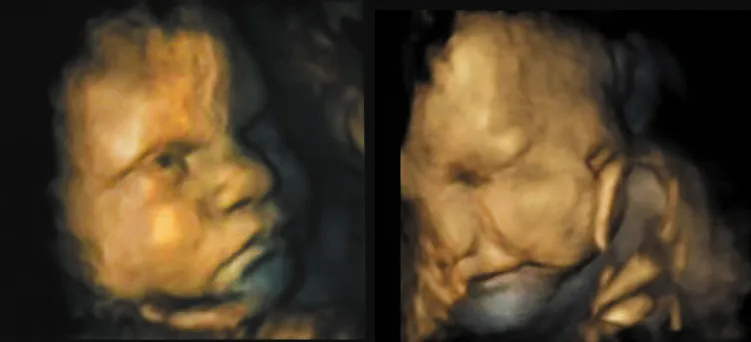
Before he or she is born, a fetus begins to move his or her face — parting lips, wrinkling a nose or lowering a brow for example — making movements that, when combined, will one day assemble expressions we all recognize in one another. A new study has shown that, as the fetus develops, these facial motions become increasingly complex.
While it was known that fetuses could form expressions while in the womb, this study tracked facial movements over time.
"What we have found for the first time is you can look at the progression of the complexity of the movements," said lead study researcher Nadja Reissland, a senior lecturer at the University of Durham in the United Kingdom.
By capturing images of two fetuses periodically from 24 to about 35 weeks of gestation, the researchers watched individual, unrelated movements progress to complex combinations, associated with recognizable facial expressions. [See images of fetal facial expressions]
In addition to tracking 19 total facial movements, the study focused on sets of movements associated with two expressions, one associated with crying, the other laughing. Over time, the movements associated with these began to appear in more complex combinations.
They used 4-D ultrasound images, which resemble video, to track the facial motions of two female fetuses.
At 24 weeks, fetuses were more likely to make a single movement, like a widening of the lips for example, all by itself. Then, as the weeks passed, they began combining the movements, putting, say, a lip widening movement with a nose wrinkle. By about 35 weeks, combinations of three and four movements associated with the two expressions had surpassed single or double movements. A similar trend occurred when the researchers looked at all 19 movements.
Get the world’s most fascinating discoveries delivered straight to your inbox.
Reissland pointed out that these facial movements don't mean the fetuses were experiencing emotion.
"We can see the expressions which we can recognize; we can't say whether the fetus has emotion," she said. "They [don't] have yet the cognition necessary to have the emotions." [Smiles Are Innate, Not Learned]
Rather, these motions are likely a form of practice, as the fetuses prepare to enter the social world, where they must form bonds with others. Fetuses also suck their thumbs in the womb and make breathing motions, both precursors for important activities once they are born, she said.
For future research, Reissland is interested in looking for other fetal facial expressions associated with anger, smiling and sadness. This study appeared Aug. 31 in the journal PLoS ONE.
You can follow LiveScience writer Wynne Parry on Twitter @Wynne_Parry. Follow LiveScience for the latest in science news and discoveries on Twitter @livescience and on Facebook.
