













Flurry of Earthquakes in Peru, Virginia & Colorado Not Connected

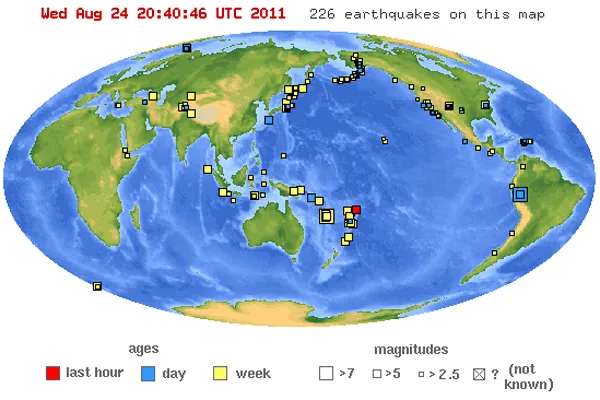
The magnitude 7.0 earthquake in northern Peru today (Aug. 24) was the third major temblor to shake the Americas in less than 48 hours. A magnitude 5.8 quake hit Virginia yesterday, and a magnitude 5.3 event rumbled under Colorado the day before.
One might naturally wonder if there's a trend here — if the Peru, Colorado and Virginia earthquakes are connected. But experts say there isn't, and they aren't.
"The question comes up all the time," said David Schwartz, an earthquake geologist with the U.S. Geological Survey (USGS), "but these three earthquakes are completely unrelated."
According to Schwartz, although an earthquake can shake a neighboring fault line to cause a cascade of additional quakes, the seismic events in Colorado and Virginia were too small to trigger others at great distances.
"If they're going to affect another fault, it's going to be something that's very close," he said. "If tomorrow there was a larger earthquake in Virginia, say, with an epicenter 20 miles from the epicenter of yesterday's earthquake, then you could start looking into cause and effect — into how yesterday's quake might have changed the stress and triggered another fault. But having these events so far apart and in different geologic settings: there's no cause and effect."
Sometimes very large earthquakes (with magnitudes around 9.0) can send seismic waves rippling around the globe, triggering quakes elsewhere, Schwartz explained. But weaker waves such as those from the Colorado and Virginia earthquakes dampen too quickly to have far-reaching consequences. [Bogus Claim: Japan Earthquake Won't Trigger a Mega California Quake]
Earthquakes happen all the time, as seen on the USGS world map of recent earthquakes. Some people are only reminded of this fact when an unusual earthquake makes the news, Schwartz said. When that happens, they start paying closer attention to the seismic events that follow it, and may sometimes draw connections where there aren't any.
Get the world’s most fascinating discoveries delivered straight to your inbox.
This article was provided by Life's Little Mysteries, a sister site to Live Science. Follow us on Twitter @llmysteries, then join us on Facebook. Follow Natalie Wolchover on Twitter @nattyover.

Natalie Wolchover was a staff writer for Live Science from 2010 to 2012 and is currently a senior physics writer and editor for Quanta Magazine. She holds a bachelor's degree in physics from Tufts University and has studied physics at the University of California, Berkeley. Along with the staff of Quanta, Wolchover won the 2022 Pulitzer Prize for explanatory writing for her work on the building of the James Webb Space Telescope. Her work has also appeared in the The Best American Science and Nature Writing and The Best Writing on Mathematics, Nature, The New Yorker and Popular Science. She was the 2016 winner of the Evert Clark/Seth Payne Award, an annual prize for young science journalists, as well as the winner of the 2017 Science Communication Award for the American Institute of Physics.