













In Photos: A Lion's Life
In Photos: A Lion's Life

One of the most majestic and regal feline species, the African lion (Panthera leo) resides in parts of sub-Saharan Africa, from the southern fringe to northern South Africa. A small number of Asian lions can also be found in the Gir Forest of northwest India. Since the 1950s, the African lion population has been reduced by half. Today, fewer than 22,600 remain in all of Africa, according to the conservation group Defenders of Wildlife.
Family Pride

Lions are the most social felines, and the only cats that live in groups. Called prides, these groups usually consist of 15 or more lions. However, prides can be as small as three or as big as 40 members. The lionesses in prides are related, and each pride has one to three resident males. Although most female lions are known to stick with one pride for their entire lives, young males often leave the group to establish their own prides.
A Monster of a Yawn

Because lions are most active at night, they spend up to 70 percent of the day conserving energy by resting or sleeping.
Lion Around

Lions prefer to pass the scorching, sunny African days cooling off in trees or lounging beneath the shade of dense vegetation.
A Lion King and His Queen

In the wild, male African lions seldom live longer than females. While the lionesses live for 15 to 18 years, the male life span is an average of 10 years. Lions are not known to have any particular mating season and will mate throughout the year.
Motherly Love

A lioness will give birth to a litter of one to four cubs in a secluded den that is usually located away from the rest of the pride. She will return to the group with her cubs when they are about 6 to 8 weeks old. Lion cubs are born with a lightly spotted coat and bright blue eyes. The leopard-like spots fade as they mature and disappear when they are 6 to 9 months old, and their eyes eventually change to a permanent golden hue.
A Roaring Good Time

A lion's roar can be heard from more than 5 miles (8 kilometers) away! Both male and female lions roar, with cubs beginning to roar at about age 1. Sometimes, an entire pride will partake in a roaring chorus. At dusk, a male lion will usually let loose a thunderous roar to alert members of his pride that they should gather together and to also warn intruders to stay away from his territory.
Get the world’s most fascinating discoveries delivered straight to your inbox.
On the Prowl

In prides, the lionesses do most of the hunting, which they primarily do after dusk. They sneak up on their prey as a group, carefully closing in on the animal from various angles. They then quickly run in short bursts of speed and attack the prey.
Hungry Beast

Once the prey is surrounded, the lions strike, often killing it by strangulation. Although females are the primary hunters, males will sometimes join in on a hunt.
Lioness Kills
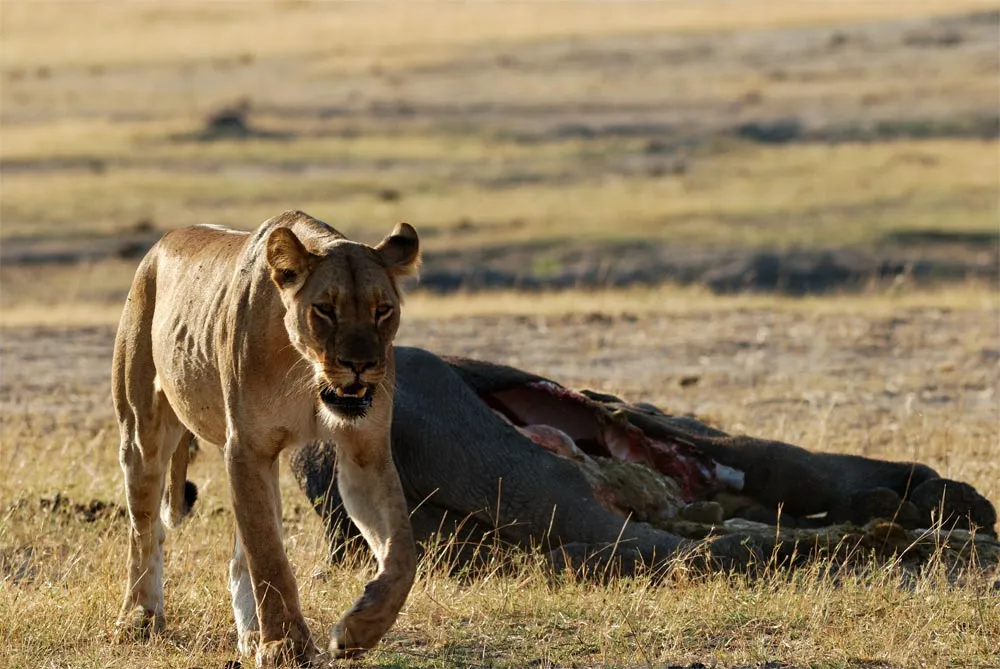
A lioness leaving an elephant carcass; researchers have found lionesses often leave the scenes of their crimes since prey are likely on high alert.
Thirsty Kitty

Lions lap up water in the same endearing fashion as other felines.