It's quick and easy to access Live Science Plus, simply enter your email below. We'll send you a confirmation and sign you up for our daily newsletter, keeping you up to date with the latest science news.
A newly discovered mushroom species "lives in the rain forest, under a tree," and researchers say it's nearly as strange as its SpongeBob SquarePants namesake.
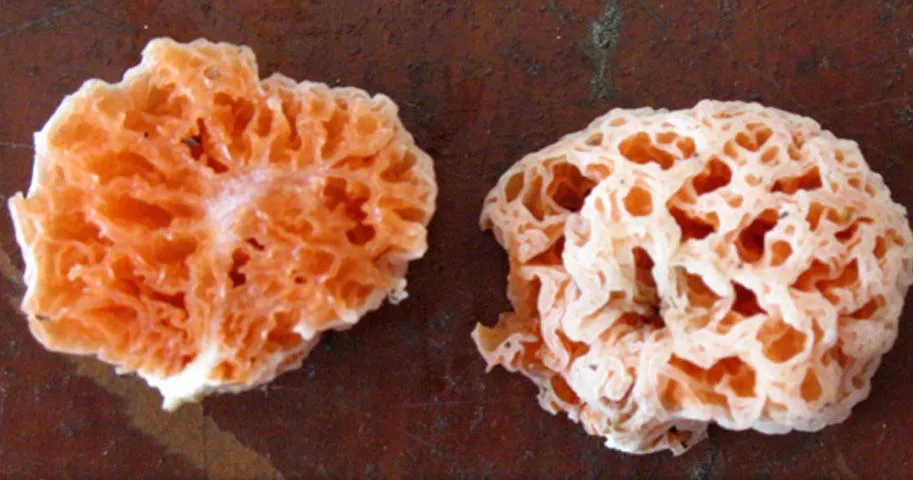
Shaped like a sea sponge, the bright orange (and sometimes purple) mushroom, Spongiforma squarepantsii, was discovered in the forests of Sarawak, Malaysia, on the island of Borneo in 2010, and just described in May in the journal Mycologia.
The fungus has a particular odor, smelling "vaguely fruity or strongly musty," according to Dennis Desjardin of San Francisco State University. [Image of funky mushroom]
Desjardin and his colleagues looked at the sponge under a high-powered scanning electron microscope. They found the spore-producing area of the fungus looks like a seafloor carpeted in tube sponges, without the cap and stem found in supermarket varieties. (Fungi like mushrooms and toadstools reproduce with tiny spores, which for mushrooms tend to reside in the cap.)
Here, a scanning electron microscope image of the spores from the newly discovered SpongeBob mushroom.
(Image credit: Dennis Desjardin and Andrew Ichimura, San Francisco State University)
"It's just like a sponge with these big hollow holes," Desjardin said. "When it's wet and moist and fresh, you can wring water out of it and it will spring back to its original size. Most mushrooms don’t do that."
The cap and stem design is an elegant evolutionary solution to a fungal problem. The stem lifts a fungus' reproductive spores off the ground so that they can be dispersed more easily by wind and passing animals, while the cap protects the spores from drying out in their lofty but exposed position.
In its humid home, S. squarepantsii has taken a different approach to keeping its spores wet. "It's become gelatinous or rubbery," Desjardin said. "Its adaptation is to revive very quickly if it dries out, by absorbing very small amounts of moisture from the air."
Sign up for the Live Science daily newsletter now
Get the world’s most fascinating discoveries delivered straight to your inbox.
Their close examination along with genetic analyses of the mushroom revealed that it was a different species from the other member of the Spongiforma genus. The other species is found in central Thailand, and differs in color and odor.
Follow LiveScience for the latest in science news and discoveries on Twitter @livescience and on Facebook.
For the science geek in everyone, Live Science offers a fascinating window into the natural and technological world, delivering comprehensive and compelling news and analysis on everything from dinosaur discoveries, archaeological finds and amazing animals to health, innovation and wearable technology. We aim to empower and inspire our readers with the tools needed to understand the world and appreciate its everyday awe.

 Live Science Plus