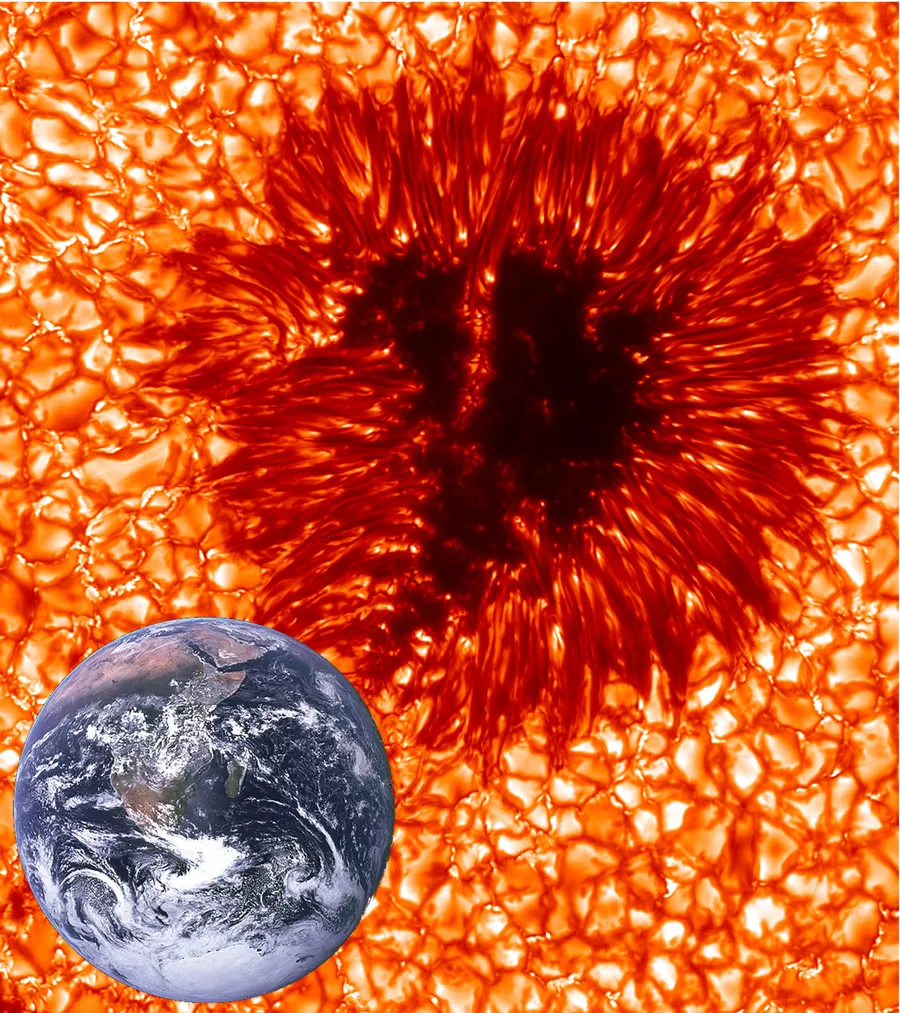
An image of the sunspot with the Earth shown to scale. The image has been colorized for aesthetic reasons. This image with 0.1 arcsecond resolution from the Swedish 1-m Solar Telescope represents the limit of what is currently possible in terms of spatial resolution.
(Image credit: The Royal Swedish Academy of Sciences, V.M.J. Henriques (sunspot), NASA Apollo 17 (Earth))
By gazing at the edges of sunspots, astronomers now are pinpointing key details of how these mysterious dark marks form.
Sunspots are blotches on the sun that appear dark because they are cooler than the rest of the solar surface. Astronomers do know they are linked to intense magnetic activity on the sun, which can suppress the flow of hot matter, but much about their structure and behavior remains enigmatic.
The dark heart of a sunspot, called the umbra, is surrounded by a brighter edge known as the penumbra, which is made of numerous dark and light filaments more than 1,200 miles (2,000 kilometers) long. They are relatively thin, at approximately 90 miles (150 km) in width, making it difficult to resolve details that could reveal how they arise.
Now scientists have discovered these columns are rapid downflows and upflows of gas, matching recent theoretical models and computer simulations suggesting these filaments are generated by the movement of hot and cold gases known as convective flow. [Photos: Sunspots on Earth's Closest Star]
The researchers used the Swedish 1-meter Solar Telescope to focus on a sunspot on May 23, 2010. They found dark downflows of more than 2,200 miles per hour (3,600 kph) and bright upflows of more than 6,600 miles per hour (10,800 kph). The models suggest that columns of hot gas rise up from the interior of the sunspot, widen, cool and then sink downward while rapidly flowing outward.
Map of velocities in the sunspot as measured using the Doppler effect. Blue implies that the gas is moving towards us - this corresponds to an upward motion on the solar surface. Red implies that the gas is moving away from us - this corresponds to a downward motion on the solar surface. The net-like pattern surrounding the sunspot is solar granulation. The field of view corresponds to 24000 km on the sun.
(Image credit: The Royal Swedish Academy of Sciences, G.B. Scharmer, V.M.J. Henriques, D. Kiselman, J. de la Cruz Rodriguez)
"This is what we have been expecting to find, but we were maybe surprised about actually succeeding in seeing these flows," researcher Göran Scharmer, a solar physicist at the Royal Swedish Academy of Sciences and Stockholm University in Sweden, told SPACE.com.
In the future, the researchers hope to also measure the magnetic fields linked with these flows to learn more about how they cause such activity.
Sign up for the Live Science daily newsletter now
Get the world’s most fascinating discoveries delivered straight to your inbox.
The scientists detailed their findings in a paper published online June 2 in the journal Science.
This story was provided by SPACE.com, a sister site to LiveScience. Follow SPACE.com contributor Charles Q. Choi on Twitter @cqchoi. Visit SPACE.com for the latest in space science and exploration news on Twitter @Spacedotcom and on Facebook.
Charles Q. Choi is a contributing writer for Live Science and Space.com. He covers all things human origins and astronomy as well as physics, animals and general science topics. Charles has a Master of Arts degree from the University of Missouri-Columbia, School of Journalism and a Bachelor of Arts degree from the University of South Florida. Charles has visited every continent on Earth, drinking rancid yak butter tea in Lhasa, snorkeling with sea lions in the Galapagos and even climbing an iceberg in Antarctica.