 Live Science Plus


You are now subscribed
Your newsletter sign-up was successful
Want to add more newsletters?

Delivered Daily
Daily Newsletter
Sign up for the latest discoveries, groundbreaking research and fascinating breakthroughs that impact you and the wider world direct to your inbox.

Once a week
Life's Little Mysteries
Feed your curiosity with an exclusive mystery every week, solved with science and delivered direct to your inbox before it's seen anywhere else.

Once a week
How It Works
Sign up to our free science & technology newsletter for your weekly fix of fascinating articles, quick quizzes, amazing images, and more

Delivered daily
Space.com Newsletter
Breaking space news, the latest updates on rocket launches, skywatching events and more!

Once a month
Watch This Space
Sign up to our monthly entertainment newsletter to keep up with all our coverage of the latest sci-fi and space movies, tv shows, games and books.

Once a week
Night Sky This Week
Discover this week's must-see night sky events, moon phases, and stunning astrophotos. Sign up for our skywatching newsletter and explore the universe with us!
Join the club
Get full access to premium articles, exclusive features and a growing list of member rewards.
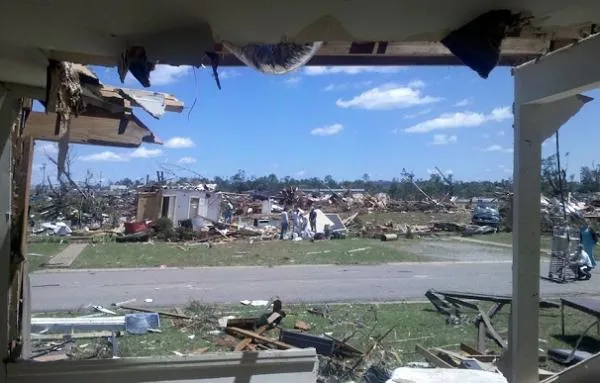
The tornado that stormed through Joplin, Mo., on May 22 shredded an estimated 8,000 buildings and stranded desperate families that now must decide whether to rebuild or find a new home. For those choosing to rebuild, Rima Taher, an expert on wind-resistant structures, has a bit of advice: don't do it the old way.
"You wonder why we keep doing the same things, making the same buildings," Taher told InnovationNewsDaily.
By analyzing debris from hurricanes, Taher has come up with a set of guidelines for building new homes in areas prone to extreme weather. [Read More: Why Aren't There Tornado Safety Building Codes?]
"There are similar problems. So, what usually works for tornadoes would work for hurricanes," Taher said.
When wind hits, the roof provides the most critical defense. But during a hurricane or a tornado, the roof is often the first to go. Taher found that increasing the number of slopes on a roof improves the aerodynamics of the structure and greatly reduces the amount of pressure exerted on it. She recommended building a roof with at least four slopes, rather than a traditional gable roof that has only two.
As wind swirls around a house, it can push on the roof from both the inside and outside. Taher suggested installing a moveable flap close to the seam of the roof. During hurricanes and tornadoes, the flap would open, stabilizing the air pressure. In hot weather, the flap would provide ventilation.
Taher also recommended spending a bit of extra money on hurricane clips that attach the roof more firmly to the walls than nails or staples alone.
Researchers at the Center for Building Science and Technology in France tested the recommendations by placing wooden models in a wind tunnel and used the results to design a "cyclonic home" that has twice the wind resistance a traditional home.
Moreover, most of the suggestions are simple to execute and well worth the investment.
"A lot of the things we suggest don't really cost a lot of money. The expense is really minimal compared to the benefits," Taher said.
This story was provided by InnovationNewsDaily, a sister site to LiveScience. Follow InnovationNewsDaily on Twitter @News_Innovation, or on Facebook.
