 Live Science Plus






Research in Action: Sun Mystery Explained
You are now subscribed
Your newsletter sign-up was successful
Want to add more newsletters?

Delivered Daily
Daily Newsletter
Sign up for the latest discoveries, groundbreaking research and fascinating breakthroughs that impact you and the wider world direct to your inbox.

Once a week
Life's Little Mysteries
Feed your curiosity with an exclusive mystery every week, solved with science and delivered direct to your inbox before it's seen anywhere else.

Once a week
How It Works
Sign up to our free science & technology newsletter for your weekly fix of fascinating articles, quick quizzes, amazing images, and more

Delivered daily
Space.com Newsletter
Breaking space news, the latest updates on rocket launches, skywatching events and more!

Once a month
Watch This Space
Sign up to our monthly entertainment newsletter to keep up with all our coverage of the latest sci-fi and space movies, tv shows, games and books.

Once a week
Night Sky This Week
Discover this week's must-see night sky events, moon phases, and stunning astrophotos. Sign up for our skywatching newsletter and explore the universe with us!
Join the club
Get full access to premium articles, exclusive features and a growing list of member rewards.
This Research in Action article was provided to LiveScience in partnership with the National Science Foundation.
One of the most enduring mysteries in solar physics is why the sun's outer atmosphere, or corona, is millions of degrees hotter than its surface.
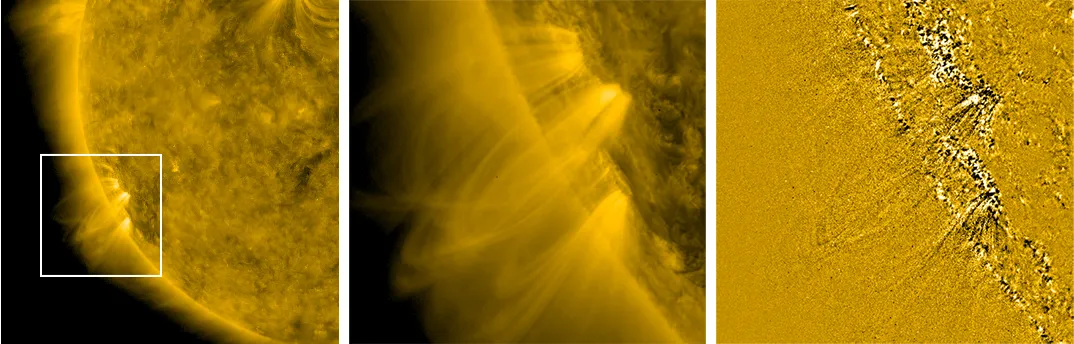
Now scientists believe they have discovered a major source of hot gas that replenishes the corona: jets of plasma shooting up from just above the sun's surface.
The finding addresses a fundamental question in astrophysics: how energy is moved from the sun's interior to create its hot outer atmosphere.
"It's always been quite a puzzle to figure out why the sun's atmosphere is hotter than its surface," says Scott McIntosh, a solar physicist at the High Altitude Observatory of the National Center for Atmospheric Research (NCAR) in Boulder, Colo., who was involved in the study.
"By identifying that these jets insert heated plasma into the sun's outer atmosphere, we can gain a much greater understanding of that region and possibly improve our knowledge of the sun's subtle influence on the Earth's upper atmosphere," McIntosh says.
The research, results of which are published in the journal Science, was conducted by scientists from Lockheed Martin's Solar and Astrophysics Laboratory (LMSAL), NCAR and the University of Oslo. It was supported by NASA and the National Science Foundation (NSF), NCAR's sponsor.
"These observations are a significant step in understanding observed temperatures in the solar corona," says Rich Behnke of NSF's Division of Atmospheric and Geospace Sciences, which funded the research.
"They provide new insight about the energy output of the sun and other stars" says Behnke who explains that "the results are also a great example of the power of collaboration among university, private industry and government scientists and organizations."
The research team focused on jets of plasma known as spicules, which are fountains of plasma propelled upward from near the surface of the sun into the outer atmosphere.
Any opinions, findings, and conclusions or recommendations expressed in this material are those of the author and do not necessarily reflect the views of the National Science Foundation. See the Research in Action archive.
