 Live Science Plus


You are now subscribed
Your newsletter sign-up was successful
Want to add more newsletters?

Delivered Daily
Daily Newsletter
Sign up for the latest discoveries, groundbreaking research and fascinating breakthroughs that impact you and the wider world direct to your inbox.

Once a week
Life's Little Mysteries
Feed your curiosity with an exclusive mystery every week, solved with science and delivered direct to your inbox before it's seen anywhere else.

Once a week
How It Works
Sign up to our free science & technology newsletter for your weekly fix of fascinating articles, quick quizzes, amazing images, and more
Delivered daily
Space.com Newsletter
Breaking space news, the latest updates on rocket launches, skywatching events and more!

Once a month
Watch This Space
Sign up to our monthly entertainment newsletter to keep up with all our coverage of the latest sci-fi and space movies, tv shows, games and books.

Once a week
Night Sky This Week
Discover this week's must-see night sky events, moon phases, and stunning astrophotos. Sign up for our skywatching newsletter and explore the universe with us!
Join the club
Get full access to premium articles, exclusive features and a growing list of member rewards.
A robotic balloon with a science mission recently set records for distance and duration in a 41-day flight above the Antarctic.
The NASA-operated balloon flew circles around the South Pole while gathering data on cosmic rays, high-energy particles that travel at nearly light-speed and slam into Earth's upper atmosphere.
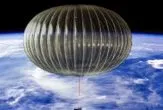
Artist rendering of the Ultra-Long Duration Balloon, expected to fly for 100 days. Credit: NASA
Team members are aiming for eventual flights that could last 100 days with a next-generation, pumpkin-shaped balloon called the Ultra-Long Duration Balloon.
The helium-filled balloon was launched from the National Science Foundation's McMurdo Station in Antarctica on Dec. 16. It traveled 41 days, 22 hours, landing on Jan. 27. The previous record for a pilotless balloon flight was 31 days, 20 hours, also an Antarctic effort, in 2001.
The balloon is made of thin polyethylene material, about the same thickness as Saran Wrap. It soared to 23.7 miles (38,100 meters).
To pack the weight of the 4,000-pound detection facility, a huge balloon was needed. It is bigger than a football field -- more than 450 feet (137 meters) wide.
Officials said the test went well and longer flights with more robust science experiments will be planned.
- GlobalFlyer Seeks Round-the-World Record
- The da Vinci Code for Flight
- Image Gallery: The World's Tallest Buildings

