 Live Science Plus





You are now subscribed
Your newsletter sign-up was successful
Want to add more newsletters?

Delivered Daily
Daily Newsletter
Sign up for the latest discoveries, groundbreaking research and fascinating breakthroughs that impact you and the wider world direct to your inbox.

Once a week
Life's Little Mysteries
Feed your curiosity with an exclusive mystery every week, solved with science and delivered direct to your inbox before it's seen anywhere else.

Once a week
How It Works
Sign up to our free science & technology newsletter for your weekly fix of fascinating articles, quick quizzes, amazing images, and more

Delivered daily
Space.com Newsletter
Breaking space news, the latest updates on rocket launches, skywatching events and more!

Once a month
Watch This Space
Sign up to our monthly entertainment newsletter to keep up with all our coverage of the latest sci-fi and space movies, tv shows, games and books.

Once a week
Night Sky This Week
Discover this week's must-see night sky events, moon phases, and stunning astrophotos. Sign up for our skywatching newsletter and explore the universe with us!
Join the club
Get full access to premium articles, exclusive features and a growing list of member rewards.
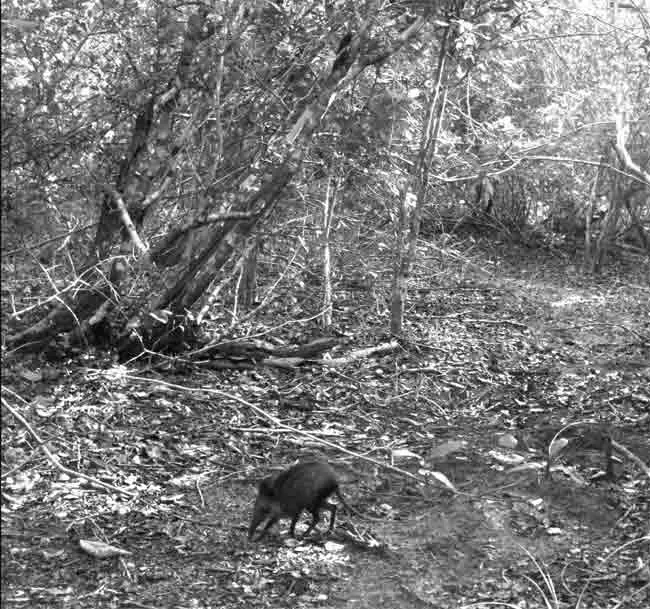
A furry mammal with a trunk-like nose was caught scampering about in a remote African forest. This elephant shrew, a large one, is likely a new species.
Conservationists studying the biodiversity of the Boni-Dodori forest on the coast of northeastern Kenya had set up camera traps there after a scientist had spotted an elephant shrew (also called a sengi) she didn’t recognize.
From the images of the new species, researchers now know the animal has maroon coloring on its sides, shoulders and back, and a lower rump that's jet-black. It's relatively large for an elephant shrew, weighing in at 1.3 pounds (600 grams) with a total length of 22 inches (550 millimeters), and a tail length of about 10 inches (250 mm).
The team, which included the Zoological Society of London (ZSL) and the Kenya Wildlife Service (KWS), will next analyze the animal’s DNA to confirm whether or not it is indeed a new species of elephant shrew.
If it is a new species, that would make 18 species of sengi in the family Macroscelididae (13 species of soft-furred sengi and five species of the giant sengi). All are native to Africa. The animals are more closely related to elephants than shrews, despite being relatively small creatures – ranging from 4 to 12 inches (10 to 30 centimeters) in length and weighing from less than a tenth of a pound to 1.5 pounds (30 to 700 grams).
The peculiar name is a reflection of their long, flexible, trunk-like noses, which they use to search for insect meals. The newly captured animal is a type of giant sengi, which have patterned coats and other distinct features from the smaller sengis.
"With their ancient and often misunderstood ancestry, their monogamous mating strategies, and their charismatic flexible snouts, they are captivating animals," study researcher Galen Rathbun from the California Academy of Sciences said in a statement.
In 2008, Rathbun announced another new species of giant sengi caught in the forests of Tanzania. Its weight gave this animal away: "From the moment I first lifted one of the animals into our photography tent, I knew it must be a new species — not just because of its distinct coloring, but because it was so heavy," Rathbun said in 2008 of that discovery.
