















Legendary 'Yeti' Galaxy Finally Discovered Behind a Shroud of Cosmic Dust
The monster galaxy's "footprints" were hiding in plain sight.

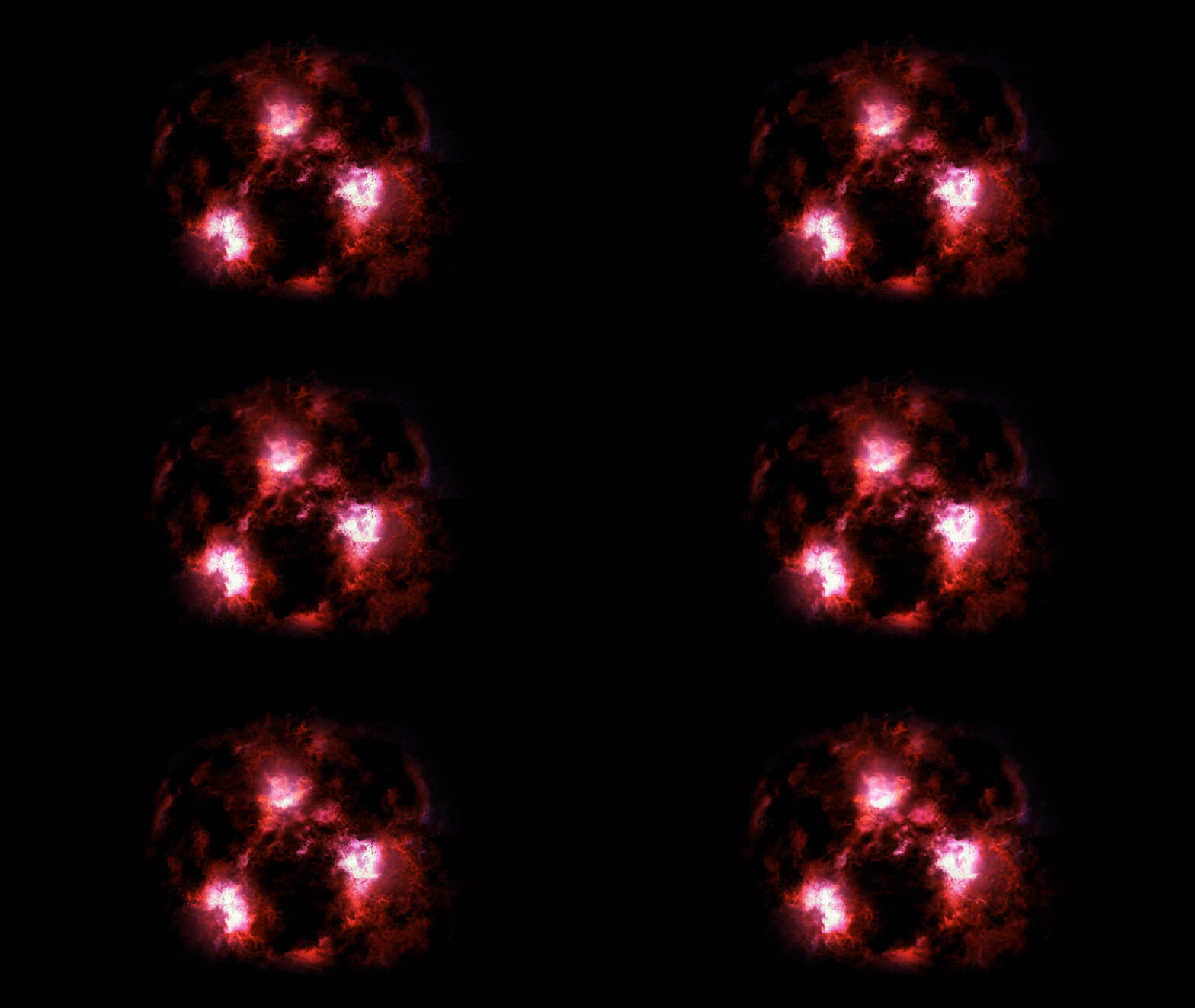
Researchers have captured the first images of a "monster galaxy" as elusive as the mythical, monstrous yeti: an enormous, hidden galaxy churning out stars at a rate 100 times greater than that of the Milky Way.
Massive galaxies like this one were long suspected to have formed in the very young universe. But much like the yeti — the fabled, ape-like giant of the Himalayas that is yet to be found — young versions of these galaxies proved frustratingly difficult to locate, and astronomers searched in vain for signs of them during their rapid growth.
However, scientists recently glimpsed evidence of a youthful galaxy's light as its star-forming illumination glimmered through dust clouds; the discovery was a "serendipitous detection," the researchers reported in a new study. In other words, the astronomers didn't go looking for a cosmic yeti; they found its footprints by accident.
Related: Real or Not? The Science Behind 12 Unusual Sightings
Some of the most massive galaxies in the infant universe are thought to have emerged and grown very quickly, but observations have captured these star-filled beasts only in their mature state. In the new study, the authors described the first baby pictures of one of these so-called monster galaxies, captured during a highly active star-forming period.
The glimmering signal was picked up the Atacama Large Millimeter Array (ALMA), a network of 66 sensitive radio telescopes in Chile's high-altitude Atacama Desert. Dense clouds of cosmic dust in a very small region of the sky cloaked the young galaxy, but ALMA detected faintly glowing pulses of radio light behind the clouds.
"The light seemed not to be linked to any known galaxy at all," said lead study author Christina Williams, a National Science Foundation postdoctoral fellow at the Steward Observatory, part of the University of Arizona's Department of Astronomy.
Get the world’s most fascinating discoveries delivered straight to your inbox.
Since radio waves have the longest wavelengths along the spectrum of electromagnetic radiation, they are the only waves that can travel over very long distances. And because ALMA only picked up radio signals from this galaxy, researchers concluded that the object is quite a distance away.
"When I saw [that] this galaxy was invisible at any other wavelength, I got really excited because it meant that it was probably really far away and hidden by clouds of dust," Williams said in a statement.
How far away? About 12.5 billion light-years from Earth, or about a billion years after the universe emerged from the Big Bang, the researchers reported.
"We figured out that the galaxy is actually a massive monster galaxy with as many stars as our Milky Way, but brimming with activity, forming new stars at 100 times the rate of our own galaxy," said study co-author Ivo Labbé, an associate professor in the Centre for Astrophysics and Supercomputing at the Swinburne University of Technology in Melbourne, Australia.
Astronomers' views of hidden "cosmic yetis" like this one could soon dramatically improve with the launch of the James Webb Space Telescope (JWST) in 2021, Williams said in the statement. This large, infrared observatory will carry cameras and spectrometers capable of detecting very faint signals, such as those from dust-masked ancient galaxies, according to NASA.
"JWST will be able to look through the dust veil so we can learn how big these galaxies really are and how fast they are growing, to better understand why models fail in explaining them," Williams said.
The new study's findings were published online Oct. 22 in The Astrophysical Journal.
- Mythical Creatures: Beasts That Don't Exist (Or Do They?)
- The 15 Weirdest Galaxies in Our Universe
- In Images: Rising 'Phoenix' Aurora and Starburst Galaxies Light Up the Skies
Originally published on Live Science.

Mindy Weisberger is a science journalist and author of "Rise of the Zombie Bugs: The Surprising Science of Parasitic Mind-Control" (Hopkins Press). She formerly edited for Scholastic and was a channel editor and senior writer for Live Science. She has reported on general science, covering climate change, paleontology, biology and space. Mindy studied film at Columbia University; prior to LS, she produced, wrote and directed media for the American Museum of Natural History in NYC. Her videos about dinosaurs, astrophysics, biodiversity and evolution appear in museums and science centers worldwide, earning awards such as the CINE Golden Eagle and the Communicator Award of Excellence. Her writing has also appeared in Scientific American, The Washington Post, How It Works Magazine and CNN.