













Creating 'universal' transplant organs: New study moves us one step closer.
The technique should work with many organs, as well as blood.

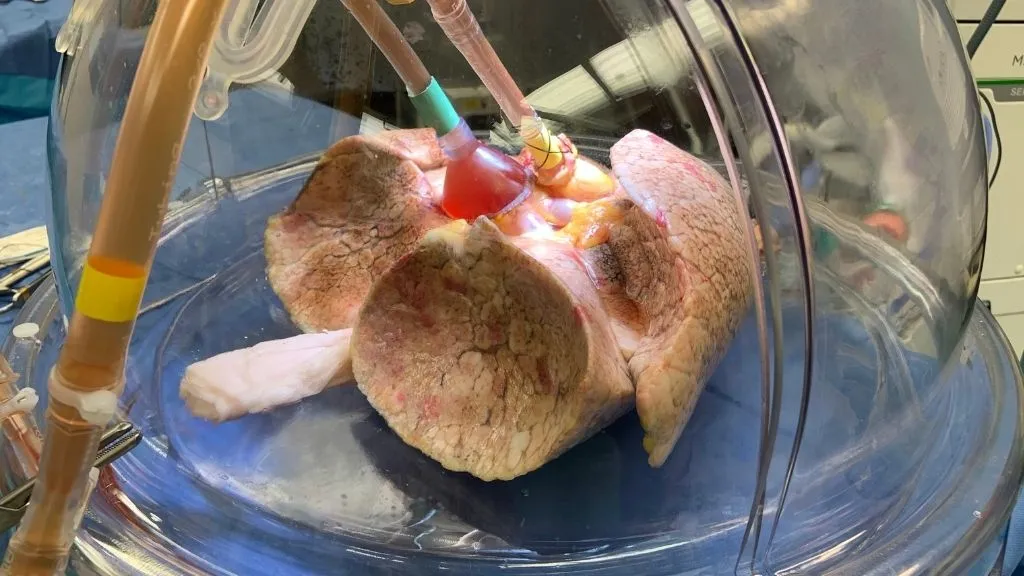
Scientists successfully converted donated lungs into "universal" transplant organs in a proof-of-concept experiment. That means, theoretically, the lungs could be transplanted into any recipient, regardless of their blood type, as long as the organs were the appropriate size.
In the new study, published Wednesday (Feb. 16) in the journal Science Translational Medicine, the researchers ran experiments on the universal lungs in an ex vivo lung perfusion (EVLP) device, which keeps lungs alive outside the body. Within the next year-and-a-half, the study authors plan to test such organs in a clinical trial with human recipients, Dr. Marcelo Cypel, the surgical director of the Ajmera Transplant Centre, a professor of surgery at the University of Toronto and senior author of the study, told Live Science.
The technology could help reduce the number of donated lungs that must be discarded because there's no size-matched and blood-type compatible recipient nearby, said Dr. Richard N. Pierson III, a professor of surgery at Harvard Medical School and the scientific director of the Center for Transplantation Sciences at Massachusetts General Hospital, who was not involved in the study. Organ size and blood type are the primary factors used to match organ donors and recipients.
Related: How long can organs stay outside the body before being transplanted?
In addition, "this would help address the current shortage of O lungs, for O patients the waiting time is longest and the shortage most severe," he told Live Science in an email. Patients with blood type O have a 20% greater risk of dying while waiting for a lung transplant than those with other blood types; they have to wait longer because they cannot accept organs from donors of any other blood type, according to a 2019 report in The Journal of Heart and Lung Transplantation.
"If we could take this barrier out of the allocation system, I think this will … decrease the wait time for patients and also mortality on the waitlist," Cypel said.
From type A to type O
A person's blood type refers to whether or not they have certain sugar molecules, called antigens, on the surface of their red blood cells and on the surfaces of blood vessels in their body. These antigens are known as A and B. People with type A blood have only A antigens, and those with type B blood have only B antigens. Individuals with type AB blood have both; people with type O blood have neither.
Get the world’s most fascinating discoveries delivered straight to your inbox.
While red blood cells and blood vessels carry these antigens, plasma — the clear, fluid portion of blood — contains antibodies that react to specific blood antigens. For example, people with type A blood carry anti-B antibodies in their plasma, so if an "A" individual receives a blood transfusion from a "B" person, their immune system will see that blood as foreign and launch a swift attack.
Similarly, individuals with type O blood carry both anti-A and anti-B antibodies in their plasma, meaning their immune systems attack red blood cells and organs that carry A or B antigens (or both). For this reason, type O organ recipients can only be matched with type O donors, which carry neither A nor B antigens.
But because they're antigen-free, type O organs can actually be placed in any recipient, of any blood type. With such universal organs in high demand, people with type O blood end up spending the longest time on transplant waitlists.
In an effort to address this problem, Cypel reached out to Stephen Withers, a professor of biochemistry at The University of British Columbia. Withers' lab had been working on a method to strip the antigens from A, B and AB red blood cells, essentially to transform the cells into the universal type O. In 2018, the team discovered a group of enzymes in the human gut that could accomplish this feat very efficiently, according to a statement.
"We reached out to them and said, 'We would like to study this to try to convert the whole organ into a universal blood type organ,'" Cypel said. The two groups also collaborated with the University of Alberta for the new study.
Related: Why do we have different blood types?
In the new study, the team applied two enzymes, called FpGalNAc deacetylase and FpGalactosaminidase, to donor lungs from people with type A blood. (The lungs used in the study were unfit for transplantation into patients.) The lungs received this enzymatic treatment while supported on the EVLP device, which kept the lungs at normal body temperature and pumped a solution of nutrients, proteins and oxygen through the organs.
The team found that, by applying the enzymes for four hours, they could eliminate 97% of the A antigens from the lungs. When Cypel and his colleagues use the EVLP device for lung transplantations, they typically leave the organs in the device for about four to five hours, "so that's very clinically applicable," he said.
RELATED CONTENT
The team ran a safety assessment using three pairs of type A lungs. They treated the right-side lungs with the enzymes and left the left-side lungs untreated. After the lungs spent four hours in the EVLP, the team perfused the organs with type O plasma, which carries anti-A and anti-B antibodies, and assessed how the different lungs fared. Specifically, they looked for any signs of "hyperacute rejection," where antibodies promptly latch onto the organ, cause extensive damage and undermine its ability to function.
"We could see that in the lungs that were treated with the enzyme, the lungs performed perfectly well … whereas the lungs that were not treated, they had signs of hyperacute rejection quite quickly," Cypel said.
Now, Cypel and his colleagues have begun preparing a proposal for a clinical trial of the enzyme-treated lungs. In human patients, the team will be able to address questions that cannot be answered by their lab study.
For example, at some point after the transplantation procedure, the cells of treated lungs will likely start producing blood antigens once more, as the organ produces new cells, Cypel said. At that point, would the immune system suddenly attack the transplanted organ? "We think that's not going to be the case," thanks to a phenomenon known as "accomodation," he said.
If an organ can avoid hyperacute rejection in the first few days after transplant, it can accommodate, or develop a resistance against future attacks from the recipient's immune system. This has been demonstrated in the context of kidney transplants between people with incompatible blood types, Cypel said. These mismatched transplants can be successful if, just before transplantation, the recipient undergoes a procedure to have their blood group antibodies removed, according to UCLA Health. These antibodies later return but don't damage the donor kidney, although exactly why remains somewhat mysterious, Cypel said.
The team will monitor for signs of accommodation in their clinical trial, he said. The human trial will also need to demonstrate that the enzymes used to strip away the blood antigens don't harm patients, as the organ recipients will likely be exposed to trace amounts of the treatment in their transplants, Pierson said. "But, based on how it works, I wouldn't expect that to be a major issue; just a checkbox on the way to regulatory approval," he said.
The enzymatic treatment could eventually be used on a variety of transplant organs, in addition to lungs, as well as on blood that's used for transfusions, Pierson said. "No reason it can't be used for any other solid organ or cell transplant."
Originally published on Live Science.

Nicoletta Lanese is the health channel editor at Live Science and was previously a news editor and staff writer at the site. She is a recipient of the 2026 AHCJ International Health Study Fellowship, with a project focused on antibiotic stewardship practices in Japan and the U.S. They hold a graduate certificate in science communication from UC Santa Cruz and degrees in neuroscience and dance from the University of Florida. Beyond Live Science, Lanese's work has appeared in The Scientist, Science News, the Mercury News, Mongabay and Stanford Medicine Magazine, among other outlets. Based in NYC, she also remains involved in dance and performs in local choreographers' work.