















Physicists get close to taming the chaos of the 'three-body problem'


Physicists have spent centuries grappling with an inconvenient truth about nature: Faced with three stars on a collision course, astronomers could measure their locations and velocities in nanometers and milliseconds and it wouldn't be enough to predict the stars' fates.
But the cosmos frequently brings together trios of stars and black holes. If astrophysicists hope to fully understand regions where heavenly bodies mingle in throngs, they must confront the "three-body problem."
While the result of a single three-body event is unknowable, researchers are discovering how to predict the range of outcomes of large groups of three-body interactions. In recent years, various groups have figured out how to make statistical forecasts of hypothetical three-body matchups: For instance, if Earth tangled with Mars and Mercury thousands of times, how often would Mars get ejected? Now, a fresh perspective developed by physicist Barak Kol simplifies the probabilistic "three-body problem," by looking at it from an abstract new perspective. The result achieves some of the most accurate predictions yet.
"It does really well," said Nathan Leigh, an astronomer at the University of Concepción in Chile who is involved in testing the new model. "I think Barak's [model] right now is the best one."
Related: The 18 biggest unsolved mysteries in physics
What is the volume of chaos?
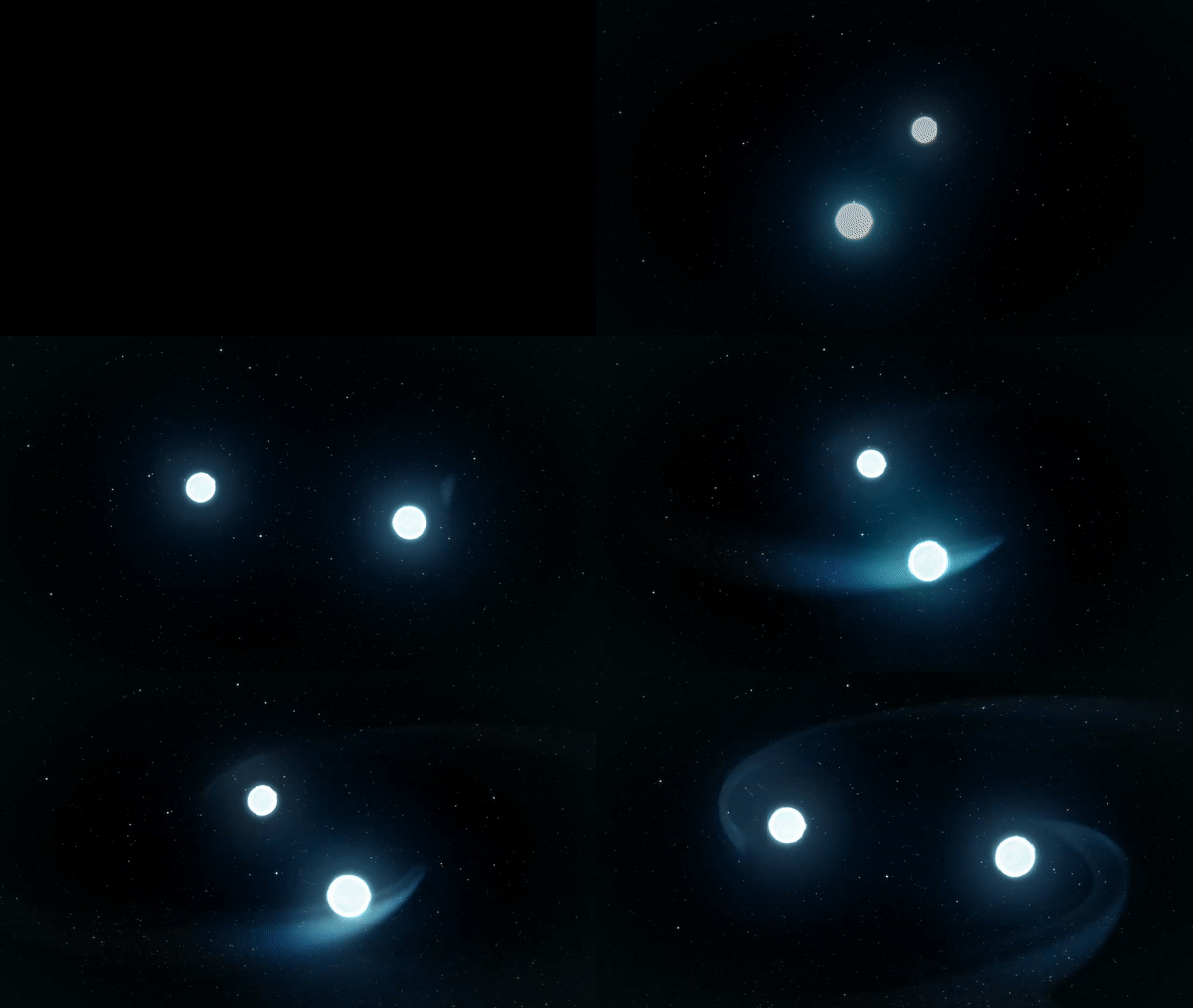
In this NASA animation, two neutron stars collide, ending in a kilonova. When two cosmic objects are involved, physicists can easily work out the likely outcome of a mash-up.
When gravity draws two objects together, the potential outcomes are simple. The objects might zoom by each other, or they might enter into an elliptical orbit around a shared center of mass. Isaac Newton was able to write down brief equations capturing these motions in the 1600s.
But if one star approaches a pair of stars already orbiting each other, all bets are off. The intruder might zoom by in a predictable way. Or it could enter the fray, initiating a period of furious loops and swerves that might last for moments or years. Eventually, the furor always subsides when one of the three stars is thrown clear of the other two. One of two scenarios will follow: If the third wheel has enough energy, it escapes, leaving the pair to live in peace. Or if it doesn't, that third object will zip away only to fall back toward the pair again and launch another episode of mayhem.
Get the world’s most fascinating discoveries delivered straight to your inbox.
Famed mathematician Henri Poincaré showed in 1889 that no equation could accurately predict the positions of all three bodies at all future moments, winning a competition sponsored by King Oscar II of Sweden. In this three-body case, Poincaré had discovered the first instance of chaos, a phenomenon whose outcome can effectively disconnect from how it began.
Since perfect predictions for individual three-body events are impossibles, physicists turned toward statistical forecasts. Given general information about the three bodies, such as their energy and their collective spin, what could one say about the odds that, for example, the lightest one would eventually get kicked out?
Related: The 11 most beautiful mathematical equations
To ponder this problem, physicists have abandoned the familiar backdrop of 3D space and moved to an abstract arena known as "phase space." In this expansive new realm, each spot represents one possible configuration of the three stars: That's a 3D position, a 3D velocity and a mass for each of the three bodies — an unchanging21-dimensional space, all told. A specific three-body event (such as one star flying toward a pair) starts at some point in phase space and traces out a path as it evolves from one configuration to another.
In this framework, physicists have been able to use chaos to their advantage. For a chaotic system, there is not just one possible outcome, but many. That means that if you let the three-body system evolve over time, it will explore every possible chaotic path, eventually reaching every nook and cranny of some chaotic region of its phase space. For the three-body problem, scientists can calculate, statistically, where each body might end up by precisely computing the volume inside its phase space that represents chaotic motion.
Physicists have used requirements such as conservation laws to cut the whole phase space down to a simpler "playground" of eight dimensions. But precisely defining the (also eight-dimensional) chaotic region within that has been a challenge, in part because three co-orbiting bodies can hop between chaotic and regular motion (by temporarily kicking out a body). Various groups have visualized the volume of the chaotic space in different ways, culminating in a definitive model by Nicholas Stone, of the Hebrew University of Jerusalem, and Leigh in 2019 that eliminated past assumptions to build the most accurate and mathematically rigorous three-body model to date.
"You can't do it better than we did it," said Leigh, who is also affiliated with the American Museum of Natural History in New York. "The only thing you can do is come up with a different model."
This theory "has made a huge dent in solving [the statistical three-body model]"
Viraj Manwadkar
A leaky chaos balloon
That's exactly what Kol, also of the Hebrew University of Jerusalem, has done. Stone and Leigh and previous groups have focused on the boundary of that chaotic region, a place where three-body systems transition from chaos to regular motion by kicking out one body.
Kol, at the Hebrew University of Jerusalem, in contrast, studies a metaphorical "hole" in the chaotic volume, where such a transition is more likely to take place. The longer a three-body system bounces around inside the chaotic region, the more likely it is to find such a hole, ejecting a member and escaping chaotic motion. The nature of this exit or exits, Kol believes, tell you everything there is to know about the statistical three-body problem.
Stone and Leigh's previous approach imagined the chaotic region as "a balloon and the entire surface is a little leaky and it has the same leakiness everywhere," Stone said. "Barak [Kol]'s approach is saying that 'No, the balloon has discrete holes and some patches that are leakier than others.'"
Kol captures the shape of the exits from the chaotic balloon in a mysterious function called chaotic absorptivity — the odds that a calm stellar couple with a certain energy will go chaotic if you fire a third star at them (as opposed to the pair immediately rebuffing the newcomer). Using this function and Kol's framework, one can, in principle, answer any statistical question about the whole phase space in all of its multidimensional glory, such as when a trio will eject a member (on average), the odds it will fly away with a certain speed, and the range of possible shapes for the orbit of the remaining pair. His theory was published April 1 in the journal Celestial Mechanics and Dynamical Astronomy.
This theory "has made a huge dent in solving [the statistical three-body model]," said Viraj Manwadkar, a researcher at the University of Chicago helping to test the model. "It has simplified [the problem] greatly."
Who gets the boot?
So far, Kol's ideas seem promising. In a not-yet-peer reviewed paper posted to the preprint database arXiv in January, Manwadkar, Kol, Leigh and Alessandro Trani of the University of Tokyo held a battle royale to see how Kol's theory held up against other statistical three-body forecasts.
They ran millions of simulations of mashups between trios of stars of different masses to see how often each star got kicked out of the group. When the stars have the same mass, the unpredictability of chaotic motion guarantees that each individual has a one-third chance of getting the boot — no fancy models required.
But as the masses skew, a pattern emerges: Lighter stars are easier to eject.When the three bodies have 10-sun (10 times the mass of the sun), 15-sun and 20-sun masses, for instance, the 10-sun star gets kicked out in 78% of the simulations. Kol's theory nailed that forecast, while rival theories predicted the lightweight's ejection to take place between 70% and 87% of the time. The new framework does even better as the masses get more lopsided.
"Those predictions are beautifully accurate," Stone said.
From digital stars to astrophysics
RELATED CONTENT
The catch is that no one knows how to precisely describe the shape of the hole, the chaotic absorptivity function (which is, in turn, a complicated and multidimensional object). The theory excels at predicting which body would be ejected because that specific calculation in some sense "averages" over many different holes, freeing the researchers from working out the details.
But to make the kind of forecasts astrophysicists really care about, such as the typical shapes of the elliptical orbits of the stellar pairs left behind after a chaotic three-body encounter, the chaotic absorptivity matters a lot. Stone and Leigh's 2019 model, which calculates the volume of the chaotic region over eight dimensions can already make these predictions.
To help Kol's model make similar forecasts, Manwadkar plans to run many simulations of single stars colliding with pairs, which will help sketch out the shape of the enigmatic absorptivity function point by point. Eventually, he hopes for a nice equation that will describe its entire shape, solving the statistical three-body problem.
"The dream is to get a mathematical expression," Manwadkar said, which would enable the most accurate statistical forecasts to date.
If the researchers succeed, the next step will be to see what the theory has to say about real incidents of three-body chaos out there in the universe.
Stars can concentrate in thick stellar clusters where singles regularly run into pairs, and three-body simulations help researchers understand how millions of three-body events change such clusters over time. And three-way meetings between black holes are thought to leave behind some of the pairs that merge and send out gravitational waves. A good statistical three-body solution could help astrophysicists at the Laser Interferometer Gravitational-Wave Observatory (LIGO) and future gravitational wave detectors understand their observations more deeply.
"What I'm excited about is applying one or both [models] to astrophysical problems," Stone said.
Originally published on Live Science.

Charlie Wood is a staff writer at Quanta Magazine, where he covers physics both on and off the planet. In addition to Live Science, his work has also appeared in Popular Science, Scientific American, The Christian Science Monitor, and other publications. Previously, he taught physics and English in Mozambique and Japan, and he holds an undergraduate degree in physics from Brown University.