














James Webb telescope's 'shocking' discovery may hint at hidden exomoon around 'failed star'
JWST's surprise discovery of methane emissions and likely aurorae over a distant brown dwarf could indicate this "failed star" is orbited by an active moon.

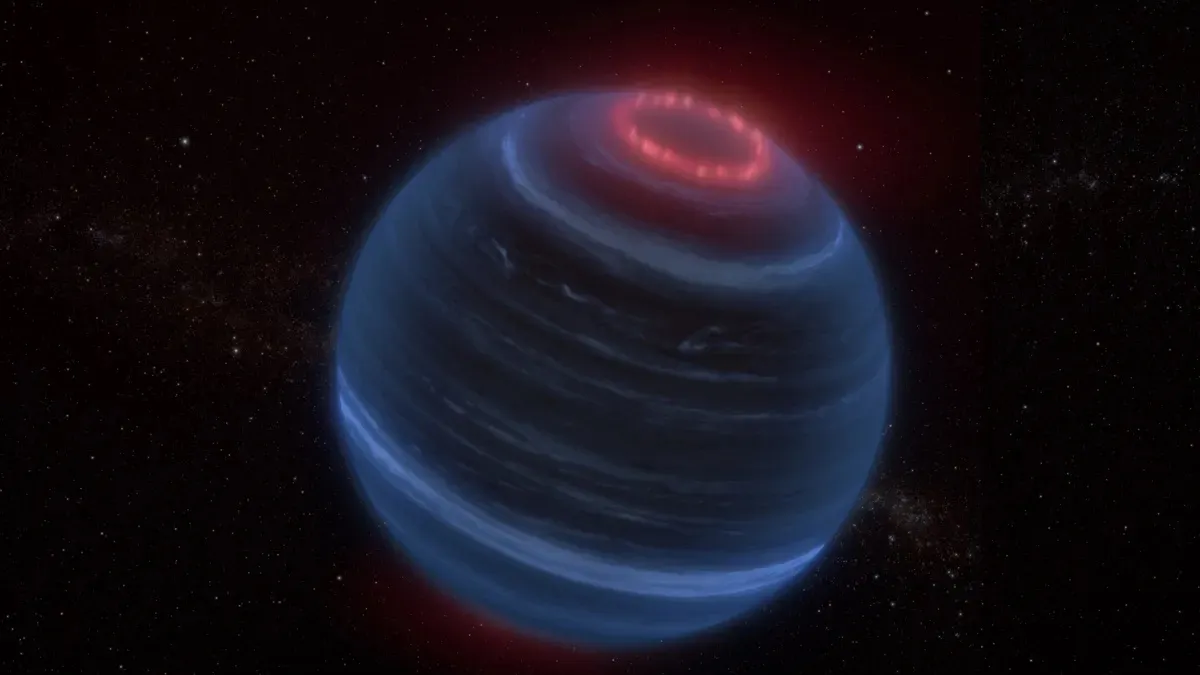
Using the James Webb Space Telescope (JWST), astronomers have made the surprising discovery of methane emissions coming from a brown dwarf, or "failed star."
The find suggests that the brown dwarf features aurorae, and might even be orbited by an undiscovered exomoon, researchers said.
The JWST brown dwarf discovery is surprising, because these cold and isolated worlds are not expected to be warm enough for methane to emit infrared light.
The findings came about as a result of a JWST program to investigate 12 brown dwarfs. They suggest that these failed stars can generate aurorae similar to Earth's northern lights and southern lights, as well as those seen over Jupiter and Saturn. The lack of a star near this lonely brown dwarf may mean that the polar lights over it are being generated by a hidden active moon.
The study team investigated the cold brown dwarf CWISEP J193518.59–154620.3 (W1935), located 47 light-years from Earth. While the mass of W1935 is poorly constrained, ranging from 6 to 35 times that of Jupiter, it is known to have a surface temperature of around 400 degrees Fahrenheit (204 degrees Celsius). That is around the temperature at which you'd bake chocolate chip cookies (failed brownies?).
"Methane gas is expected in giant planets and brown dwarfs, but we usually see it absorbing light, not glowing," Jackie Faherty, team leader and senior education manager at the American Museum of Natural History, said in a statement. "We were confused about what we were seeing at first, but ultimately, that transformed into pure excitement at the discovery."
Get the world’s most fascinating discoveries delivered straight to your inbox.
Why do some stars fail?
Brown dwarfs get their unfortunate nickname "failed stars" because, despite forming directly from a collapsing cloud of gas and dust like a star, they don't have enough mass to trigger the nuclear fusion of hydrogen to helium at their cores.
This is the process that defines what a main-sequence star is, so brown dwarfs — which have masses greater than the largest planets but smaller than the smallest star — technically "fail" to reach this status.
Faherty and colleagues were looking at several brown dwarfs with JWST when they noticed that W1935 was similar, but with one intriguing difference: It is emitting methane, something never seen around a failed star before.
Modeling W1935 revealed this particular brown dwarf also has a so-called "temperature inversion." That's a phenomenon in which the atmosphere of a planet gets colder at deeper levels. This is something usually seen in planets orbiting stars that heat their atmospheres from the top down, but it wasn't expected for W1935 because the brown dwarf is isolated, and there is no external heat source.
"We were pleasantly shocked when the model clearly predicted a temperature inversion," team member and University of Hertfordshire scientist Ben Burningham said in the statement. "But we also had to figure out where that extra upper atmosphere heat was coming from."

A composite image of Jupiter taken by Webb's NIRCam, showing the planet's rings and two of its moons, Amalthea and Adrastea. The blue glow around Jupiter's poles is the aurora.
To solve this mystery, the team looked closer to home at the solar system's gas giants, Jupiter and Saturn. Both of these gas giants have methane emissions, and both have atmospheres that demonstrate temperature inversion.
For Jupiter and Saturn, the cause of methane emissions and temperature inversion is aurorae, leading Faherty and the team to conclude this is what the JWST had detected around W1935. The big question is, what is driving the aurora at W1935?
This is an issue, because solar wind — the stream of charged particles from the sun — is the major driver of aurorae for Jupiter, Saturn and Earth. These charged strike the planets' magnetic fields and travel down field lines, interacting with particles in the atmosphere. This heats the upper layers of the atmosphere and causes the emission of light near the planet's poles. With no host star to blast W1935 with stellar winds, however, this process can't be the major driver of the lonely brown dwarf's aurora.
However, the aurora of Jupiter and Saturn have a secondary minor driver, in the form of charged particles streaming into the gas giants as a result of their active moons spewing material into space. For instance, Jupiter's moon Io is the most volcanic body in the solar system, spewing lava dozens of miles into space, while the Saturn moon Enceladus spits geysers into space that contain water vapor and other material that simultaneously freezes and boils when it hits space.
Thus, the aurora of W1935 with no star or stellar winds indicates that the brown dwarf might be orbited by an active moon.
related stories
More evidence will be needed before scientists can confirm the existence of a brown dwarf moon for the first time. Until then, these initial indications offer an insight into just how influential the JWST has been since it started sending its observations of the universe back to Earth in the summer of 2022.
"Every time an astronomer points JWST at an object, there’s a chance of a new mind-blowing discovery," Faherty concluded. "Methane emission was not on my radar when we started this project, but now that we know it can be there and the explanation for it so enticing, I am constantly on the lookout for it. That’s part of how science moves forward."
The team's research was published April 17 in the journal Nature.

Robert Lea is a science journalist in the U.K. who specializes in science, space, physics, astronomy, astrophysics, cosmology, quantum mechanics and technology. Rob's articles have been published in Physics World, New Scientist, Astronomy Magazine, All About Space and ZME Science. He also writes about science communication for Elsevier and the European Journal of Physics. Rob holds a bachelor of science degree in physics and astronomy from the U.K.’s Open University