Get the world’s most fascinating discoveries delivered straight to your inbox.
You are now subscribed
Your newsletter sign-up was successful
Want to add more newsletters?
Join the club
Get full access to premium articles, exclusive features and a growing list of member rewards.
An account already exists for this email address, please log in.
Scientists trace origin of Earth's mysterious 'minimoon' days before it escapes into space for 30 years
A new study reveals that the asteroid 2024 PT5, which has been orbiting Earth for 2 months, may have a "lunar origin." However, it is about to break free from our planet, making it tricky to tell for sure.
A new study suggests that the temporary Earth-orbiting asteroid 2024 PT5 may have a "lunar origin." (This image is an artist's interpretation of a generic minimoon.)
Earth's latest "minimoon" may be a tiny chunk of our planet's larger, permanent satellite that was ejected by a violent collision millions of years ago, a new study hints. However, we are unlikely to find out for certain because this temporary companion, which has been orbiting our planet for the last two months, is about to be catapulted away from us — and it won't return for another 30 years.
A minimoon is an object —normally an asteroid — that temporarily gets captured by Earth's gravity and orbits our planet for a short period, usually for less than a year. Minimoons should not be confused with "quasi-moons," which are similar objects to minimoons that orbit the sun alongside Earth for years and occasionally circle our planet, but they are not properly orbiting us.
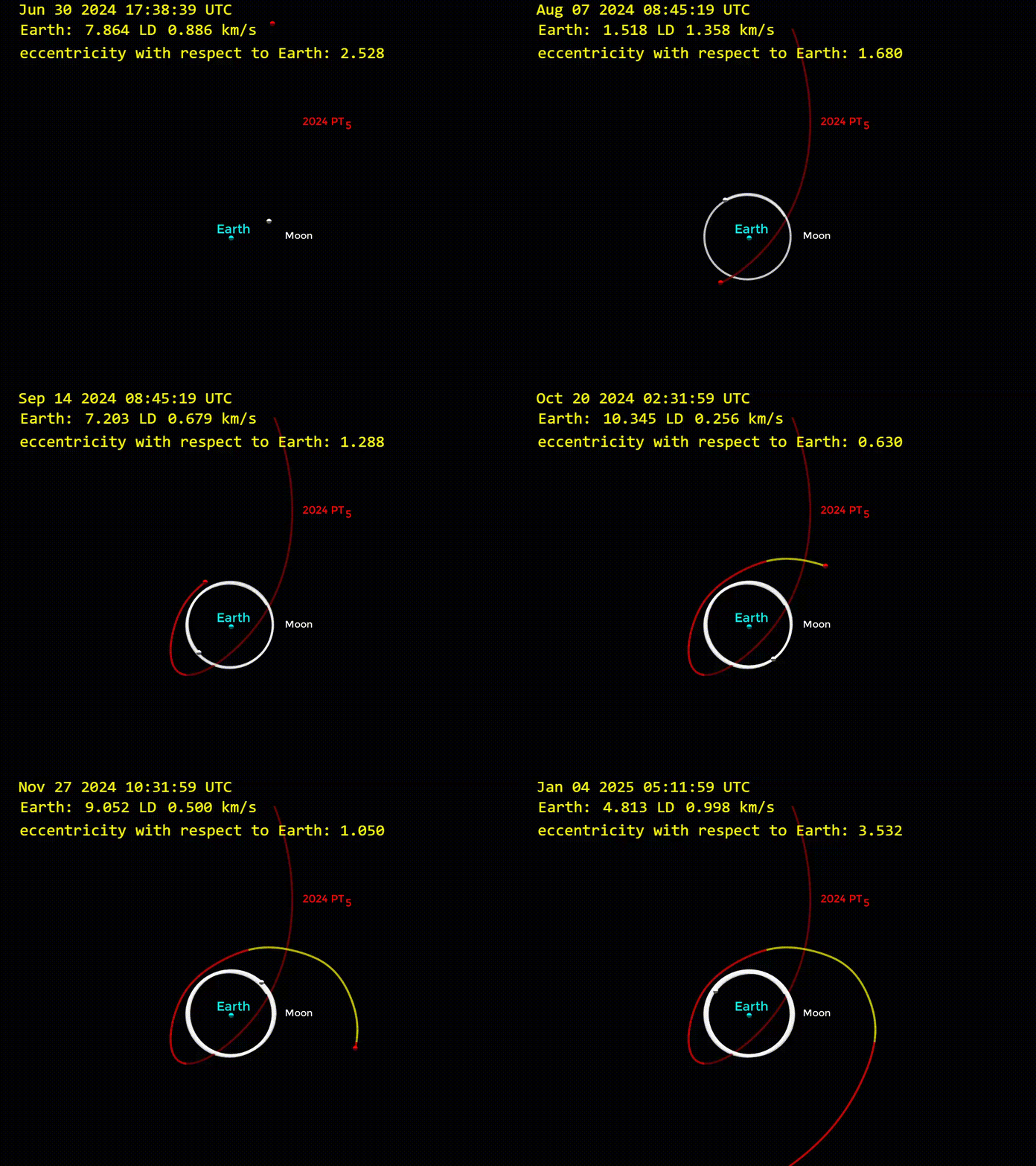
In early September, researchers discovered a new asteroid, 2024 PT5, approaching Earth and realized it would get stuck in a temporary orbit around our planet from Sept. 29 to Nov. 25. The space rock is around 33 feet (10 meters) wide, meaning it is too small to be visible to the naked eye. It will have completed around one-quarter of a full orbit around Earth by the time it leaves us, at a distance of up to 2.3 million miles (3.7 million kilometers) from our planet — or around 9.5 times the distance between Earth and the moon.
Astronomers believe that 2024 PT5 belongs to a small group of asteroids known as the "Arjunas," Laura Nicole Driessen, a researcher in radio astronomy at the University of Sydney, wrote in The Conversation. However, the origin of these space rocks is currently unclear.
In the new study, uploaded Nov. 13 to the preprint server arXiv, a team of researchers including the two who initially discovered the mini-moon analyzed new observational data for 2024 PT5, which was captured by a pair of telescopes in the Canary Islands. They found that the light coming from the space rock looked remarkably similar to "lunar ejecta" — material from the moon that is catapulted into space when the satellite gets pounded by meteorites. They also found that the minimoon likely spins about its own axis completely once every hour.
2024 PT5 has orbited Earth for two months (yellow line) after being captured by our planet but will soon break free from our world's gravitational pull.
(Image credit: Tony Dunn/X)
The researchers said that the new evidence is "suggestive of a lunar origin" but the results are not conclusive due to a lack of data. The team also noted that 2022 NX1 — the most recent minimoon prior to 2024 PT5, which was captured by Earth’s gravity from June to July 2022 — showed similar characteristics, suggesting that the Arjuna asteroids could largely be made up of lunar ejecta that have settled into a semi-regular orbit around the Earth-moon system over thousands or millions of years. However, this is also unconfirmed.
Sign up for the Live Science daily newsletter now
Get the world’s most fascinating discoveries delivered straight to your inbox.
After 2024 PT5 leaves Earth orbit next week it will start to drift away from our planet and won't return for future close approaches until 2055 and 2084 — aside from another close pass in January 2025 as it slingshots further away from Earth, according to NASA's Jet Propulsion Laboratory.
The moon has been constantly bombared by meteorites for billions of years. Some of the larger impacts have unleashed lunar ejecta into the inner solar system.
(Image credit: Getty Images)
As a result, researchers may be unable to collect enough data to confirm the new hypothesis before the space rock disappears. It is currently unclear if 2024 PT5 will reenter a temporary orbit around Earth during either of its returns later this century.
2024 PT5 is the fifth minimoon ever spotted orbiting Earth, but scientists think they are much more common than this number suggests, and advancements in technology are making it easier to spot them. Similarly, our planet currently has seven known quasi-moons, but they are likely more common than we realize.
Harry is a U.K.-based senior staff writer at Live Science. He studied marine biology at the University of Exeter before training to become a journalist. He covers a wide range of topics including space exploration, planetary science, space weather, climate change, animal behavior and paleontology. His recent work on the solar maximum won "best space submission" at the 2024 Aerospace Media Awards and was shortlisted in the "top scoop" category at the NCTJ Awards for Excellence in 2023. He also writes Live Science's weekly Earth from space series.