Get the world’s most fascinating discoveries delivered straight to your inbox.
You are now subscribed
Your newsletter sign-up was successful
Want to add more newsletters?
Join the club
Get full access to premium articles, exclusive features and a growing list of member rewards.
An account already exists for this email address, please log in.
'Dinky' asteroid imaged by NASA has ultra-rare double moon, study confirms
Researchers have proposed a model for how a double moon named Selam formed around the tiny asteroid Dinkinesh. This is the first 'contact binary' moon ever discovered, scientists say.
When NASA's Lucy mission flew past the asteroid Dinkinesh on Nov. 1, 2023, it discovered an unexpected companion: a pair of fused moons that scientists named Selam. Now, researchers have proposed a model explaining how Selam may have formed.
Astronomers supervising Lucy ― a car-sized spacecraft that launched on Oct. 16, 2021 ― had primarily intended to study Jupiter's Trojan asteroids, two swarms of space rocks that lead and lag behind the gas giant as it careens around the sun. However, in January 2023, they added the diminutive main-belt asteroid Dinkinesh — affectionately called "Dinky" — to the spacecraft's travel itinerary as its first destination. This flyby was supposed to be a dress rehearsal, allowing Lucy's team to test a system for tracking and imaging asteroids.
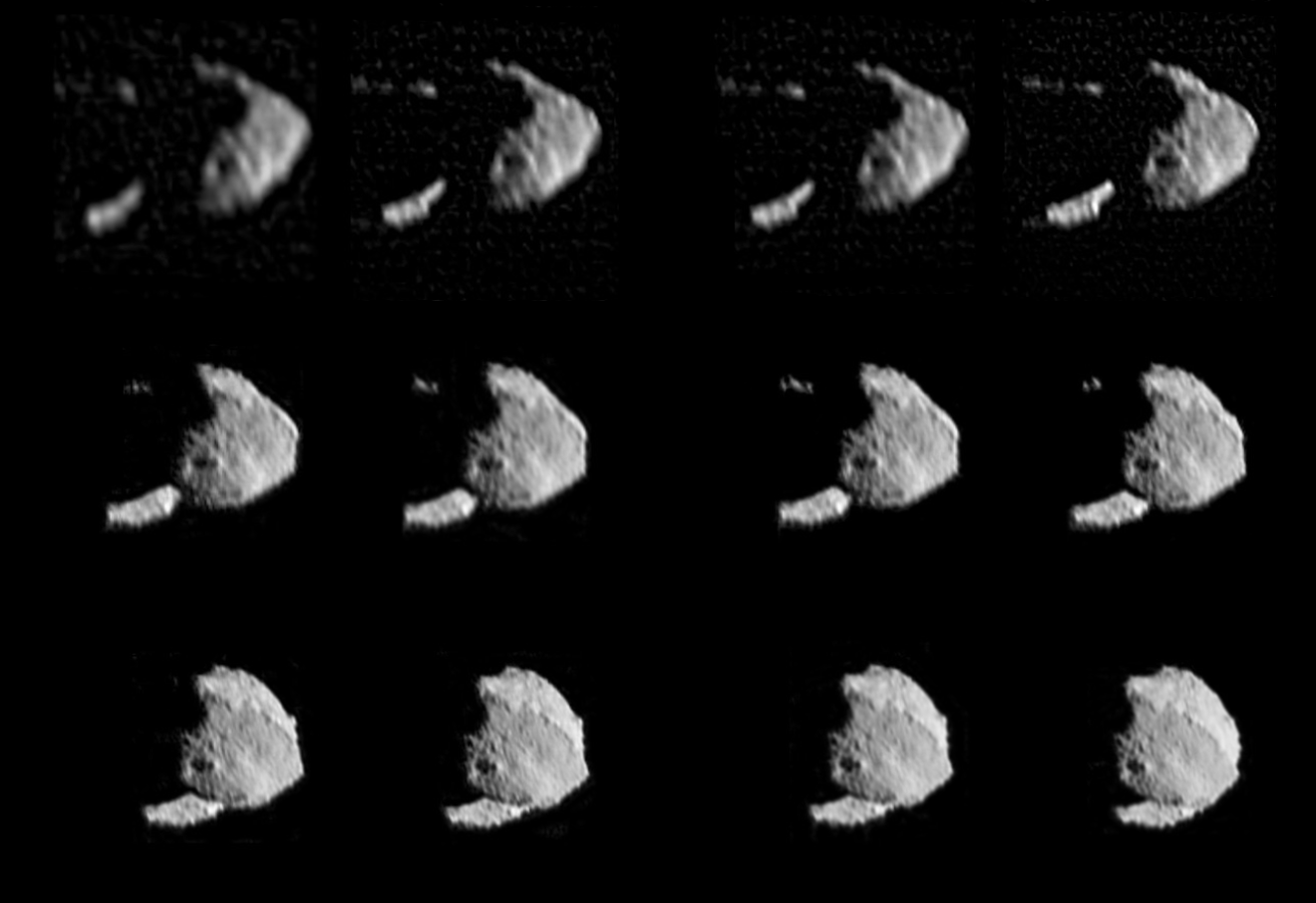
As Lucy approached Dinky, astronomers saw signs that the small asteroid was orbited by an even smaller moon. But when Lucy swooshed past — ultimately coming within 267 miles (430 kilometers) of the asteroid while snapping hundreds of high-definition photos — the researchers saw the truth was even stranger than they predicted. The images revealed that Selam wasn't one, but two "moonlets" touching each other as they orbited Dinkinesh.
Such objects, called contact binaries, aren't very common in the solar system. But they do include some larger Kuiper Belt objects, like the double-lobed Arrokoth, according to Jessica Sunshine, a professor of astronomy at the University of Maryland and co-author of a new study on the object. However, "Selam stands out as the only contact binary satellite," she said.
Now, Sunshine and other Lucy mission scientists have further analyzed the images — both the photos the spacecraft took up close and many more it captured as it zoomed away — to gather new insights about Dinky and Selam, as well as to offer a possible explanation for how Selam formed. Their findings were published May 29 in the journal Nature.
The distant shots showed that Selam synchronously rotates around its parent asteroid, taking about 52.5 hours for one complete cycle. This means Dinky only ever sees one face of its moon pair, just as Earth only sees one face of its moon. The photos also showed that Selam orbits Dinky at a distance of roughly 1.9 miles (3.1 kilometers). With this data, the researchers calculated that Selam likely weighs between 2 million and 20 million tons, with Dinky being 16 times more massive.
Sign up for the Live Science daily newsletter now
Get the world’s most fascinating discoveries delivered straight to your inbox.
A stereo movie of Selam from NASA's Lucy spacecraft flyby on Nov. 1, 2023. Made of two connected lobes, Selam is the first contact binary satellite ever seen.
Dinkinesh's close-ups, on the other hand, revealed that, like Didymos and Ryugu — asteroids that previous space missions have examined — it is top-shaped, with a belt-like bulge along its middle and a trough from north to south. The trough runs beneath the equatorial bulge, suggesting it formed later than the bulge.
These observations suggest one possible way Selam formed: by breaking up under the glare of sunlight, the scientists propose. According to the study, when the sun's radiation heated Dinky's surface, the asteroid unevenly re-radiated the energy as heat, producing a tiny thrust. This caused Dinky to spin faster, making it shed bits that formed an encircling ring (and gave it its trough).
"Much of the material would be redeposited on the primary asteroid," as the equatorial bulge, Sunshine said, but some particles would have coalesced into two clumpy masses that fused together, forming Selam. The model fits with the other parameters the authors deduced; per their calculations, Dinky was heavy enough and was spinning fast enough to have shed some of its material.
Simone Marchi, a scientist at the Southwest Research Institute and a co-author of the study, said the findings could explain how other asteroids formed. However, he noted that the troughs on Ryugu and Didymos may not be related to the formation of moons; Ryugu, after all, lacks a satellite.
Sunshine went further, saying that "if we can understand how these small bodies form and interact, we are one step closer to understanding how planets, including the Earth, formed."
As for Lucy, the spacecraft will fly back to Earth in December, using our planet's gravity to gain enough speed to whip through the asteroid belt. It's set to reach Jupiter's Trojan asteroids by 2027.
Deepa Jain is a freelance science writer from Bengaluru, India. Her educational background consists of a master's degree in biology from the Indian Institute of Science, Bengaluru, and an almost-completed bachelor's degree in archaeology from the University of Leicester, UK. She enjoys writing about astronomy, the natural world and archaeology.