













First-ever 'space hurricane' detected over the North Pole
Any planet with plasma and a magnetic field could be victim to these 'violent' space storms, researchers said.

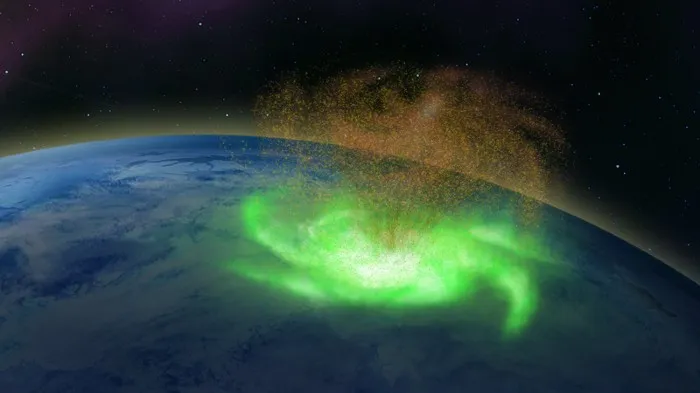
For the first time, astronomers have detected a powerful, 600-mile-wide (1,000 kilometers) hurricane of plasma in Earth's upper atmosphere — a phenomenon they're calling a "space hurricane."
The space hurricane raged for nearly 8 hours on Aug. 20, 2014, swirling hundreds of miles above Earth's magnetic North Pole, according to a study published Feb. 22 in the journal Nature Communications.
Made from a tangled mess of magnetic field lines and fast-flying solar wind, the hurricane was invisible to the naked eye — however, four weather satellites that passed over the North Pole detected a formation not unlike a typical terrestrial hurricane, the study authors wrote. The space hurricane was shaped like a funnel with a quiet "eye" at the center, surrounded by several counterclockwise-spinning spiral arms of plasma (ionized gas found all over the solar system, including in Earth's atmosphere).
Instead of raining water, the space hurricane rained electrons directly into Earth's upper atmosphere.
"Until now, it was uncertain that space plasma hurricanes even existed, so to prove this with such a striking observation is incredible," study co-author Mike Lockwood, space scientist at the University of Reading in the U.K., said in a statement. "Tropical storms are associated with huge amounts of energy, and these space hurricanes must be created by unusually large and rapid transfer of solar wind energy and charged particles into the Earth's upper atmosphere."
Using a 3D model of the hurricane, the researchers hypothesized that the formation resulted from a complex interaction between incoming solar wind (high-speed gales of plasma periodically released by the sun) and the magnetic field over the North Pole.
While this is the first observed space hurricane, the researchers hypothesize that these "weather" systems could be common events on any planet with a magnetic shield and plasma in its atmosphere.
Get the world’s most fascinating discoveries delivered straight to your inbox.
RELATED CONTENT
"Plasma and magnetic fields in the atmosphere of planets exist throughout the universe, so the findings suggest space hurricanes should be a widespread phenomena," Lockwood said.
Should you fear the space hurricane? Probably not. The upper-atmosphere phenomenon poses little threat to our planet, the researchers noted, but it could impact existing space weather effects, for instance by increasing drag on satellites, or disrupting GPS and radio communications systems.
Originally published on Live Science.

Brandon is the space / physics editor at Live Science. With more than 20 years of editorial experience, his writing has appeared in The Washington Post, Reader's Digest, CBS.com, the Richard Dawkins Foundation website and other outlets. He holds a bachelor's degree in creative writing from the University of Arizona, with minors in journalism and media arts. His interests include black holes, asteroids and comets, and the search for extraterrestrial life.