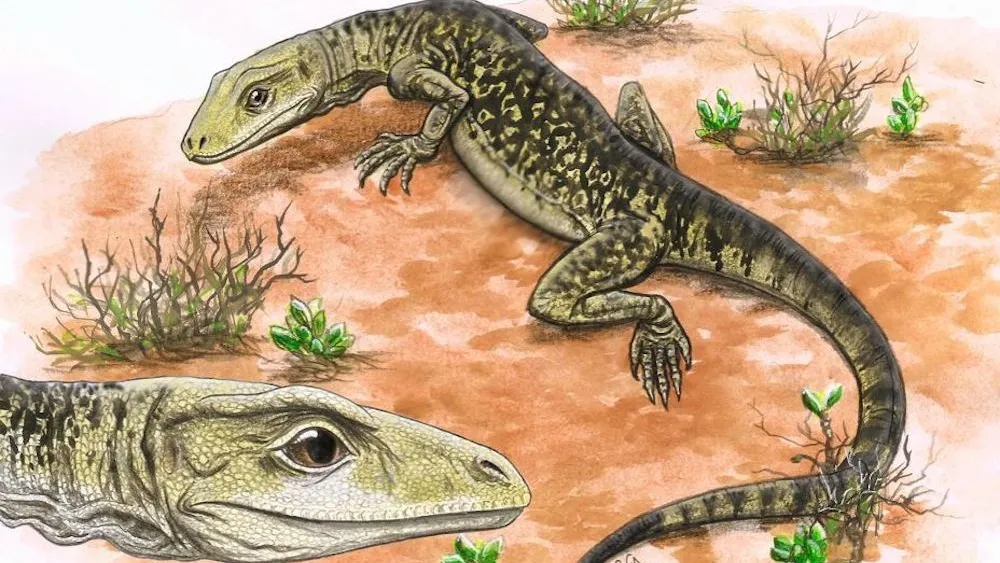
A palm-size lizard with teeth as sharp as butcher knives is so old that it shifts the origins of modern lizards and snakes back by 35 million years, a new study reveals.
Paleontologists found the fossilized remains of the tiny, razor-toothed reptile embedded in a rock hidden in storage at the Natural History Museum (NHM) in London. It had been held there since being pulled from a quarry near Bristol, England, in the 1950s. Little was known about the fossil, which had been labeled (incorrectly) "Clevosaurus and one other reptile."
For the new study, researchers analyzed the fossil and found that the lizard dates to around 202 million years ago, from the latter part of the Triassic period (237 million years to 201 million years ago); and that the remains included a partial skeleton, skull and mandibles. A computed tomography (CT) scan of the fossil helped researchers determine that they were looking at a type of Squamata — the largest order of reptiles, encompassing lizards, snakes and a group of legless lizards called amphisbaenians, or "worm lizards."
The fossil is small enough to "fit in the palm of your hand" and includes a 1.2-inch (3 centimeters) skull with a jaw full of sharp teeth, said Michael Benton, the study's co-author and a professor of vertebrate paleontology at the University of Bristol.
Because of the fossil’s small size, the researchers had to use less invasive techniques to study the lizard; such methods weren’t around when it was first discovered.
"Traditional methods of cleaning using a needle just caused havoc, and CT scanning reveals all the tiny details as well as hidden portions inside the rock, and without damage," Benton said. "[We] needed to see this level of detail of the skull bones to determine its detailed anatomy and [to] make comparisons with modern and fossil forms."
Sign up for the Live Science daily newsletter now
Get the world’s most fascinating discoveries delivered straight to your inbox.
Using the CT scans as a guide, the researchers created a 3D reconstruction of the lizard and found that it would have been nearly 10 inches (25 cm) long — half of which was its long, thin tail, according to the study.
A side view of the lizard's skull and razor-sharp teeth.
(Image credit: David Whiteside, Sophie Chambi-Trowell and Mike Benton/Natural History Museum UK)
But despite the lizard's small stature, its sharp teeth would have delivered a menacing bite, which inspired the paleontologists to name it Cryptovaranoides microlanius; the species name means "small butcher," while the genus means "hidden" and "lizardlike," a nod to the decades it spent languishing unnoticed in NHM storage. When C. microlanius was alive, it likely preyed on arthropods and small vertebrates on the limestone-rich islands that once surrounded what is now Bristol, according to the study.
C. microlanius’ age rewrites the origins of modern-day lizards and snakes, revealing that squamates were alive more than 30 million years earlier than previously thought. This discovery "helps complete the picture" of squamate evolution, Benton said.
"A key question in modern biology is to understand the really successful groups, like squamates (lizards and snakes) with over 11,000 species," Benton said. "How did they get so successful and how do they respond to climate change? So, checking back in time we need to know just when, where and how that huge modern group originated — our fossil now re-calibrates the whole shebang and draws it back 35 million years."
The findings were published Dec. 2 in the journal Science Advances.
Jennifer Nalewicki is former Live Science staff writer and Salt Lake City-based journalist whose work has been featured in The New York Times, Smithsonian Magazine, Scientific American, Popular Mechanics and more. She covers several science topics from planet Earth to paleontology and archaeology to health and culture. Prior to freelancing, Jennifer held an Editor role at Time Inc. Jennifer has a bachelor's degree in Journalism from The University of Texas at Austin.