













Rapid tests may not detect omicron early in infection
PCR tests successfully detected the virus days before the rapid tests did, according to a new study.

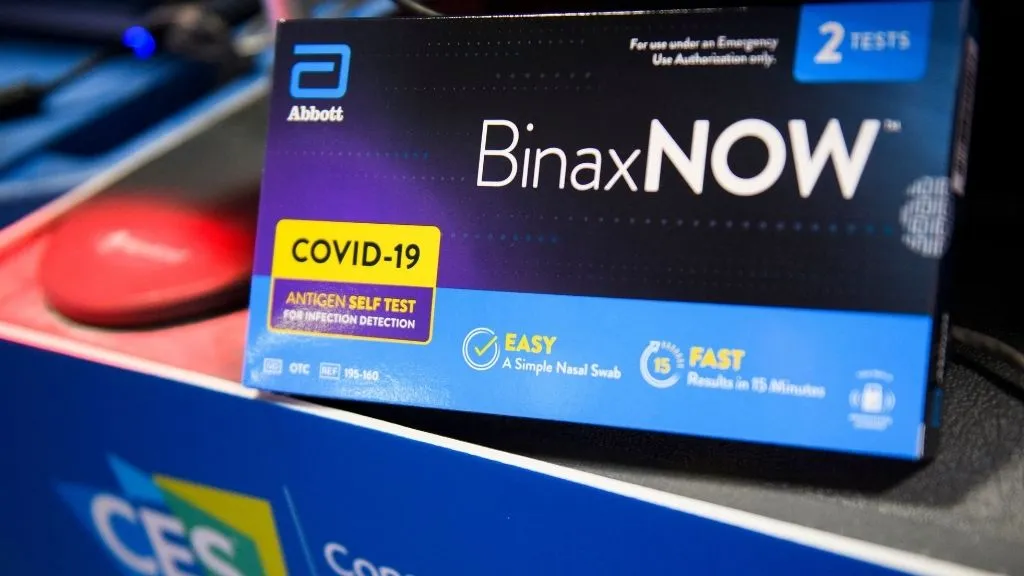
Rapid antigen tests for COVID-19 may not reliably detect the omicron variant during the first few days of infection, even when a person is shedding the virus in high enough quantities to be contagious, preliminary evidence hints.
For the new study, posted Wednesday (Jan. 5) to the preprint database medRxiv, researchers looked at 30 people from five different workplaces in New York and California, all of whom tested positive for SARS-CoV-2 in December 2021. Due to their workplace policies, each person was undergoing both daily rapid tests and daily PCR tests, which take longer to process but can detect smaller amounts of virus. People in the study used the Abbott BinaxNOW and Quidel QuickVue rapid antigen tests, which are both approved for use by the Food and Drug Administration (FDA).
Of the participants, all but one were likely infected with the omicron variant, based on how a genetic quirk of the variant shows up on PCR tests, the team noted in their report.
Related: 20 of the worst epidemics and pandemics in history
On the day of each person's first positive PCR test, and on the day after, their rapid tests all came back negative, STAT News reported. It wasn't until nearly two days after the positive PCR that any of the rapid tests came back positive. Across all the subjects, "the median time from first positive PCR to first detectable antigen positive was three days," the researchers wrote in their report.
That's despite the fact that, in 28 of the 30 cases, the amount of virus detected by PCR was high enough to infect other people on Day 1, STAT News reported. Through contact tracing, the team confirmed that in four of those cases, infected people passed on the virus to others while still testing negative on rapid tests.
"It's absolutely likely there were many more than four transmissions," lead author Blythe Adamson, the principal epidemiologist at Infectious Economics in New York and an employee of Flatiron Health, an affiliate of Roche, told STAT News. "We named four because there were four that were confirmed through contact tracing and epidemiology investigation. There were likely many more."
Get the world’s most fascinating discoveries delivered straight to your inbox.
While the findings are worrisome, other early data and anecdotal reports hint there may be a way to make these tests more sensitive earlier on in infection, by swabbing the throat in addition to the nose, The New York Times reported. This idea still needs to be verified with further research. In the meantime, the study highlights the importance of isolating if you have any COVID-19 symptoms — even if you have a negative result on a rapid test.
A negative rapid test result is "not a ticket that allows you to go back to normal or to drop any other measures," Isabella Eckerle, a clinical virologist at the University of Geneva in Switzerland, told the Times. And in particular, people should exercise caution if they've tested negative on a rapid test but have symptoms consistent with COVID-19, or believe they've been exposed to the virus.
RELATED CONTENT
The new study has not yet been peer-reviewed, but its results do align with a recent update from the FDA. Based on the agency's own lab studies, "Early data suggests that antigen tests do detect the omicron variant but may have reduced sensitivity," the update reads. That said, reduced sensitivity in the lab doesn't always translate to reduced sensitivity in real-world applications, Bruce Tromberg, director of the National Institute of Biomedical Imaging and Bioengineering, told The New York Times.
The new preprint hints that, indeed, this reduced sensitivity noted by the FDA may also translate to real-world test results, thus creating a lag between positive PCR results and positive rapid results. This does not mean rapid tests are useless — they can still detect the omicron variant, they just take longer to do so than PCR.
"Due to immediate turnaround time, frequent rapid antigen testing does slow transmission — and with a highly infectious variant frequent testing is needed, which is not realistic with PCR," Abbott spokesman John Koval told the Times. Plus, PCR tests may not be as readily available as at-home rapid tests. So rapid tests still have utility; people should just be wary of false-negative results, test themselves at least twice over two consecutive days following an exposure, and keep track of potential COVID-19 symptoms regardless of their test results, the Times reported.
The big question now is, why are the rapid tests less sensitive to the omicron variant? Rapid antigen tests detect proteins on the coronavirus's surface, and as the virus mutates, these proteins can become less recognizable to the test. Once these problem mutations are identified, "adjustments to existing tests can be undertaken by each developer with support from the FDA, if appropriate," FDA spokeswoman Stephanie Caccomo told the Times.
That said, the rapid tests may have a second Achilles heel: The FDA-approved rapid tests are only approved for use in the nose, not the throat or mouth. Anecdotal reports and preliminary studies have hinted that omicron may replicate faster in the mouth and throat than it does in the nose, the Times reported. And the authors of the medRxiv paper found similar results in an analysis of five people in their study who took both nose swab- and saliva-based PCR tests. They found that, in these individuals, the amount of virus in their saliva peaked one to two days before that in their noses.
"The major unknown is what it has been for weeks now: Are the [rapid antigen tests] inherently less able to detect omicron, or is there less omicron to detect on nasal swabs?" John Moore, a professor of microbiology and immunology at Weill Cornell Medical College, told STAT News. For now, the answer to that question remains unclear.
Read more about the new medRxiv study in STAT News and The New York Times.
Originally published on Live Science.

Nicoletta Lanese is the health channel editor at Live Science and was previously a news editor and staff writer at the site. She is a recipient of the 2026 AHCJ International Health Study Fellowship, with a project focused on antibiotic stewardship practices in Japan and the U.S. They hold a graduate certificate in science communication from UC Santa Cruz and degrees in neuroscience and dance from the University of Florida. Beyond Live Science, Lanese's work has appeared in The Scientist, Science News, the Mercury News, Mongabay and Stanford Medicine Magazine, among other outlets. Based in NYC, she also remains involved in dance and performs in local choreographers' work.