













'More people are in harm's way': Tornadoes are shifting east of Tornado Alley, forecasters warn

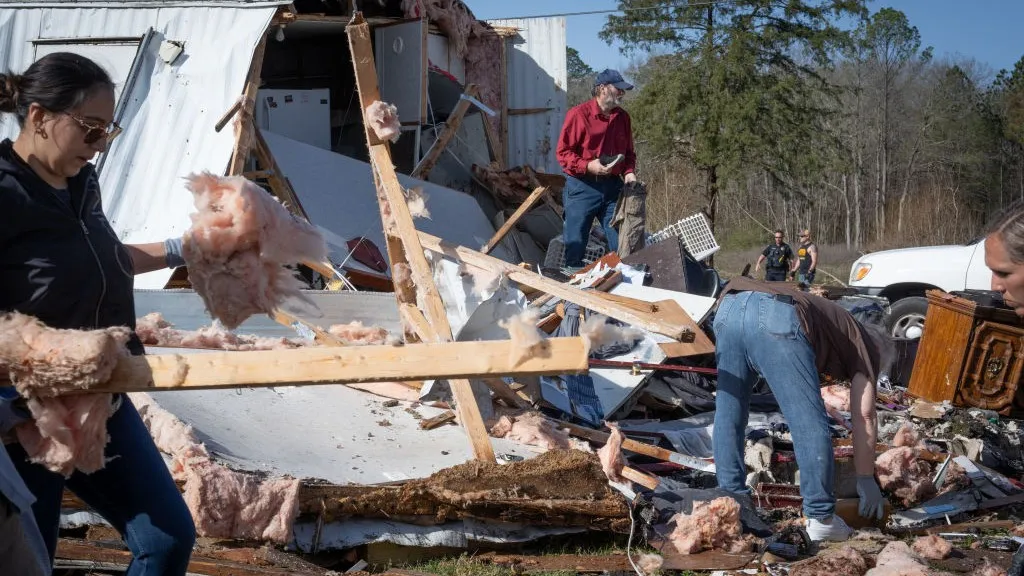
A string of deadly tornadoes, violent dust storms and fast-moving wildfires ripped across several midwestern and southern U.S. states over the weekend, leaving at least 42 people dead, according to CNN.
Many of the deaths have occurred outside Tornado Alley, with at least six fatalities reported in Mississippi and three reported in both Arkansas and Alabama. This follows a pattern previously predicted by long-range forecasters at AccuWeather, which warned of an eastward-shift in tornado risk this year.
"Families and businesses across the Mississippi and Tennessee valleys need to prepare for a stormy spring. This forecast is concerning because more people are in harm's way, compared to Tornado Alley," AccuWeather lead long-range expert Paul Pastelok said in a statement. "More people live in the Mississippi and Tennessee valleys, and more of those families are in vulnerable buildings without basements like mobile homes."
What is Tornado Alley?
Tornado Alley is a nickname given to a region stretching across several South Central states where destructive tornadoes are most likely to occur, according to AccuWeather.
"This area encompasses much of northern Texas northward through Oklahoma, Kansas, Missouri and parts of Louisiana, Iowa, Nebraska and eastern Colorado," AccuWeather senior meteorologist Dan Kottlowski said in a statement.
Related: 'Winter is far from over': Polar vortex reversal could bring springtime snow to US
However, according to the National Oceanic and Atmospheric Administration (NOAA) this nickname can be misleading as tornadoes can occur anywhere in the U.S. — and tornado threat shifts at different times of the year and under different weather patterns.
Get the world’s most fascinating discoveries delivered straight to your inbox.
Tornadoes are violently rotating columns of air that stretch between the ground and the base of storm clouds. Their strength is measured using the Enhanced Fujita Scale, which estimates the tornado's strength based on the damage it causes. The highest ranking on the scale is EF5, indicating "incredible" damage.
Why is tornado risk shifting eastward?
In the U.S., tornado season usually begins in early March when cold air from Canada clashes with warm, moist air from the Gulf.
Pastelok said that this year's eastward shift in tornado risk is due to a large and persistent area of high pressure that is expected to hover over the Southwest this spring, limiting the severity of thunderstorms, and thus tornado risk, in the Western Plains. Exceptionally warm sea water in the Gulf is also expected to significantly influence severe weather in Southeastern states.
Cooler weather across much of the Great Lakes and Northeast is expected to limit the severity of thunderstorms and tornados in the Northern states through early spring.
On Friday (March 14) and Saturday, a particularly powerful storm system tore through many Central and Southern states, with 52 confirmed tornadoes whipping up expansive dust storms and wildfires. Nearly 1,100 flights were canceled during the two day period and 150 million people were affected by the extreme weather, AccuWeather reports.
According to the National Weather Service (NWS), two EF4-strength tornadoes — indicative of "devastating" damage — ripped through Arkansas on Friday. This was the first time in over 25 years that two EF4-strength tornadoes hit the state in a single day. One of these tornadoes, which devastated the town of Diaz, reached estimated wind speeds of 190 mph (306 kilometers per hour), NWS reports.
Meanwhile, winds topping 80 mph (129 km/h) were reported across the Southern Plains on Friday, with three people killed in car crashes attributed to dust storms in Texas.
Wind-driven wildfires have also caused extensive damage across Texas and Oklahoma, with the latter reporting more than 130 fires, according to state Governor Kevin Stitt.
The storm system is expected to move offshore by the end of the day on Monday (March 17), according to CNN. However, extremely critical fire-weather conditions are likely to persist into Tuesday afternoon (March 18), according to the NWS Storm Prediction Center.
RELATED STORIES
Between 1,300 and 1,450 tornadoes are predicted to occur across the U.S. in total in 2025, according to AccuWeather. This is above the historical average of 1,225. Between 75 and 150 tornadoes have been forecast for March, 200 to 300 in April and 250 to 350 in May.
As well as increasing the frequency of tornadoes, our warming atmosphere may also contribute to more impactful and dangerous thunderstorms, AccuWeather senior meteorologist and climate expert Brett Anderson said in the statement.
"Our warming atmosphere can hold more moisture, unleashing intense rainfall rates that can trigger dangerous flash flooding," he said. "As water temperatures continue to increase in the Gulf, warmer air with more moisture can be forced northward into the Southern states ahead of a cold front, providing an extra boost of energy for severe thunderstorms that can produce tornadoes."

Pandora is the trending news editor at Live Science. She is also a science presenter and previously worked as Senior Science and Health Reporter at Newsweek. Pandora holds a Biological Sciences degree from the University of Oxford, where she specialised in biochemistry and molecular biology.
You must confirm your public display name before commenting
Please logout and then login again, you will then be prompted to enter your display name.