













Extinct 'Hobbit' creature the size of a house cat discovered in Wyoming dig site
Meet Beornus honeyi — but you can call him Beorn.

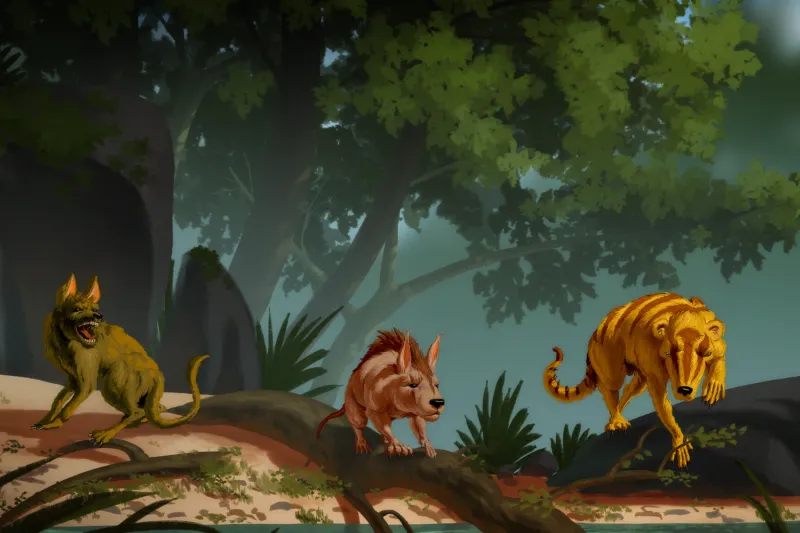
Early on their quest to reach the Lonely Mountain in J.R.R. Tolkien's "The Hobbit" (1937), Bilbo Baggins and company cross paths with an enormous, shape-shifting warrior named Beorn.
"Sometimes he is a huge black bear," the wizard Gandalf says of the man, "sometimes he is a great strong black-haired man with huge arms and a great beard."
In either form, Beorn is a giant among his peers. And now, paleontologists have immortalized the shaggy, axe-wielding brute with the discovery of an extinct mammal that rose to prominence in the Paleocene epoch (65 million to 23 million years ago), shortly after the death of the dinosaurs. They call this furry, puffy-cheeked creature Beornus honeyi.
"I have always been a huge Tolkien fan, and there is a long-standing tradition of naming early Paleocene mammals after Tolkien characters," Madelaine Atteberry, a researcher at the University of Colorado Boulder and lead author of a new study on B. honeyi and its relatives, told Live Science in an email. "I chose Beornus honeyi because of the large size and 'inflated' appearance of its teeth compared to the other mammals from this time period."
Related: The world's 6 smallest mammals
You might expect the Beorn of ancient mammals to be a hulking, bear-like monster with axe-sharp teeth and claws — but the reality, much like Bilbo Baggins' party, is a little unexpected.
B. honeyi is a condylarth — part of an order of prehistoric, four-legged mammals that looked a bit like dogs, but were actually the ancestors of hoofed mammals like horses and rhinos, according to the new study, published Aug. 17 in the Journal of Systematic Palaeontology. But Beornus was no rhino; fossils of the creature's lower jaw suggest it was no larger than a modern house cat.
Get the world’s most fascinating discoveries delivered straight to your inbox.
That's actually huge compared with the menagerie of rat-sized condylarths that roamed North America in the early Paleocene, according to the researchers. This relative largeness, plus B. honeyi's extra-large molars and puffed-out cheeks, made it worthy of its Tolkien-esque name, Atteberry said. Like other condylarths, Beornus likely used its big, flat teeth to grind up plants, but may have also dined on the occasional insect or other source of meat, the team wrote.
But Beornus was just one of many small mammals that seems to have thrived after the fall of the dinosaurs. In the same study, which included a number of jaw fossils excavated from the Great Divide Basin in southern Wyoming, the researchers also identified two other species of condylarths previously unknown to science — Conacodon hettingeri and Miniconus jeanninae. All three of the newly described species were closely related, but showed distinct differences in the shapes and sizes of their teeth.
These condylarths could help rewrite the story of the earliest mammals that populated North America after the dinosaur extinction, Atteberry said. Prior studies of fauna from the first 320,000 years after that mass extinction suggest that mammals were still recovering, and that individual families like condylarths were diversifying very slowly.
"However, the earliest Paleocene fauna in the Great Divide Basin in Wyoming is a different story," Atteberry said. "It has more diversity than what we would predict for this time period, which suggests that we cannot really generalize mammalian recovery after the dinosaur extinction."
RELATED CONTENT
In other words, Beorn and its buddies may have been part of a thriving small-mammal scene during the early Paleocene. These three species are part of a collection of some 420 mammalian fossils discovered at the Great Divide Basin alone, and more newfound species from the same era are likely to turn up there, the researchers said.
Perhaps those future fossil discoveries will find a place in the Tolkien club, as well. More than two dozen extinct mammals have been named after Tolkien lore so far, including the weasel-like insectivore Bubogonia bombadili (named for the eccentric forest-dweller Tom Bombadil) and the canine ancestor Barophagus orc (named for the brutish humanoids that Tolkien's works popularized).
Originally published on Live Science.

Brandon is the space / physics editor at Live Science. With more than 20 years of editorial experience, his writing has appeared in The Washington Post, Reader's Digest, CBS.com, the Richard Dawkins Foundation website and other outlets. He holds a bachelor's degree in creative writing from the University of Arizona, with minors in journalism and media arts. His interests include black holes, asteroids and comets, and the search for extraterrestrial life.