















Astonishing dinosaur mummy has 'glittering' skin that was punctured and ripped by ancient crocs
Scientists examined a dino mummy called "Dakota."

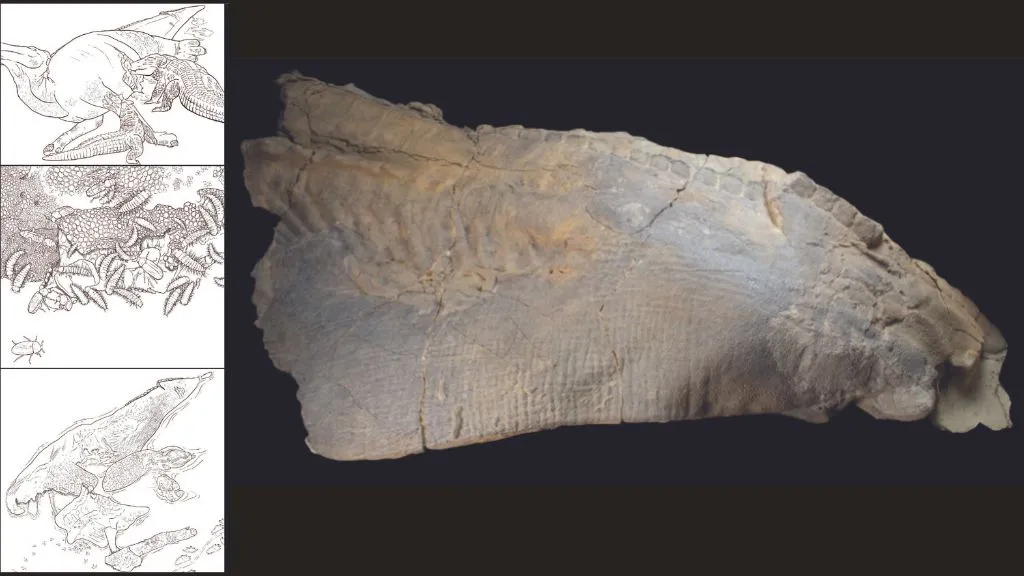
Around 67 million years ago in what is now North Dakota, a duck-billed dinosaur keeled over and died, and crocodiles' ancient relatives descended on the carcass, tearing holes through the skin and marking up the bones. Today, evidence of the predators' feast can still be seen in the dino's fossilized remains, which include remarkable "mummified" skin.
These lingering bite marks may help explain how the dinosaur became a mummy in the first place, a new study suggests. The research, published Wednesday (Oct. 12) in the journal PLOS One, also proposes that dinosaur mummies with exceptionally well-preserved skin and soft tissues may be more common than scientists once thought.
"There used to be an assumption that, in order to get a mummy, you absolutely had to have rapid burial," meaning the dinosaur would have to be buried almost instantaneously at or near its time of death, said Stephanie Drumheller, co-lead author of the study and a palaeontologist at the University of Tennessee, Knoxville. Once a dinosaur's body was covered in sediment, perhaps from a sudden landslide or flash flood, the remains would be shielded from the elements and from the teeth of hungry scavengers. That gave the animal's skin a chance to mummify.
Now, Drumheller and her colleagues have identified another means of making dinosaur mummies — no rapid burial required. Instead, these mummies may have been buried weeks or months postmortem, after all sorts of scavengers, from crocodilians to microbes, had nibbled at their bodies. And by snacking on the corpses, scavengers may have helped ready them for fossilization.
Related: Mummified, spread-eagled Triassic 'shovel lizards' look like roadkill and likely died in a drought

This illustration shows what Dakota the dinosaur likely looked like in life. The photo beneath shows Dakota's fossilized foot as it looks today.
"Unintuitively, if you have predators partially eating the remains, that can actually help the long-term stabilization of things like skin — long enough to get it buried underground, when those secondary chemical changes can happen," Drumheller told Live Science.
"It seems reasonable to me," said Brian Pickles, an associate professor of ecology at the University of Reading in the United Kingdom, who was not involved in the study. "If the carcass was scavenged on a sandbar or riverbank and nothing particularly edible was left behind then it is plausible that the skin and bones could have been left there for quite a while with the skin drying out in the sun before being covered over," Pickles told Live Science in an email.
Get the world’s most fascinating discoveries delivered straight to your inbox.
Drumheller and her colleagues drew these conclusions by examining a well-known Edmontosaurus fossil housed at the North Dakota Heritage Center and State Museum in Bismarck. The specimen, nicknamed "Dakota," was discovered in 1999 on a ranch near Marmarth, in southwestern North Dakota. Specifically, it was excavated from the Hell Creek Formation, a fossil-packed geological formation that took shape near the end of the Cretaceous period (145 million to 66 million years ago) and the start of the Paleogene period (66 million to 23 million years ago).
The Edmontosaurus fossil is missing its head and the very tip of its tail, and it may also be missing its left forelimb, but the rest of the animal's bones are intact, co-lead author Clint Boyd, senior paleontologist for the North Dakota Geological Survey, told Live Science. Large swaths of preserved skin covers the bones of the dinosaur's right forelimb, hind limbs and tail.
"The skin itself is a very deep brown, almost brownish black, and it actually has a bit of a shine to it because it has so much of that iron in it" from the fossilization process, said Mindy Householder, a study co-author and a fossil preparator for the State Historical Society of North Dakota in Bismarck. "It almost looks like it's glittering," she said.
Dakota's glittering skin went on public display at the Heritage Center starting in 2014, although at that time, the fossil had not been completely freed of the rock surrounding it. In 2018, fossil preparators set about cleaning the specimen more thoroughly, and in that process, they uncovered markings that looked suspiciously like bite marks. Initially, study co-author Becky Barnes, paleontologist and lab manager at the North Dakota Geological Survey, flagged potential bite marks on the specimen's tail, and Householder found more on the "pinky finger" of the right forelimb.
Bite marks left on bones can fossilize quite clearly, and once the team started searching for such marks in earnest they found distinct imprints of crocodilian teeth on Dakota's bones. However, finding bite marks in "skin is trickier," Drumheller said. Skin stretches and tears as it's bitten into, and the decomposition process can warp the tissue further. To get a sense of what bite marks on dinosaur skin might look like, the team looked to forensic studies of modern mammals and human bodies.
(Though because dinosaur skin is thicker and more durable than human skin, it's not a perfect comparison, Drumheller noted.)
Through their analysis, the researchers discerned that the "deep, raking furrows and punctures" on Dakota's tail were likely made by teeth or claws dragging through the flesh. It's possible that a crocodilian or a dinosaur, such as a large deinonychosaur or a juvenile Tyrannosaurus rex, may have left such marks, the study authors suggested. The team also found more than a dozen puncture wounds on Dakota's right hand and forelimb, and noted that the skin of the latter had been partially peeled back, likely while a predator fed.
Related: Best-preserved dinosaur stomach ever found reveals 'sleeping dragon's' last meal
These injuries suggest that Dakota's carcass remained unburied and vulnerable to scavenging for some time after the dinosaur's death — but if the dino wasn't rapidly buried, how did it mummify? Again, the researchers turned to forensic literature for answers. There, they learned about a mode of decomposition that might apply to Dakota and many other mummified dinosaurs.
RELATED STORIES
Through this mummification process, which the study authors call "desiccation and deflation," the dinosaur carcass could have remained unburied for weeks or even months as animals, insects and microbes tore holes through the skin and ate away at the animal's internal organs. The gaping holes in the skin would have enabled any gasses and fluids associated with decomposition to seep out of the dinosaur, thus helping the skin to thoroughly dry out, or "desiccate."
At that point, the carcass would have donned a "deflated appearance, with skin and associated dermal structures draped closely over the underlying bone," according to the study. The deflated dino would then have been buried and fully fossilized at a later date, and would end up looking like the mummified Dakota specimen as it appears today.
"This is something that's actually fairly predictable in the forensic literature," Drumheller said. "It's just not something that had been looked at in the context of dinosaur mummies previously."
Not all dinosaur mummies form through desiccation and deflation, the authors stressed, but it's reasonable to think that most of them do. Other dino mummies likely formed through rapid burial, as previously thought, or alternatively, some may have formed through being submerged in deep water with little oxygen present, the team wrote in the study. The lack of oxygen in the deep water would slow the decomposition process, enabling mummification to unfold, which is a process that has been documented in so-called bog bodies — swamp-preserved remains of medieval humans.
At this point, the researchers feel confident that they know what happened to Dakota between the dinosaur's death and its burial, but the details of what unfolded after burial remain fuzzy. The team now plans to study which chemical reactions enable dinosaur skin to fossilize in this context, and to do so, they're hoping to analyze more dinosaur mummies that likely formed in the same way Dakota did.
There's also a lingering question as to why so much of the fossilized dinosaur skin that's been discovered belongs to duck-billed dinosaurs, Pickles said. "If it was just about predators and scavengers leaving skin behind on highly abundant herbivores then wouldn't we expect to find lots of ceratopsian and sauropod fossils with skin on them too?" he said. That's another question to explore in follow-up studies.
Meanwhile, while that research gets off the ground, dinosaur enthusiasts can currently visit Dakota's right forelimb, left foot and tail at the North Dakota Heritage Center and State Museum, Boyd said. The rest of the specimen is still being cleaned and examined. Fossil preparators have spent about 14,000 hours working on Dakota so far, and they expect to spend several thousand more hours with the remarkable mummy before their work is done.
Editor's note: This story was updated on Oct. 13, 2022 with comments from Brian Pickles. The article was first published on Oct. 12.

Nicoletta Lanese is the health channel editor at Live Science and was previously a news editor and staff writer at the site. She is a recipient of the 2026 AHCJ International Health Study Fellowship, with a project focused on antibiotic stewardship practices in Japan and the U.S. They hold a graduate certificate in science communication from UC Santa Cruz and degrees in neuroscience and dance from the University of Florida. Beyond Live Science, Lanese's work has appeared in The Scientist, Science News, the Mercury News, Mongabay and Stanford Medicine Magazine, among other outlets. Based in NYC, she also remains involved in dance and performs in local choreographers' work.